

If you want exposure to Chinese tech giants, Hong Kong banks or property developers, you will eventually want to buy Hong Kong stocks Singapore brokers can reach on the Hong Kong Stock Exchange (HKEX). The process is simple once you understand a few quirks that do not apply to Singapore or US shares: board lots that vary from stock to stock, trading in Hong Kong dollars (HKD), a different mix of fees, and dividend tax that depends on where the company is incorporated.
This guide walks through each of those. It is general information, not financial advice. Fees, rates and rules change, so check the current details with your broker, IRAS and the relevant Hong Kong authorities before you invest.
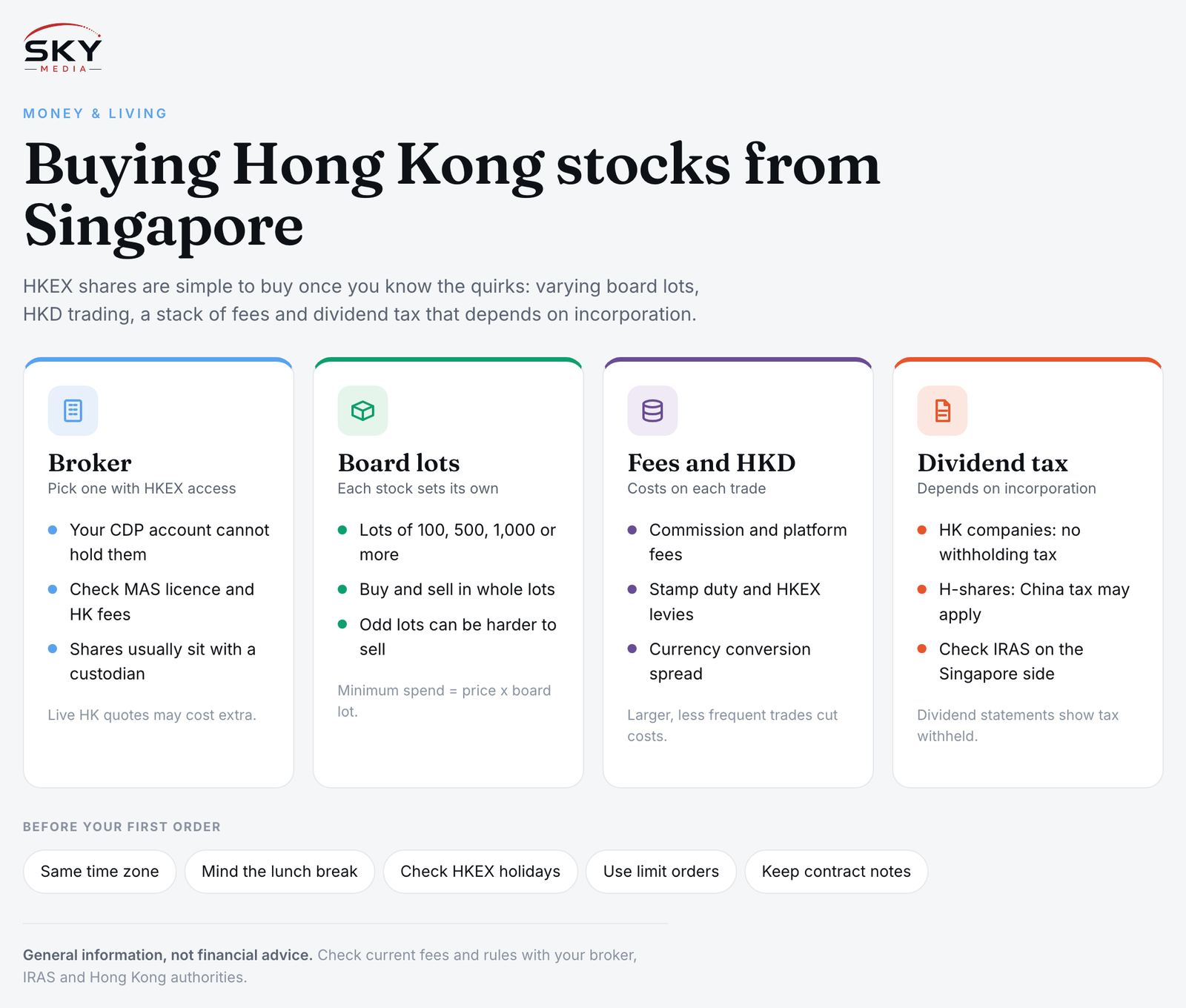
Choosing a Broker With HKEX Access
You cannot buy HKEX shares through your CDP (Central Depository) account, which only holds Singapore Exchange (SGX) securities. Instead, you need a broker that offers Hong Kong market access. Broadly, you will find three types:
- Local bank brokerages and traditional stockbrokers that offer multiple markets, often with phone support and the option to link to your bank account.
- App based brokers that focus on low commissions and a mobile experience, many of which offer US and Hong Kong markets in one account.
- International multi market brokers with access to dozens of exchanges, suited to investors who already trade across regions.
When comparing, look at:
- Whether the broker is licensed by the Monetary Authority of Singapore (MAS). You can check the MAS Financial Institutions Directory.
- The commission and platform fees on Hong Kong trades specifically, which are often priced differently from SGX or US trades.
- Currency conversion spreads, and whether you can hold HKD in the account.
- How your shares are held. With most brokers, foreign shares sit in a custodian or nominee account in the broker’s name on your behalf, not in your own name. Read how client assets are protected.
- Whether real time Hong Kong quotes cost extra, since some brokers charge for live market data.
If you already invest in US shares, our guide to investing in US stocks from Singapore covers the custodian model in more detail, and much of it applies to Hong Kong too.
Board Lots: Hong Kong’s Biggest Quirk
On SGX, the standard board lot is 100 shares. In Hong Kong, each company sets its own board lot. One stock might trade in lots of 100 shares, another in lots of 500, 1,000 or 2,000. You can normally only buy or sell in whole board lots on the main market.
This matters because the minimum amount you need to invest depends on both the share price and the board lot. A stock with a low price but a large board lot can still need a sizeable sum to buy one lot, while a high priced stock with a small lot might be cheaper to enter than it looks.
Your broker’s order screen shows the board lot for each stock. If you end up holding fewer shares than a full lot (an “odd lot”, for example after a corporate action), selling them can be harder and may happen at a less favourable price on a separate odd lot market.
Funding Your Account in HKD
HKEX shares are mostly quoted in HKD, although some stocks have dual counters, including counters quoted in renminbi (RMB). You have a few ways to fund trades:
- Let the broker convert automatically. You deposit SGD and the broker converts to HKD when you buy. Convenient, but check the conversion spread.
- Convert to HKD yourself first. Some brokers let you convert and hold HKD in a multi currency account. This lets you choose when you convert and keep dividends in HKD for reinvestment.
- Transfer HKD from an existing account. If you already hold HKD, for example from working in Hong Kong, you may be able to wire it in. Read using a Hong Kong account to bridge China and Singapore if you move money between the three places.
Remember that you take on currency risk: your returns in SGD depend on both the share price and the HKD to SGD rate.
The Fees on a Hong Kong Trade
A Hong Kong trade usually carries a stack of charges. The table below shows the common types. Rates are set by the broker or by Hong Kong authorities and change from time to time, so check the current figures before you trade.
| Fee | Who charges it | When it applies | What to check |
|---|---|---|---|
| Brokerage commission | Your broker | Every buy and sell | Minimum per trade, and whether it differs from SGX or US trades |
| Platform or account fee | Your broker | Per trade or monthly, varies | Whether it is waived for small or active accounts |
| Stamp duty | Hong Kong government | Most share purchases and sales | The current rate and any exempt products, such as some ETFs |
| Trading fee and transaction levies | HKEX and Hong Kong regulators | Every buy and sell | Usually small, shown on your contract note |
| Settlement and custody charges | Broker or clearing house | Per trade, or on dividends and corporate actions | Charges for collecting dividends, which can eat into small payouts |
| Currency conversion | Your broker or bank | When you change SGD to HKD and back | The spread against the mid market rate |
Because of minimum commissions and stamp duty, many small trades can be expensive in percentage terms. Investing in larger, less frequent lots usually keeps costs down. Trades typically settle a couple of business days after the trade date.
Dividend Tax on Hong Kong Shares
Dividend tax depends on two things: Hong Kong’s rules, and the country where the company is incorporated.
- Hong Kong incorporated companies. Hong Kong does not currently impose a withholding tax on dividends paid by these companies, so you generally receive the full declared dividend, minus any broker collection fee.
- Mainland China incorporated companies (H-shares) and some red chips. Dividends may be subject to Chinese withholding tax, deducted before the money reaches you. The rate can depend on the investor’s tax residence and any applicable tax treaty.
- Companies incorporated elsewhere. Some HKEX listed companies are incorporated in places such as the Cayman Islands or Bermuda, which have their own treatment.
On the Singapore side, foreign sourced dividends received by individuals are generally not taxed, but there are exceptions, for example income received through a partnership. Check the current position with IRAS. Your broker’s dividend statements will show what was withheld at source.
Practical Tips Before You Place Your First Order
- Trading hours suit Singapore. Hong Kong is in the same time zone as Singapore, so you can trade the morning and afternoon sessions during your normal day. Note the lunch break between sessions, and check HKEX’s holiday calendar, which differs from Singapore’s public holidays.
- Typhoon and rainstorm closures. Severe weather signals in Hong Kong can affect trading. HKEX publishes its current arrangements.
- Understand the share type. Research whether a stock is an H-share, a red chip or a Hong Kong company, because it affects dividend tax and how closely it follows mainland China policy.
- Use limit orders. Hong Kong prices move in set tick sizes. A limit order lets you control the price you pay.
- Keep records. Save your contract notes and dividend statements for your own tax and estate records.
Is Hong Kong a Good Fit for Your Portfolio?
Buying Hong Kong shares gives you access to companies that are not listed in Singapore or the US, many with deep links to the mainland Chinese economy. The trade off is concentration risk, currency exposure and policy sensitivity. If you are new to investing, consider whether a diversified fund or ETF gives you the exposure you want with less effort, and speak to a licensed financial adviser if you are unsure.
Explore more: Investing in US Stocks From Singapore · Singapore vs Hong Kong: A Comparison for Expats
Further reading: How to Buy Japanese Stocks From Singapore