

Sea freight is hard to time precisely. Vessels change schedules, your start date moves, your flat is not ready or your pass approval takes longer than expected. If your shipment arrives before your move to Singapore, the goods do not simply wait for free at the port. Charges can start building, and someone has to deal with customs clearance and delivery.
This guide explains how to handle that gap: what happens when goods land early, your options for holding them, how customs coordination usually works when you are still abroad and how to plan the final delivery. It is general information, not legal or customs advice. Rules and fees change, so confirm current requirements with your moving company and Singapore Customs.
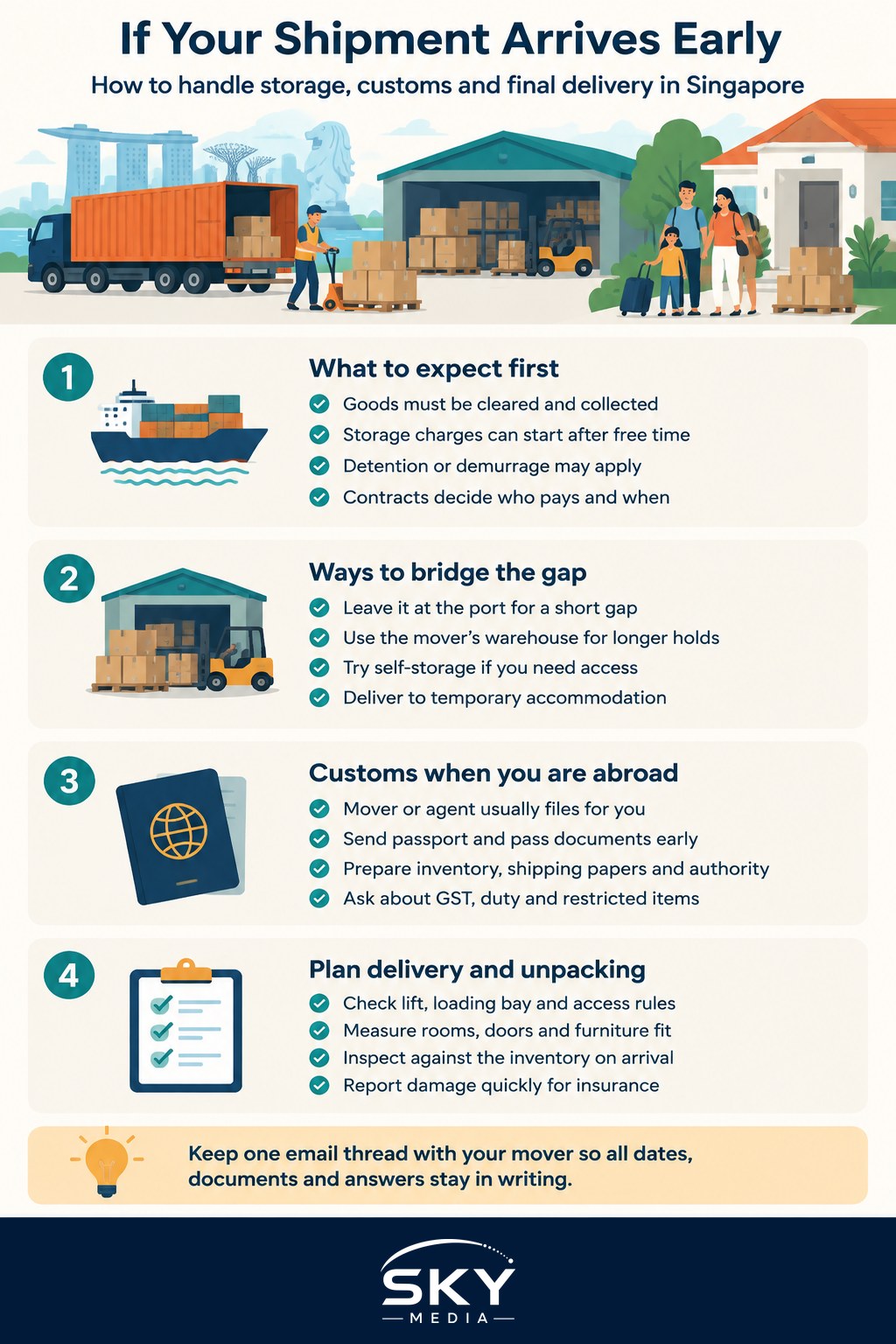
What Happens When Your Goods Land Early
When a container or shipment reaches Singapore, it needs to be cleared and collected within the period your shipping arrangement allows. After that, two kinds of charges commonly apply:
- Port or terminal storage charges for goods sitting at the port beyond the free period.
- Container detention or demurrage charges if you shipped a full container and it is held longer than allowed by the shipping line.
The free period, the daily rates and who pays depend on your contract with the mover or freight forwarder. Check this before your goods ship, not after they arrive. If you are on a corporate relocation package, find out whether your employer covers storage and for how long.
The key point is that delay usually costs money, so the earlier you plan where the goods will go, the better.
Your Options for Holding the Shipment
There are several ways to bridge the gap between arrival and having a home ready. The right one depends on how long the gap is and how much access you need to your things.
| Option | Suits a gap of | Pros | Watch out for |
|---|---|---|---|
| Leave it at the port | A few days only | No extra handling | Storage and detention charges can build quickly once free time ends |
| Mover’s or forwarder’s warehouse | A few weeks to months | Goods cleared and unpacked from the container, often insured, one company handles everything | Monthly storage fees, handling fees in and out, limited access to individual boxes |
| Self-storage unit | Medium to long gaps | You can access your items, flexible sizes | You must arrange delivery into the unit, check insurance and access hours |
| Deliver to temporary accommodation | When you have a serviced apartment or short-term rental with space | Your things are with you | Space limits, building move-in rules, a second move later |
| Delay shipping at origin | When you know about the delay before goods leave | Avoids Singapore charges altogether | Storage may still cost money at origin, needs early decision |
For most people with an uncertain move-in date, moving the goods into the mover’s warehouse after clearance is the simplest route. It stops port and container charges and gives you one point of contact.
Coordinating Customs When You Are Still Abroad
Goods entering Singapore must be cleared through Singapore Customs, the government agency responsible for import controls, duties and GST on imported goods. For household moves, the moving company or a customs agent they appoint normally handles the declaration on your behalf.
Because you are not yet in Singapore, expect your mover to ask you for documents remotely. These often include:
- A copy of your passport.
- Your work pass, in-principle approval letter or other proof of your status in Singapore, if available.
- A detailed inventory or packing list.
- Shipping documents, such as the bill of lading or air waybill.
- A letter of authority allowing the agent to act for you.
Whether your household goods qualify for any relief from GST or duty, and what items are restricted or controlled, depends on current Singapore Customs rules. Items such as alcohol, tobacco, medicines, certain foods, plants and animal products often have special requirements. Check the Singapore Customs website and ask your mover early, because a missing document is one of the most common reasons clearance stalls.
If your pass is still being processed, tell your mover. Ask whether they can clear the goods now with the documents you have, or whether it is better to keep the shipment in bonded or port storage until your status is confirmed. Do not guess. Ask for the options in writing.
Questions to Ask Your Mover Right Away
As soon as you learn the shipment will arrive before you do, contact your mover or forwarder with a clear list of questions:
- When exactly will the goods arrive, and when does free time end?
- What will storage cost per day, week or month at the port and at your warehouse?
- Can you clear customs without me in Singapore, and what documents do you need?
- Is my insurance still valid while goods are in storage, and for how long?
- Can I access specific boxes from storage if I need them before final delivery?
- How much notice do you need to schedule final delivery?
- What are the handling charges for moving goods into and out of the warehouse?
Keep all the answers in one email thread so you have a written record.
Planning the Final Delivery
Once you have a home, delivery needs its own planning. Singapore residences often have rules that affect move-in day.
- Condominiums. The management office, run on behalf of the MCST (Management Corporation Strata Title, the body that manages a condo), usually requires advance booking of a lift and loading bay for moving in, and may ask for a refundable deposit. Ask your landlord or agent for the move-in rules.
- HDB flats. Check whether the lift and loading area can handle large items, and whether there are restrictions on moving hours in your block.
- Landed homes. Check road access and whether a large truck can park nearby.
Before booking delivery, measure the rooms, doors and lift so you know which furniture will fit. Our guide on how to check a Singapore address before you move in covers what to look at on a viewing, and checking if furniture fits before you buy explains how to measure doorways and corridors properly.
Unpacking and Inspection
On delivery day, check the inventory against what arrives and note any damage on the delivery documents before the crew leaves. Insurance claims usually have time limits, so report problems promptly to your mover and insurer.
Preventing the Problem Next Time
If you are still planning your move, a few steps reduce the chance of an awkward gap:
- Pack in two waves. Send essentials by air freight or in your luggage, and ship the rest by sea so it can wait if needed.
- Build a buffer into your timeline. Assume your housing start date may slip.
- Agree storage terms upfront. Ask the mover to include a period of storage in the quote.
- Secure housing early. If you are still deciding, read our guide to renting vs buying a home when you arrive, since most newcomers rent first to stay flexible.
Quick Checklist
- Confirm arrival date and free time with your mover.
- Decide on port, warehouse, self-storage or temporary accommodation.
- Send all customs documents and a letter of authority promptly.
- Check insurance cover during storage.
- Learn your building’s move-in rules before booking delivery.
- Inspect everything on delivery day and report damage quickly.
An early shipment is a common relocation hiccup. With a clear plan and good communication with your mover, it becomes a storage bill and a scheduling task, not a crisis.
Frequently Asked Questions
Will I pay GST on used household goods shipped to Singapore? It depends on Singapore Customs rules, which may offer relief for certain personal effects but not for everything. Items such as alcohol, tobacco, and new goods are treated differently. Ask your mover to confirm what applies to your shipment, and check the Singapore Customs website for current details.
Can a friend or landlord receive my shipment while I am still abroad? Possibly, if you authorise them in writing and the mover agrees to release the goods to that person. They may need ID and must be able to check the inventory and sign for delivery. Check your building’s move-in rules and speak to your mover about what they require.
What should I do if my goods arrive damaged or incomplete? Record the problem on the delivery documents before the crew leaves, take photos, and report it to your mover and insurer promptly. Claims usually have time limits, so do not wait. Keep the inventory list, packing records and insurance paperwork handy.
How far ahead should I book a moving company for an international move? As early as you can once your move date looks reasonably firm, since popular periods fill up and quotes need time to compare. Getting several written quotes lets you compare storage terms, not just price. Share your housing and pass uncertainty with them so they can plan for delays.
Is sending my belongings by sea or by air better for a move to Singapore? Sea freight is generally cheaper for large volumes but slower and harder to time, which is what causes early or late arrivals. Air freight is quicker and costs more, so it suits essentials. Many people send essentials by air and the rest by sea.