
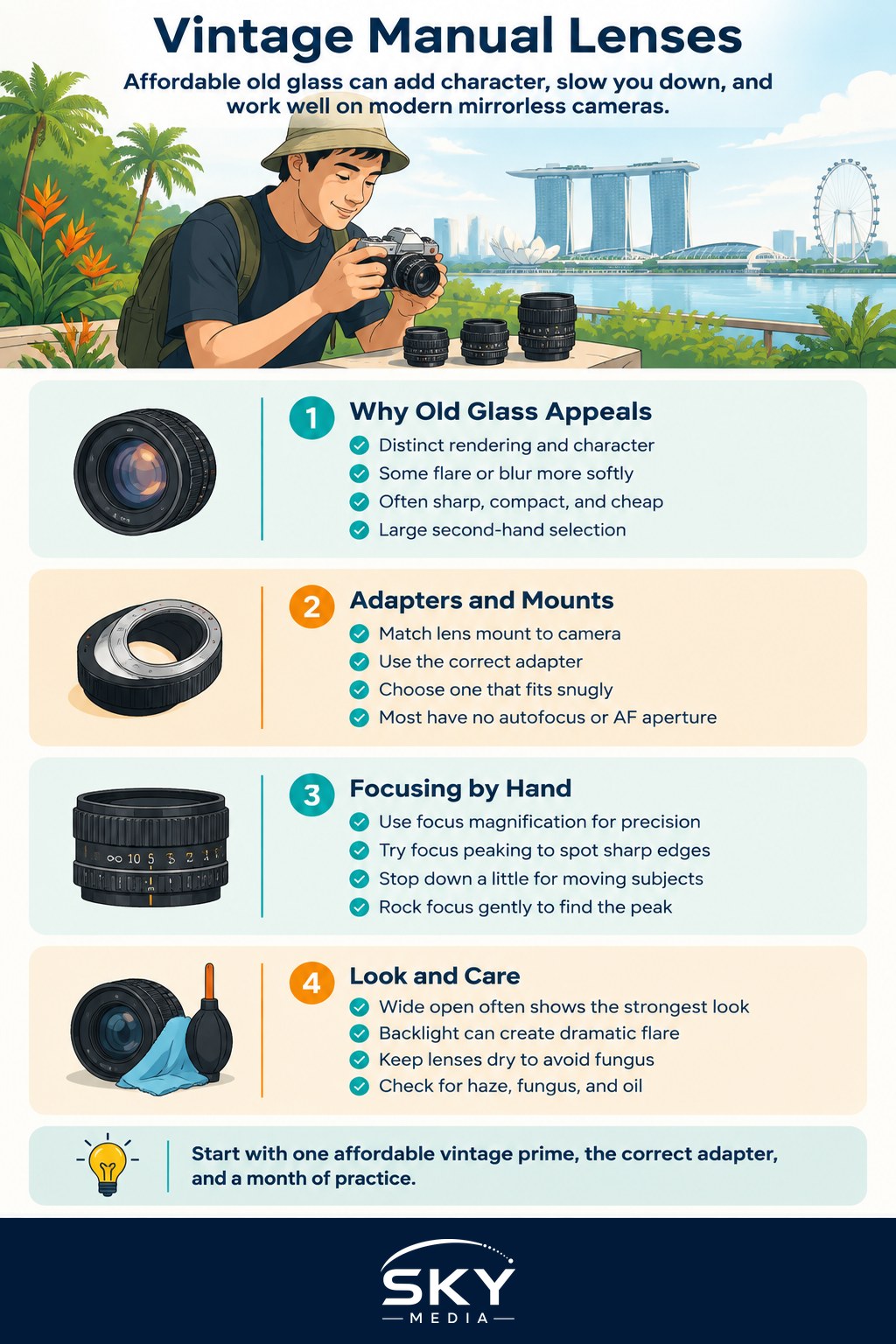
Old lenses have a way of adding character that many modern lenses smooth away. Shooting with vintage manual lenses is one of the most affordable and enjoyable ways to expand your creative range, whether you shoot film or mount them on a modern mirrorless body. You slow down, you focus by hand, and you get a look that feels a little more personal. This guide covers how to choose old glass, mount it, focus it well, and care for it in our humid climate, so you can get lovely results without spending a fortune.
Why Photographers Love Old Glass
Vintage lenses often render images with a distinct signature. Some flare beautifully into the light, some produce swirly or soft backgrounds, and some are simply sharp, compact, and cheap. Because so many were made over the decades, there is a huge pool of affordable options waiting on the second hand market.
There is also the pleasure of the process. Manual focusing pulls you into the scene and makes each frame feel considered. If you enjoy that deliberate approach, you may also like practising deliberate technique in how to shoot in manual mode, since controlling exposure by hand pairs naturally with focusing by hand.
Adapters and Lens Mounts
The magic that makes old lenses so usable today is the adapter. Because many mirrorless cameras have a short distance between the mount and the sensor, a simple adapter can let you fit lenses from all sorts of old systems. The key is matching the lens mount to your camera through the correct adapter.
Adapters vary in quality and features. A plain adapter just holds the lens at the right distance. Choose one that fits snugly without wobble, since play in the adapter hurts focus accuracy. If mounts and adapters feel confusing, our guide to understanding lens mounts and adapters breaks down what fits what and why the flange distance matters.
Be realistic about limits. Most vintage lenses give you no autofocus and no electronic aperture control, so you set aperture on the lens ring and focus by hand. That is part of the fun, not a fault.
Focusing Manual Lenses Accurately
Nailing focus by hand takes a little practice, but modern cameras make it much easier. Two features help enormously. Focus magnification zooms into your subject so you can see exactly when it snaps sharp. Focus peaking highlights the in focus edges with a coloured outline as you turn the ring.
To build good habits:
- Use magnified view for still subjects and portraits where sharp eyes matter.
- Stop the lens down a little for more margin when subjects move.
- Rock the focus ring gently back and forth to find the sharpest point.
- Take a couple of frames of important shots and check them.
Focus peaking in particular is worth learning well, and our walkthrough on how to use focus peaking shows how to set it up so it actually helps rather than distracts.
Getting the Most From the Look
Vintage lenses often shine wide open, where their character is strongest, giving you soft backgrounds and gentle rendering. They can also flare dramatically when pointed near the sun, which you can use creatively or tame with a lens hood. Experiment with shooting into backlight, then shading the front element with your hand to control the flare.
If you love a creamy, blurred background, old fast primes are a cheap route to it, and our tips on how to get creamy bokeh apply beautifully to vintage glass. Move your subject away from the background, open the aperture, and let the old lens do its thing.
Caring for Old Lenses in Singapore
Humidity is the enemy of vintage glass. Fungus can grow inside a lens left in a warm, damp cupboard, and it can permanently mark the elements. Store your lenses in a dry cabinet or an airtight box with fresh silica gel, and check them from time to time. When buying used, inspect the glass against a bright light for haze, fungus threads, and oil on the aperture blades, since these affect both image quality and value.
Old lenses can also stiffen or develop sticky aperture blades over the years. Gentle, regular use helps, and a trusted repair specialist can service a lens worth keeping. Avoid forcing a stiff focus ring, which can cause damage.
Simple Ways to Start
You do not need a shelf of lenses to enjoy this. Pick one affordable vintage prime, get the correct adapter for your camera, and shoot it for a month. Learn its quirks, its sweet aperture, and how it handles our strong light. Then decide whether you want to add another with a different character.
Shooting with vintage manual lenses is a wonderful reminder that gear does not have to be new or expensive to be inspiring. With a little patience for manual focus and a dry cabinet to keep fungus away, old glass can give your photos a look that feels genuinely yours. Take one lens out this weekend, slow down, and enjoy seeing Singapore through a piece of history.
Frequently Asked Questions
Which vintage lens should a beginner buy first? A fast, standard-length prime is a sensible first buy, since it is affordable, versatile and teaches you a lot about light and focus. Choose a lens in clean condition with a smooth focus ring and clear glass. Check that an adapter exists for your camera before buying.
Can I use vintage lenses on a DSLR as well as a mirrorless camera? It is much easier on mirrorless cameras because of their short distance from mount to sensor. On a DSLR, the longer distance often means adapters need extra glass, which can reduce image quality, or you may lose infinity focus. Check compatibility before you buy.
Is lens fungus fixable, and should I avoid lenses that have it? Light fungus can sometimes be cleaned by a repair technician, but deep or etched marks may be permanent. For a first purchase, avoid lenses with visible fungus, since the spores can spread to other lenses stored nearby. Inspect the glass under bright light before paying.
Will an old lens be sharp enough for a modern camera? Often yes once stopped down a little, though many vintage lenses look soft or glowy wide open. That can be part of the charm. Some will struggle with the fine detail of high-resolution sensors, so check sample images from other users before you buy.
Is it safe to buy a vintage lens online without trying it first? It carries some risk, so choose a seller who shows clear photos of the glass, the aperture blades and the focus ring, and who allows returns. Ask about haze, fungus and stiffness. Buying in person lets you shine a torch through the lens yourself.