
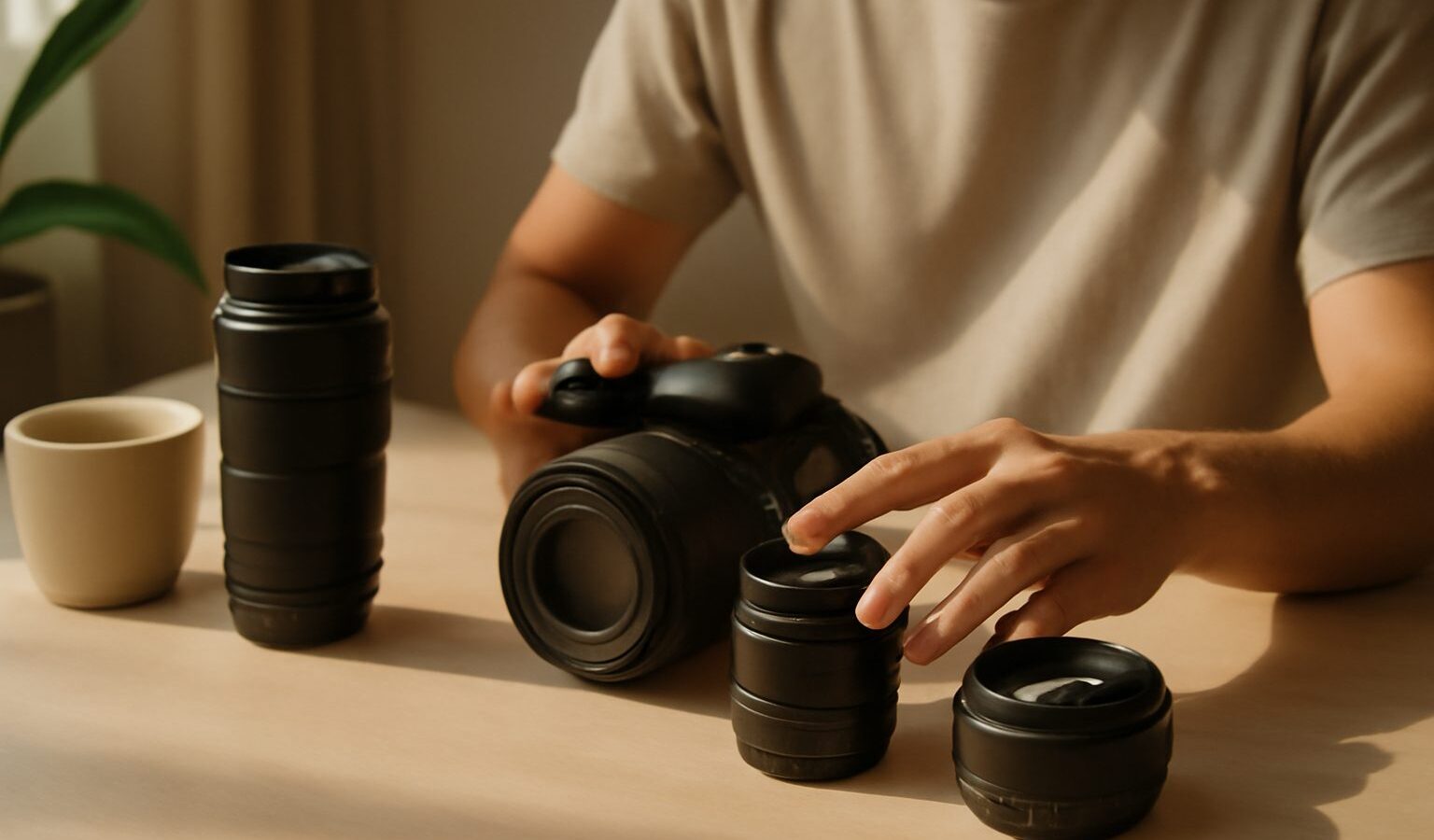
When people talk about upgrading their photography, they often reach for a new camera body. In truth, camera lenses do far more to shape the look of a photo than the body behind them. The lens decides how much of a scene you capture, how blurry the background looks, and how well you can shoot in the dim glow of a hawker centre at night. Once you understand what a lens actually does, the choice between a prime and a zoom becomes much clearer, and you can spend your money where it counts.
This guide explains focal length and aperture in plain terms, then walks through the real differences between prime and zoom lenses so you can pick the right one for how you like to shoot around Singapore.
What Focal Length Really Means
Focal length is the number printed on every lens, written in millimetres, such as 35mm, 50mm or 200mm. In simple terms, it describes how much of the scene fits in your frame and how magnified everything looks. A small number gives a wide view; a large number gives a narrow, zoomed-in view.
- Wide focal lengths (around 16mm to 35mm) take in a lot of the scene. They suit the Marina Bay skyline, the inside of a small HDB flat, or a sweeping view down a Chinatown street.
- Standard focal lengths (around 40mm to 60mm) look close to what your own eyes see. They are natural for street scenes, food on a table and everyday portraits.
- Telephoto focal lengths (around 70mm upwards) pull distant things closer and flatter faces nicely. They suit portraits, birds at the Botanic Gardens, or a performer across a crowded stage.
One extra thing to know: the same lens can look more zoomed in on a smaller sensor. Many beginner cameras use a smaller sensor than full frame, which crops the view and makes a 35mm lens behave a little like a 50mm would on a larger sensor. You do not need to memorise the maths, but it explains why the same number can frame differently on two cameras.
Aperture and Why the f-number Matters
Alongside focal length, every lens has an aperture, written as an f-number such as f/1.8 or f/4. The aperture is the opening inside the lens that lets light through, and it does two important jobs.
First, a wider opening (a smaller f-number like f/1.8) lets in more light, which helps enormously in dim conditions such as a night market or a restaurant without flash. Second, a wider opening produces that soft, blurred background that makes a subject stand out, often called bokeh. A narrower opening (a larger f-number like f/8) keeps more of the scene sharp from front to back, which is what you want for landscapes and group shots.
Here is the part that trips up beginners: the smaller the f-number, the bigger the opening. So f/1.8 is a large opening and f/16 is a small one. Lenses with a very small minimum f-number are called “fast” lenses because they let you use quicker shutter speeds in low light. They tend to cost more and weigh more, but for indoor and evening shooting they are worth it.
Prime vs Zoom: The Core Difference
A prime lens has one fixed focal length. A 50mm prime is always 50mm, so to change your framing you move your own feet closer or further away. A zoom lens covers a range of focal lengths, such as 24mm to 70mm, so you can reframe by turning a ring without moving at all.
Neither is simply better. They suit different habits and different situations. A popular first prime is the affordable 50mm, often nicknamed the “nifty fifty”, which is light, sharp and lets in plenty of light. A general-purpose zoom, meanwhile, is the do-everything lens many kits come with. The table below lays out how they compare on the things beginners care about most.
| What matters | Prime lens | Zoom lens |
|---|---|---|
| Framing | Fixed, you move to reframe | Flexible range at a twist |
| Low-light ability | Usually very good (wide aperture) | Often more limited |
| Background blur | Easier to achieve | Harder on cheaper zooms |
| Size and weight | Small and light | Larger and heavier |
| Convenience | Less versatile in a pinch | Covers many scenes in one |
| Learning value | Trains your composition eye | Quick and forgiving |
When to Reach for Each Type
The right lens depends on what you are shooting rather than any rule about which is superior. Think about the situation in front of you.
Reach for a prime when light is scarce or you want a clean, professional-looking blur. Shooting a friend across a kopitiam table at night, a plate of char kway teow with a soft background, or a relaxed portrait in a park all favour a fast prime. The fixed focal length also gently forces you to compose with intent, which improves your eye faster than you might expect.
Reach for a zoom when the scene keeps changing and you cannot move freely. A walk through the crowds of Little India during Deepavali, a child’s sports day, or a wildlife moment at Sungei Buloh all reward the ability to reframe instantly. A zoom is also the sensible single lens for travel, when carrying several primes is a hassle.
Many hobbyists end up with both: a versatile zoom for unpredictable days and one or two primes for portraits and low light. There is no need to buy everything at once.
How to Choose Your Next Lens
Rather than chasing specifications, start with the photos you most want to take. Let that guide the focal length and aperture you look for, then check current models, specs and prices for yourself, because lens ranges and pricing change often.
- For everyday and street photography, a standard prime around 35mm or 50mm is a superb, affordable first step.
- For portraits with flattering blur, look at a short telephoto prime with a wide aperture.
- For travel and general use on one lens, a mid-range zoom covering wide to short telephoto is the most practical.
- For landscapes and architecture, a wider focal length helps you fit in the skyline or a shophouse facade.
Whatever you choose, remember Singapore’s humidity. Store lenses in a dry cabinet or an airtight box with silica gel to keep fungus from growing on the glass, and let cold gear warm up gradually when you step outdoors to avoid condensation. Look after your lenses and they will outlast several camera bodies.
Explore more
A lens is only one part of the picture, so it helps to build the rest of your foundation too. If you are just starting out, our guide to photography basics for beginners in Singapore ties everything together, while understanding aperture, shutter speed and ISO explains how these settings work as a team. When you are ready to control your camera fully, learn how to shoot in manual mode for complete creative freedom.