

Losing a parent is hard enough. When brothers and sisters then disagree over the house, the money or who should be in charge, grief can turn into a lasting rift. An inheritance dispute siblings get into is rarely only about money; it often carries old grievances about caregiving and favouritism.
This guide focuses on what to do once a disagreement has started: how to cool things down, what to do when the executor is the problem, how mediation works, and what the court route looks like if talking fails. It is general information, not legal advice. Estate law has technical rules and strict procedures, so speak to a lawyer who handles probate and estate disputes before taking any formal step.
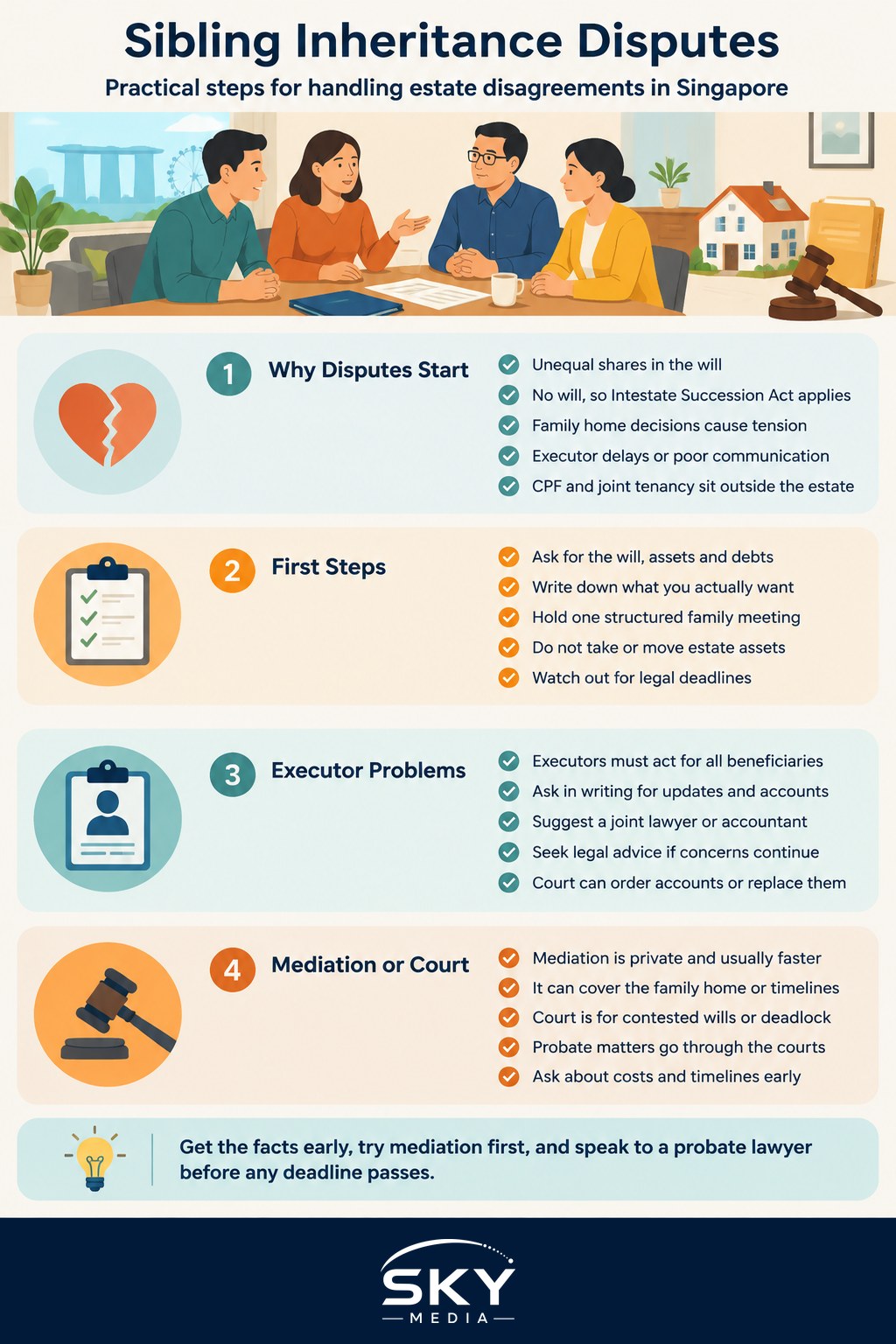
Why Siblings End Up Disagreeing Over an Estate
Most sibling conflicts fall into a few familiar patterns. Recognising which one you are in helps you choose the right next step.
- Unequal shares in the will. One child receives more, or the family home goes to one sibling. Others may suspect pressure or question whether the parent understood what they signed.
- No will at all. Without a will, the estate is distributed under the Intestate Succession Act (for non-Muslims), which sets out shares by family relationship. Siblings may agree on the shares but fight over who administers the estate or whether to sell or keep property.
- The family home. One sibling may live in it, want to buy out the others, or refuse to sell. HDB eligibility rules can complicate this further.
- Executor or administrator behaviour. Delays, poor communication, or suspicion that the person in charge is favouring themselves are among the most common triggers.
- Assets outside the will. CPF savings go according to a CPF nomination, and jointly held property under a joint tenancy usually passes to the surviving joint owner. These assets sit outside the estate and the will does not control them.
For Muslim families, the estate is distributed under Faraid, with its own rules and the Syariah Court’s role in issuing an inheritance certificate. Our guide to Muslim inheritance and Faraid basics explains how that system works.
First Steps to Take Before Positions Harden
Early, calm action prevents many disputes from ever reaching a lawyer’s office.
- Get the facts on paper. Ask for a copy of the will (if there is one), a list of known assets and debts, and an update on whether a Grant of Probate or Letters of Administration has been applied for. Disagreements thrive on rumour.
- Separate the estate from the family history. Write down what you actually want: a share of sale proceeds, a sentimental item, a timeline. Concrete requests are easier to negotiate than broad grievances.
- Hold one structured family meeting. Agree an agenda in advance, keep it to the estate, and consider asking a neutral relative or family friend to keep time. Follow up in writing so everyone has the same record.
- Do not take or move assets. Removing items from the family home, withdrawing money or changing locks before the estate is settled can create legal problems and destroy trust.
- Note the time limits. Some claims, such as challenging a will or claiming reasonable maintenance as a dependant, have deadlines. Get advice early so you do not lose an option simply by waiting.
When the Executor or Administrator Is the Problem
The executor (named in a will) or administrator (appointed when there is no will) has legal duties. In general terms they must collect the assets, pay the debts, keep proper accounts, act in the interests of all beneficiaries and distribute the estate according to the will or the law. They are not supposed to treat the estate as their own or favour themselves.
Common complaints from siblings include:
- No information about what the estate holds or what has been spent
- Long, unexplained delays in applying for the grant or distributing assets
- Selling assets cheaply to themselves or to people close to them
- Mixing estate money with personal accounts
Practical steps, in rough order of escalation:
- Ask in writing for an update and accounts. A polite, specific email (what assets, what expenses, what timeline) creates a record and often gets results.
- Suggest a joint professional. Siblings sometimes agree to appoint a lawyer or accountant to handle the paperwork, which takes the pressure off a sibling executor who may simply be overwhelmed.
- Get legal advice on your rights. A lawyer can write formally, and in some cases beneficiaries can apply to court to require accounts or, where there is serious misconduct, seek the removal or replacement of an executor or administrator.
Many sibling executors are simply overwhelmed by paperwork and grief, not acting in bad faith. Assume good intent until the facts show otherwise.
Mediation: The Route Most Families Should Try First
Mediation brings the siblings together with a trained, neutral mediator who helps them reach their own agreement. The mediator does not decide who is right. Agreements can be recorded in writing and, with legal help, made binding.
Why mediation suits sibling disputes:
- It is usually faster and far cheaper than a court fight, and it stays private.
- It allows creative outcomes, such as one sibling keeping the flat and paying the others over time.
- It gives you a better chance of still speaking to each other afterwards.
In Singapore, private mediation is available through established mediation centres and accredited mediators, and the Family Justice Courts also encourage and offer dispute resolution for many probate and family-related matters once a case is filed. Check the Family Justice Courts website and the Singapore Mediation Centre for current options and fees, as these can change.
Listen first, restate the other person’s position fairly, and focus on interests rather than blame.
Comparing Your Options
| Option | What it involves | Best for | Main drawbacks |
|---|---|---|---|
| Direct family discussion | Meetings and written follow-ups between siblings | Misunderstandings, missing information, minor disagreements | Can stall if trust is already low |
| Mediation | Neutral mediator helps siblings negotiate a settlement | Disputes over the family home, shares, timelines, personal items | Needs everyone to attend in good faith |
| Lawyer-led negotiation | Lawyers exchange letters and proposals for their clients | Executor concerns, complex assets, one sibling refusing to engage | Costs rise quickly with each round |
| Court proceedings | Formal application or claim decided by a judge | Contested wills, serious executor misconduct, deadlock | Slow, expensive, public and emotionally draining |
When Court Becomes Necessary
Sometimes litigation cannot be avoided, for example when a will’s validity is disputed or an executor will not account for the estate. Probate and estate matters are generally handled by the Family Justice Courts, with larger or more complex cases going to the High Court (Family Division). Your lawyer will advise which applies.
Types of court action siblings commonly consider:
- Challenging a will, typically on grounds such as lack of mental capacity, undue influence, or the will not being properly signed and witnessed. These claims are hard to prove and need strong evidence.
- Applying for accounts or the removal of an executor or administrator where there are real concerns about how the estate is being handled.
- Claims under the Inheritance (Family Provision) Act, where certain family members, such as dependent children, may ask the court for reasonable maintenance from the estate. Eligibility is limited and strict time limits apply, so seek advice promptly.
- Applications about the sale of property when co-beneficiaries cannot agree.
Ask your lawyer frankly about likely costs and timelines first. Even a strong case can cost more than the share in dispute.
Preventing the Next Dispute
Many people later want to spare their own children the same experience. Clear, updated wills, CPF nominations, open conversations and an executor everyone trusts all help. Our guide to planning your estate and property inheritance walks through the main tools.
Most sibling disputes can be settled without a courtroom. Get the facts, try mediation early, and take legal advice before any deadline passes.
Explore more: Managing an Inheritance in Retirement
Official sources: Singapore Courts