
One of the first practical things you will want after landing is a working local number. A Singapore SIM card gives you data for maps and messaging, a local number for verifying banking and delivery apps, and a way to stay reachable while you settle in. The good news: Singapore has strong coverage, fast networks, and plenty of options at every budget. This guide walks you through prepaid versus postpaid, the main providers, tourist and short-stay SIMs, eSIM, and what you need to register.
Prepaid or postpaid: which suits you?
The first choice is the type of plan, and it mostly depends on how long you are staying.
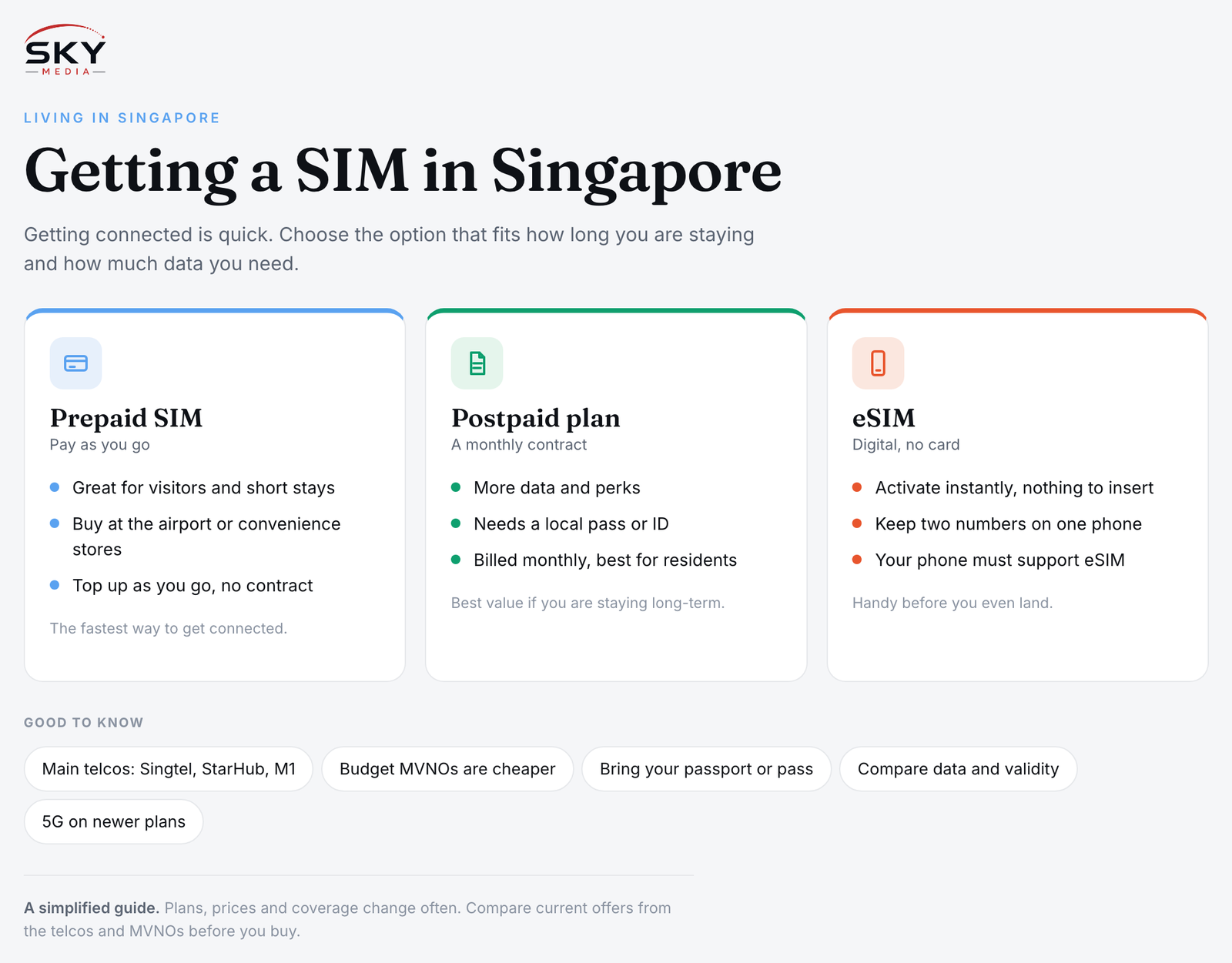
- Prepaid means you pay upfront and top up as you go. There is no contract, no credit check, and no monthly bill. It is the natural fit for tourists, students, and anyone in their first few weeks who is still sorting out a bank account and address. A prepaid SIM Singapore newcomers can buy on arrival and start using within minutes.
- Postpaid means a monthly mobile plan billed to you, often with more generous data, roaming perks, and sometimes a subsidised phone. It usually needs local ID or a valid pass, a local address, and occasionally a deposit for foreigners. It suits residents staying long term who want a fixed monthly arrangement.
A common path is to start on prepaid for flexibility, then switch to a postpaid or budget SIM-only plan once your bank account and pass are set up.
The main telcos and budget brands
Singapore’s networks fall into two groups: the big established telcos who own the networks, and the leaner budget brands (often called MVNOs) that run on those same networks at lower prices.
The three big telcos
The Singtel StarHub M1 trio are the long-standing operators. All three offer prepaid and postpaid plans, physical stores island-wide, and reliable nationwide coverage including on the MRT.
- Singtel is the largest and generally has the widest retail presence.
- StarHub and M1 are close competitors, often matching each other on price and perks.
For most everyday users, real-world coverage between the three is broadly similar. Choose on price, plan structure, and whichever has a convenient store or promotion.
Budget SIM-only brands
Alongside the big three sit a wave of digital-first, SIM-only brands aimed at value seekers. These run on the major networks but sell entirely online or through app-based sign-up, with no shops and no contracts. They typically offer large data allowances for a low, flat monthly price and are popular with students and long-stay residents who do not need a bundled phone. If you are comfortable managing everything through an app, these often give the best value for money.
A quick rule of thumb: big telcos for stores, roaming, and phone bundles; budget SIM-only brands for the most data per dollar.
Tourist and short-stay SIMs
If you are visiting or staying only a few weeks, look for a tourist SIM. These prepaid packs are built for short trips: a generous chunk of data, some local and international call minutes, and a validity window of roughly one to two weeks. You can pick one up at the airport on arrival, at convenience stores, and at telco shops in the city.
For a short visit, a tourist SIM is usually the simplest and cheapest route to getting online. As a rough guide, expect to pay a modest one-off fee for a week or two of ample data, though exact packs and prices change often, so compare what is on the shelf when you arrive.
eSIM: the SIM-free option
Many phones now support eSIM Singapore travellers and residents can activate without a physical card. Instead of slotting in plastic, you scan a QR code or activate through an app, and the plan loads onto your phone digitally.
The advantages:
- You can buy and activate before you even land, so you have data the moment you switch off flight mode.
- No need to fiddle with a tiny tray or store a spare card.
- Handy phones can hold more than one number at once, so you can keep your home line active alongside a local one.
Both the big telcos and budget brands increasingly offer eSIM versions of their prepaid and postpaid plans. Check that your phone model supports eSIM before you rely on it, as some older and region-specific handsets do not.
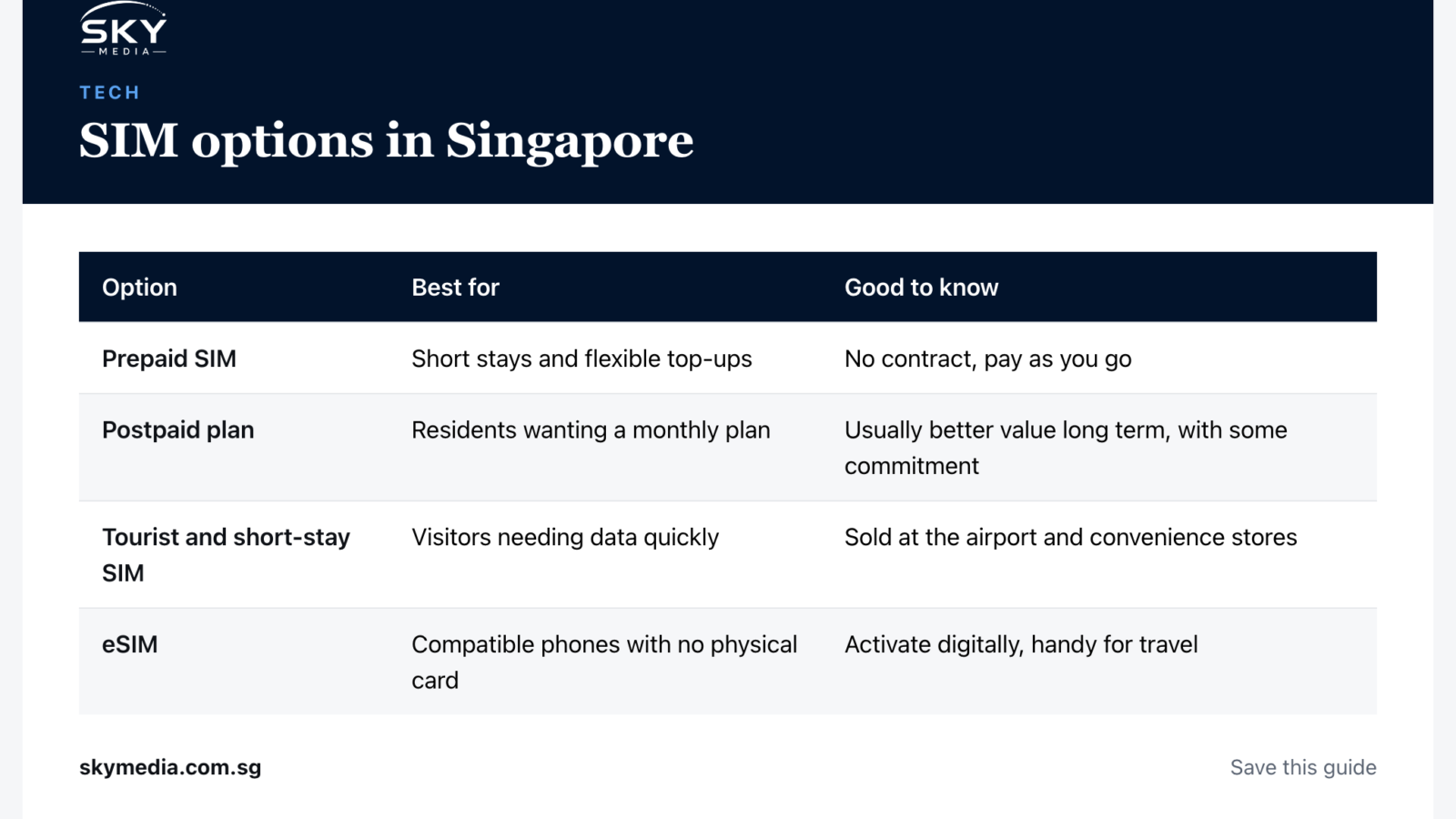
Here is how the main SIM options compare:
| Option | Best for | Good to know |
|---|---|---|
| Prepaid SIM | Short stays and flexible top-ups | No contract, pay as you go |
| Postpaid plan | Residents wanting a monthly plan | Usually better value long term, with some commitment |
| Tourist and short-stay SIM | Visitors needing data quickly | Sold at the airport and convenience stores |
| eSIM | Compatible phones with no physical card | Activate digitally, handy for travel |
What you need to register a SIM
Singapore requires every SIM to be registered to an identifiable person, so you will need to show ID when you buy one. This is a legal requirement and applies to prepaid, postpaid, and eSIM alike.
Bring:
- Your passport if you are a visitor or newly arrived.
- Your immigration pass or work/student pass, if you already hold one (for example an Employment Pass, S Pass, Student’s Pass, or Dependant’s Pass).
- For postpaid plans, often a local address and sometimes proof of it, plus possibly a deposit for foreigners.
Registration at a telco store or airport counter takes only a few minutes. Each person is limited in how many prepaid lines they may register, so keep it to what you actually need. Rules on registration and limits are set by the authorities and can be updated, so confirm current requirements with the provider or the official source when in doubt.
How much data should you expect?
Data allowances in Singapore are generous by global standards, and prices per gigabyte are low. Budget SIM-only plans in particular tend to bundle large monthly data allowances for a flat fee.
A rough sense of what different users need each month:
- Light use (messaging, maps, occasional browsing): a smaller allowance goes a long way.
- Everyday use (social media, streaming on the commute, video calls): a mid-to-large monthly allowance is comfortable.
- Heavy use (constant streaming, hotspotting a laptop): look for the largest data or unlimited-style plans.
Because you are rarely far from Wi-Fi at home, work, malls, and many public spaces, many newcomers find they use less mobile data than expected.
How to choose: a quick checklist
- Staying under a month? A tourist SIM or prepaid eSIM is simplest.
- Settling in long term? Start on prepaid, then move to a postpaid or budget SIM-only plan once your pass and bank account are sorted.
- Want the most data per dollar? Compare the budget SIM-only brands.
- Want a store, roaming, or a bundled phone? Go with one of the big telcos.
- Comfortable doing everything by app, and have a compatible phone? Consider eSIM.
Whatever you pick, plans and promotions in Singapore change frequently, so treat any figure here as a rough guide and compare the latest offers before you commit. Getting connected is quick and painless, and it is one of the easiest boxes to tick as you find your feet.
Explore more: Moving to Singapore checklist · Setting up your HDB home