

Look up at almost any HDB estate today and you will spot rows of dark blue panels lining the rooftops. Those panels are mostly the work of SolarNova, the government programme that puts solar on public housing and other public buildings. If you live in a flat, you may have wondered who put them there, whether you pay for them, and what they actually power. This guide to SolarNova HDB solar answers those questions from a resident’s point of view.
It focuses on public housing. If you own a landed property and want panels of your own, our guide to installing solar panels on a landed home covers that very different process.
What SolarNova Is and Why It Exists
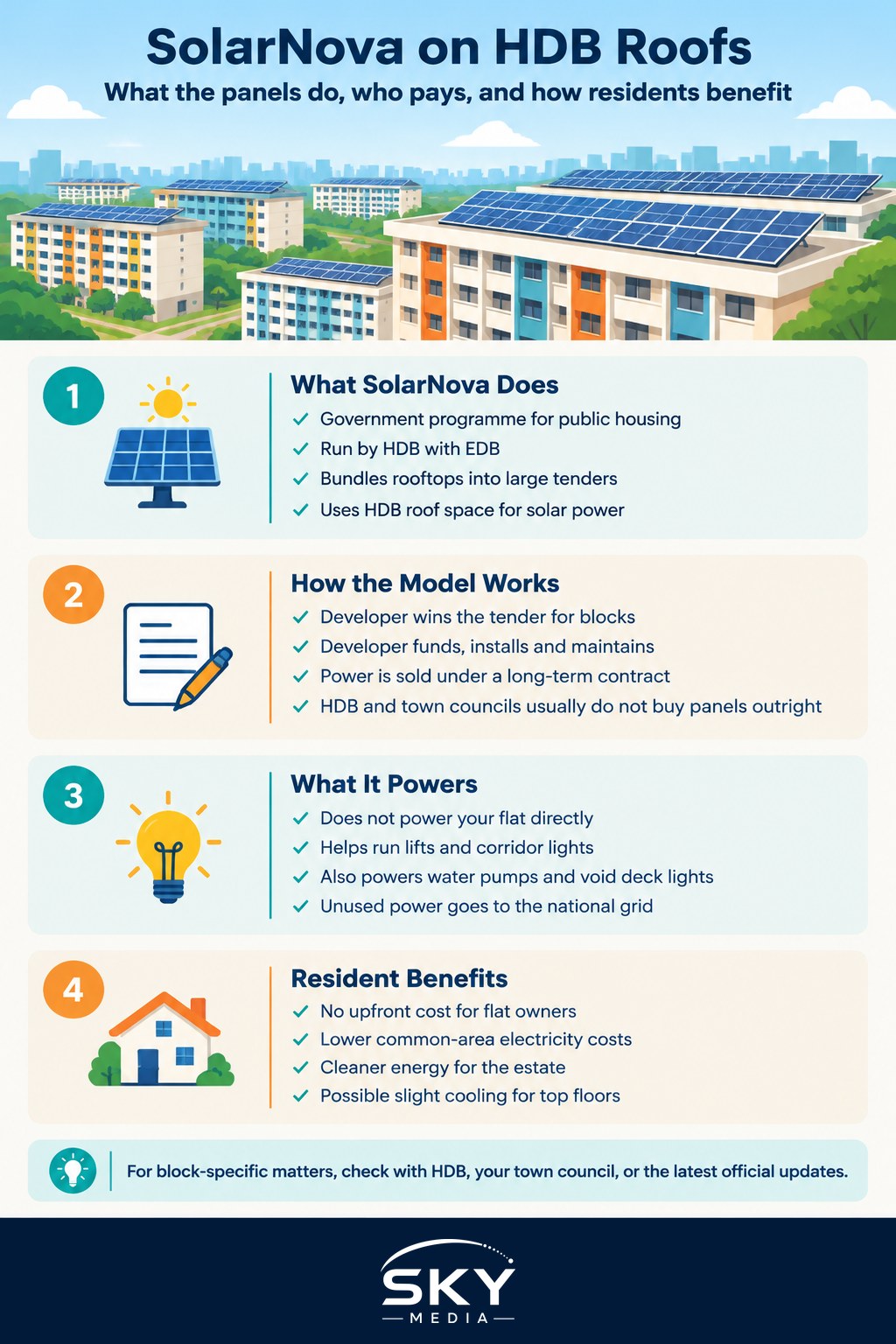
SolarNova is a whole-of-government programme led by the Housing and Development Board (HDB) together with the Economic Development Board (EDB). Its core idea is demand aggregation: instead of every agency or town council tendering for small solar projects one at a time, the government bundles many rooftops into large tenders. Bigger tenders attract more competitive bids from solar developers, which brings down the cost of each installation.
Singapore has limited options for renewable energy. There is no space for large wind farms, rivers for hydropower are absent, and land is scarce. Solar is the most practical local renewable source, and HDB blocks offer something the country is short of: large, flat, unshaded roof space spread across every town. SolarNova turns that space into a distributed power plant.
The programme also ties into wider national goals, including the HDB Green Towns Programme and the Singapore Green Plan 2030, which set out targets for solar deployment and lower carbon emissions in estates. Targets and progress figures are updated from time to time, so check HDB’s website and the Singapore Green Plan site for the current numbers.
How the Leasing Model Works
The key to SolarNova is that HDB and town councils do not usually buy the panels outright. Instead, the programme commonly uses a leasing model:
- A solar developer wins the tender for a batch of HDB blocks.
- The developer designs, finances, installs, owns and maintains the solar system on those rooftops.
- The developer sells the electricity generated to the buyer, typically the town council or HDB, at an agreed rate under a long-term contract.
- At the end of the contract, the arrangements for the panels are set out in the agreement between the parties.
Because the developer carries the upfront cost and the maintenance responsibility, the public sector avoids a large capital outlay. The developer earns its return over the life of the contract by selling the power. This is broadly similar to the power purchase agreement model used by many commercial buildings worldwide.
What the Panels Actually Power
This is where most residents get confused. The electricity from rooftop solar does not flow into your flat’s meter, and it does not reduce your household SP bill directly. Instead, it is used for the block’s common services, such as:
- Lifts
- Corridor and staircase lighting
- Water pumps that move water up to the higher floors
- Lighting in void decks and common areas
During the day, when the sun is strongest, solar output can offset a meaningful share of these common-area needs. Any surplus that the block does not use at that moment is exported to the national grid. At night, the block draws power from the grid as usual.
Floating solar works on the same principle at a much larger scale. If you are curious how Singapore uses reservoirs for solar, see our explainer on floating solar at Tengeh Reservoir.
How Residents Benefit
Residents benefit indirectly rather than through a line item on a bill.
- Lower common-area electricity costs. Town councils pay for the electricity used by common services, funded partly by the Service and Conservancy Charges (S&CC) that residents pay monthly. Cheaper and more stable power for common services helps town councils manage their operating costs.
- No upfront payment from residents. The panels are installed at no direct cost to flat owners, and you do not sign anything or pay a fee for them.
- Cleaner energy for your estate. Every kilowatt-hour from the roof is one less drawn from a grid that still relies largely on natural gas.
- Some cooling effect on top floors. Panels shade part of the roof surface, which some residents on the highest floors notice as slightly less heat absorbed by the roof slab. The effect varies by block and design, so treat it as a possible side benefit rather than a promise.
Whether S&CC rates change is a decision for each town council and depends on many factors besides solar, so do not expect a specific reduction.
SolarNova vs Other Ways to Use Solar
The table below compares SolarNova with the other main ways people in Singapore use solar power.
| Option | Who pays upfront | Who maintains | What the power is used for | Who it suits |
|---|---|---|---|---|
| SolarNova on HDB blocks | Solar developer | Solar developer | Common services in the block, surplus to grid | All HDB residents, automatically |
| Own panels on a landed home | Homeowner, or a leasing firm | Homeowner or installer | The household, surplus can be exported | Landed property owners |
| Green or solar electricity plan | No equipment cost | The retailer | Your household, via matched renewable energy | Flat and condo dwellers who want greener power |
| Condo rooftop solar | MCST (the condo’s management corporation) or a leasing firm | MCST or installer | Common property such as lifts and pool pumps | Condo residents, via an MCST decision |
For the full landed and household picture, our overview of solar power for homes in Singapore explains the options in more depth.
Common Questions From HDB Residents
Can I install my own solar panels on my HDB flat?
Generally, no. The roof is common property managed by the town council and HDB, and you cannot put your own panels there. Fixing panels on a balcony, window or external wall also involves approvals and safety rules for the building facade. If you are considering anything like this, check with HDB and your town council first. For flat dwellers, a green electricity plan from a retailer under the Open Electricity Market is the simplest way to choose greener power.
Are the panels safe?
Installations go through engineering checks for structural loads, wind, lightning protection and electrical safety, and they are maintained by the developer. Residents should not go onto the roof; rooftop access is restricted for safety.
Will there be noise or disruption during installation?
Works are mostly on the roof, with materials brought up by lift or crane. Town councils usually put up notices before works start. If you have concerns, contact your town council.
Do the panels affect my roof leaks or the block’s structure?
Rooftops are assessed before installation. If you live on the top floor and notice leaks or ceiling stains, report them to your town council as you would any other leak, and mention that the roof has solar panels so they can coordinate with the right party.
What happens when the panels get old?
Solar panels degrade slowly over many years. Maintenance, replacement and end-of-contract arrangements are part of the agreements between the developer and the public sector buyer, not something residents handle.
Where to Find Official Information
For the latest details on SolarNova tenders, deployment targets and which towns are covered, refer to:
- HDB’s website, which has pages on sustainable estates and solar deployment
- EDB, which co-leads the programme
- Your town council, for anything specific to your block, such as works notices or S&CC matters
- The Singapore Green Plan 2030 website, for national solar targets
Figures and programme details change as new tenders are awarded, so treat any number you read in older articles, including this one, as a starting point and confirm it with the official source.
Explore more: Urban farming and rooftop gardens shows another way Singapore is putting its rooftops to work.
Official sources: HDB · Energy Market Authority
Further reading: Can Condos Install Solar Panels? A Guide for MCSTs and Owners