

If you have noticed solar panels appearing on your block’s roof, lighter coloured paint on rooftops, or new planting around the multi-storey car park, you are probably seeing the HDB Green Towns Programme at work. It is a long-running, estate-wide effort by the Housing & Development Board (HDB) to make public housing towns more sustainable and more comfortable to live in, and it ties into the national Singapore Green Plan 2030.
This guide focuses on the estate programme itself: what gets installed, why, and what it means for you as a resident. If you want tips on cutting energy and water use inside your own flat, see our separate guide to green living in an HDB flat.
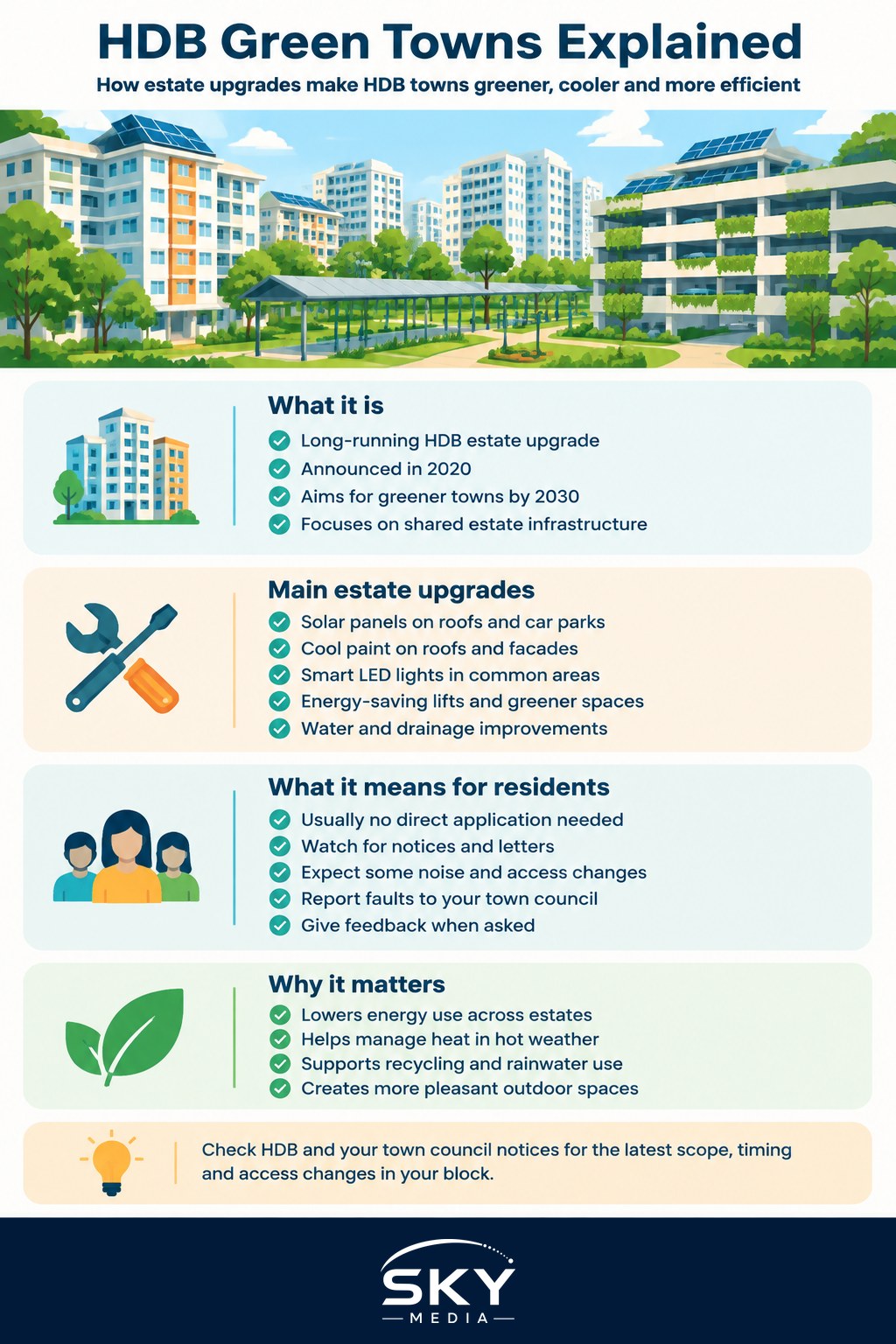
What the HDB Green Towns Programme Is
The HDB Green Towns Programme was announced in 2020 as a ten-year plan to make existing and new HDB towns greener by around 2030. Rather than asking each household to change its habits, it upgrades the shared infrastructure that everyone in an estate relies on: roofs, corridors, lifts, car parks, drains and open spaces.
HDB has described the programme around three broad goals:
- Sustainable: reduce the energy used to run HDB towns, mainly through solar power and more efficient lighting and lifts.
- Recycle: make better use of resources such as rainwater, and support recycling in estates.
- Cool: bring down heat in estates through cool coatings, greenery and better design, so outdoor spaces feel more bearable.
Because the programme rolls out town by town over many years, what you see depends on where you live and when your block’s turn comes. HDB publishes updates and targets on its website, and these can be revised, so check there for the latest scope and timelines.
The Main Upgrades Coming to HDB Estates
Rooftop solar panels
Solar is the most visible part of the programme. Under the national SolarNova initiative, which HDB leads with other agencies, photovoltaic panels are installed on HDB block rooftops and multi-storey car parks. The electricity generated is typically used to power common services such as corridor lighting, lifts and water pumps, with surplus fed into the grid.
For residents, solar panels usually mean a few days of works on the roof and some contractor activity around the block. Panels sit on the roof and do not affect your flat directly. Over time, lower common-area energy costs help the town council manage its running expenses.
Cool paint and cool coatings
Dark roofs and walls absorb heat during the day and release it in the evening. Cool paint is a special coating with high solar reflectance that bounces more sunlight back, so the surface stays cooler. HDB has trialled cool coatings on block rooftops and facades in selected estates to study how much they lower surrounding temperatures.
You may notice repainting works that look like routine maintenance, but with a lighter, reflective finish. The aim is a modest but noticeable reduction in heat around the block, especially for top-floor units and outdoor areas.
Smart LED lighting in common areas
Older fluorescent fittings in corridors, staircases and void decks are being replaced with LED lights. In many places, these are paired with motion sensors that dim the lights when nobody is around and brighten them when someone walks by. This keeps corridors lit for safety while cutting wasted electricity late at night.
If your corridor light seems to “wake up” as you approach, that is the smart lighting doing its job rather than a fault. If a light stays dark when you walk past, report it to your town council as you would any other defect.
Energy-saving lifts
Some lift upgrades include energy regeneration systems that recover energy when a lift brakes and feed it back into the building’s supply. This is often done alongside other lift works, so it may coincide with the broader programmes covered in our explainer on HDB lift upgrading and the Neighbourhood Renewal Programme.
More greenery and cooler outdoor spaces
Greenery helps shade surfaces and cool the air through evaporation. Expect more trees along walkways, rooftop greenery on multi-storey car parks, and community garden plots in some estates. Newer towns are planned with green corridors and parks from the start, while older towns get greenery added where space allows.
Water and drainage improvements
Some estates are getting smart irrigation that adjusts watering based on weather conditions, and rainwater harvesting so collected rain can be used for landscaping. Planted drains and swales, sometimes called rain gardens, can slow down and clean stormwater before it reaches the drains.
Green Towns Upgrades at a Glance
| Upgrade | Where you will see it | What it does | Impact on residents |
|---|---|---|---|
| Rooftop solar panels | Block roofs, car park roofs | Generates electricity for common services | Short roof works, little day-to-day change |
| Cool paint | Rooftops and facades | Reflects sunlight to reduce heat build-up | Repainting works, slightly cooler surroundings |
| Smart LED lighting | Corridors, staircases, void decks | Dims when empty, brightens on movement | Lights respond as you approach |
| Energy-saving lifts | Lift machinery | Recovers braking energy | Usually bundled with lift works |
| Greenery and rain gardens | Walkways, car park roofs, open spaces | Shades, cools and manages rainwater | More shade, occasional landscaping works |
How the Programme Differs From Other HDB Upgrades
It is easy to confuse the Green Towns Programme with other HDB initiatives, so here is a quick way to tell them apart:
- Home Improvement Programme (HIP): fixes maintenance problems inside and around individual flats, such as spalling concrete and ageing pipes. Read our Home Improvement Programme guide for how it works.
- Neighbourhood Renewal Programme and lift upgrading: improve shared facilities like playgrounds, linkways and lifts, often shaped by resident consultation.
- Green Towns Programme: targets the environmental performance of the whole estate, focusing on energy, heat and resources.
In practice, these programmes may overlap in timing, and HDB sometimes coordinates works to reduce disruption. Your town council and HDB notices at the lift lobby are the best guide to what is happening at your block.
What It Means for You as a Resident
Most Green Towns works are funded and managed by HDB and its partners as part of public housing upgrading, and there is usually no direct application for residents to make. That said, there are a few practical points worth knowing:
- Watch for notices. Works are announced through notices at void decks and lift lobbies, and sometimes letters. They usually describe the scope, the duration and any temporary access arrangements.
- Expect some noise and access changes. Roof works may involve cranes or materials being lifted, and some areas may be cordoned off for safety. Keep children and pets away from work zones.
- Report problems to your town council. If a sensor light stops working or new landscaping blocks a path, your town council is the first point of contact. Our guide on what your town council does explains who handles what.
- Give feedback when asked. Some greening and community spaces involve resident input, especially for community gardens and estate features.
- Pair estate changes with home habits. Shared upgrades lower the estate’s footprint, but household electricity, water and waste choices still make a big difference to your own bills.
Why Estate-Level Changes Matter
A large share of Singapore residents live in HDB flats, so improvements at estate level reach a huge number of people at once. A single block’s solar panels or corridor LEDs might seem small, but multiplied across thousands of blocks, the savings in energy and the reduction in heat add up. Cooler, greener estates also make walking, cycling and spending time outdoors more pleasant in a hot, humid climate.
The programme is also a testbed. HDB pilots new ideas, such as different cool coatings or smarter irrigation, in selected towns, studies the results, and expands what works. That means the details of the programme will keep evolving. For the latest information on your town, including what is planned and when, check the HDB website or ask your town council.
Explore more: Green Living in an HDB Flat in Singapore and Town Councils in Singapore Explained.
Official sources: HDB
Further reading: The Green Mark Scheme for Buildings · SolarNova and Solar Panels on HDB Rooftops Explained