

When you run a sole proprietorship, one of the first confusing questions is how to pay yourself. There is no HR department, no payslip and no employer CPF. Searching for a sole proprietor salary in Singapore often leads to mixed answers because, strictly speaking, a sole proprietor does not pay themselves a salary at all. You take money out of the business as drawings, and you are taxed on the business’s profit.
This guide explains how that works in practice, how tax and CPF fit in, and how to keep your finances clean. It is general information, not financial or tax advice. Rules and thresholds change, so confirm the current position with IRAS, CPF Board and ACRA.
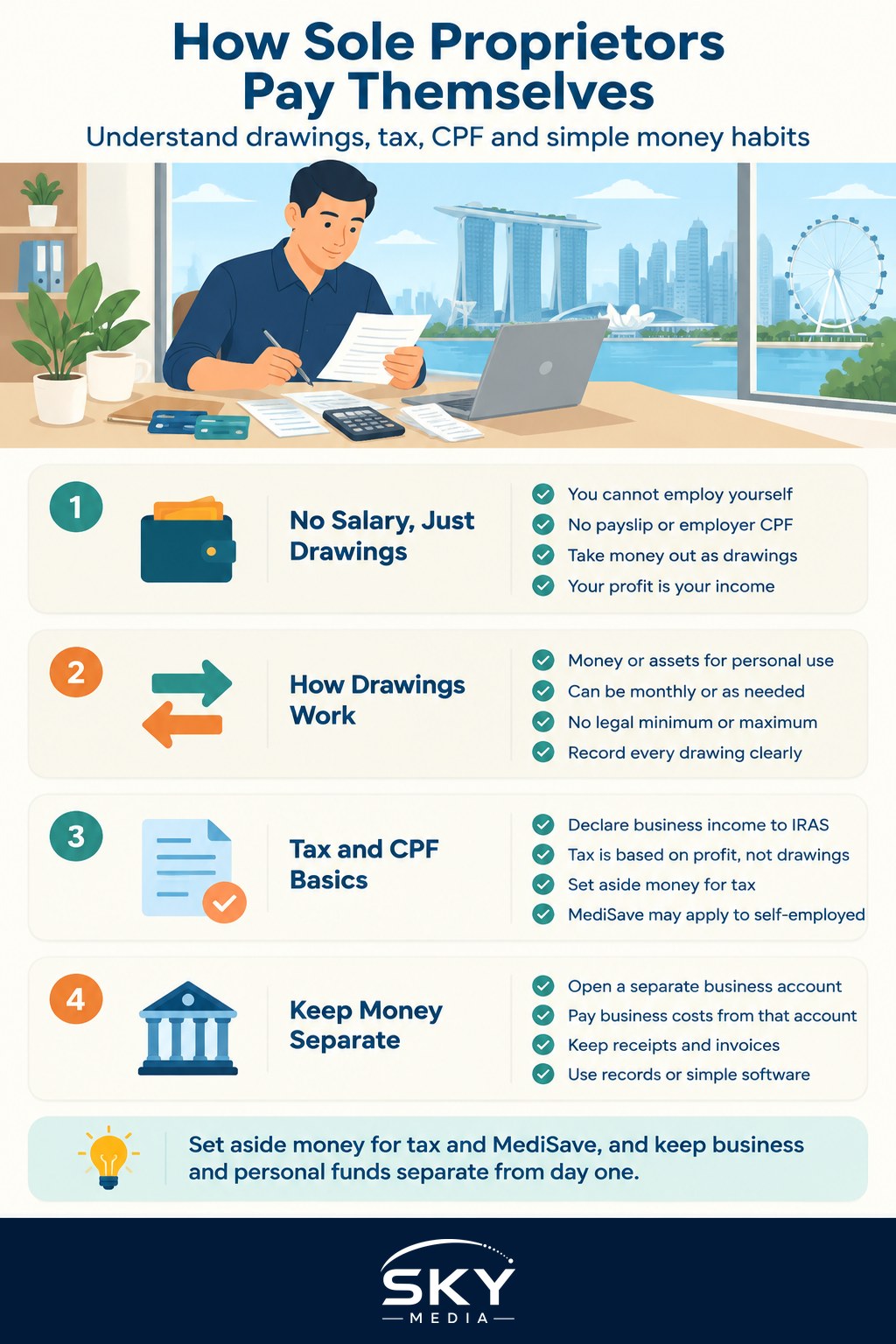
Why a Sole Proprietor Has No “Salary”
A sole proprietorship is registered with ACRA (the Accounting and Corporate Regulatory Authority) through Bizfile, but it is not a separate legal entity from you. The business and the owner are the same person in the eyes of the law and the taxman.
That has three important consequences:
- You cannot employ yourself. Money you take out is not wages, so you do not issue yourself a payslip or pay employer CPF on it.
- Your income is the business profit. Whatever the business earns, minus allowable business expenses, is your personal income for tax purposes.
- Drawings are not an expense. Money you transfer to yourself does not reduce your taxable profit, no matter what you call it.
If you are still deciding on a structure, our comparison of sole proprietorship vs Pte Ltd in Singapore explains how a private limited company can pay its director a salary, and why that changes tax and CPF treatment.
Owner’s Drawings Explained
Drawings are simply money or assets you take from the business for personal use. Common examples include:
- A monthly transfer from your business account to your personal account.
- Paying a personal bill directly from the business account.
- Taking stock or equipment from the business for personal use.
There is no legal minimum or maximum. You can take a fixed amount every month, which many owners find helps with budgeting, or draw only when cash flow allows. The key is to record every drawing in your books so your accounts show clearly what was business spending and what was personal.
Drawings vs a Company Salary vs Business Expenses
This comparison helps clarify how each type of payment is treated. Treatment can depend on your circumstances, so check with IRAS or a qualified accountant.
| Type of payment | Who it applies to | Reduces taxable business profit? | CPF treatment |
|---|---|---|---|
| Owner’s drawings | Sole proprietors and partners | No | No employer CPF; MediSave obligations depend on your net trade income |
| Director’s salary | Directors of a Pte Ltd company | Yes, for the company, if properly incurred | Employer and employee CPF apply as for employees, subject to CPF Board rules |
| Genuine business expenses | Any business | Generally yes, if wholly and exclusively for the business | Not applicable |
| Wages paid to employees | Staff you hire | Yes | Employer and employee CPF apply for eligible employees |
How Income Tax Works for Sole Proprietors
Each year you declare your business income to IRAS as part of your personal income tax filing. In broad terms:
- Work out revenue. Total sales or fees earned by the business in the year.
- Deduct allowable expenses. Costs incurred wholly and exclusively to earn that income, such as materials, software, a portion of qualifying costs, or advertising. IRAS publishes guidance on what is and is not deductible.
- Arrive at net profit. This is your trade income, which is added to any other income you have, such as employment income.
- Pay tax at personal rates. Tax is calculated on your total chargeable income after reliefs.
Because tax is based on profit and not on drawings, you may owe tax even in a year when you took little money out. Setting aside a percentage of every payment received into a separate tax savings account avoids an unpleasant surprise at filing time. IRAS has a dedicated section for self-employed persons that explains filing, record-keeping and the current tax rates.
CPF and MediSave for Self-Employed Owners
As a sole proprietor, nobody contributes CPF on your behalf. However, self-employed persons whose net trade income is above a threshold set by CPF Board must contribute to their MediSave Account. The required amount depends on your income and age, and it is usually assessed after IRAS processes your tax filing.
Beyond MediSave, you can choose to make voluntary contributions to your CPF accounts. This can help build retirement savings and may qualify for tax relief within limits. Because the rules, thresholds and caps can change, check the current details directly with CPF Board.
If you previously worked as an employee, it helps to compare this with how CPF works on a payslip. Our guide on understanding CPF and your salary in Singapore explains the employee side, so you can see what you are now responsible for yourself.
Keeping Business and Personal Money Separate
Mixing personal and business money is the most common mistake new sole proprietors make. It makes bookkeeping harder, confuses your tax filing and makes it difficult to see whether the business is actually profitable.
Good habits include:
- Open a separate business bank account. Many banks in Singapore offer accounts for sole proprietors. Receive all business income there and pay all business expenses from it.
- Pay yourself on a schedule. A fixed monthly transfer to your personal account creates a “salary-like” rhythm without any legal salary.
- Keep receipts and invoices. IRAS requires businesses to keep proper records for a set number of years. Digital copies organised by month make filing much easier.
- Use simple accounting software. Even a spreadsheet works at the start, but software that links to your bank account saves time.
- Hold a buffer. Keep enough in the business account to cover a few months of expenses before taking extra drawings.
Deciding How Much to Pay Yourself
Since there is no fixed salary, set your own sensible figure:
- Estimate your realistic monthly profit after expenses, based on the past few months.
- Subtract a portion for tax and MediSave.
- Keep a reserve for slow months and future investment in the business.
- Draw the remainder as your regular personal income.
Review this every quarter. As the business grows, you can increase drawings, and if income becomes high and steady, it may be worth asking an accountant whether incorporating as a Pte Ltd makes sense for your situation.
Getting Started the Right Way
If you have not yet registered, our step-by-step guide on how to register a sole proprietorship in Singapore covers the ACRA process. Once registered, set up your separate account, decide on a drawing routine, and keep records from day one. Paying yourself as a sole proprietor is straightforward once you understand that profit, not drawings, drives your tax and MediSave, and that clean separation of money is what keeps everything manageable.
Frequently Asked Questions
When should a sole proprietor switch to a Pte Ltd company? Consider it when profit is high and steady, or you want a separate legal entity that can pay you a director’s salary. An accountant can show how tax and CPF would change for your situation before you decide.
Do I need a separate business bank account as a sole proprietor? The law does not force it, but it is strongly advised for most owners. A separate account keeps bookkeeping clean, makes tax filing easier and shows you whether the business is actually making a profit.
Can I pay my spouse a salary from my sole proprietorship? If your spouse genuinely works in the business, wages may be deductible, but they must be real and properly recorded. Rules on what IRAS accepts are detailed, so check IRAS guidance or ask an accountant.
How much should I set aside for tax each month? Because tax is based on profit rather than drawings, you can owe tax even when you took little cash out. Set aside a fixed share of every payment in a separate account, and ask IRAS or an accountant what suits your income.
Do I have to keep business records even if I only use a spreadsheet? Yes. IRAS expects businesses to keep proper records for a set number of years, and a spreadsheet can work at the start. Keep receipts and invoices organised by month, in digital form if possible.
Official sources: IRAS