

The soundbars vs hi-fi question comes up in almost every Singapore living room. One is a single, tidy bar that solves your television’s thin sound in minutes. The other is a pair of speakers and an amplifier that can make music feel alive. Both have a place, and the right choice depends far more on how you live than on which is objectively better.
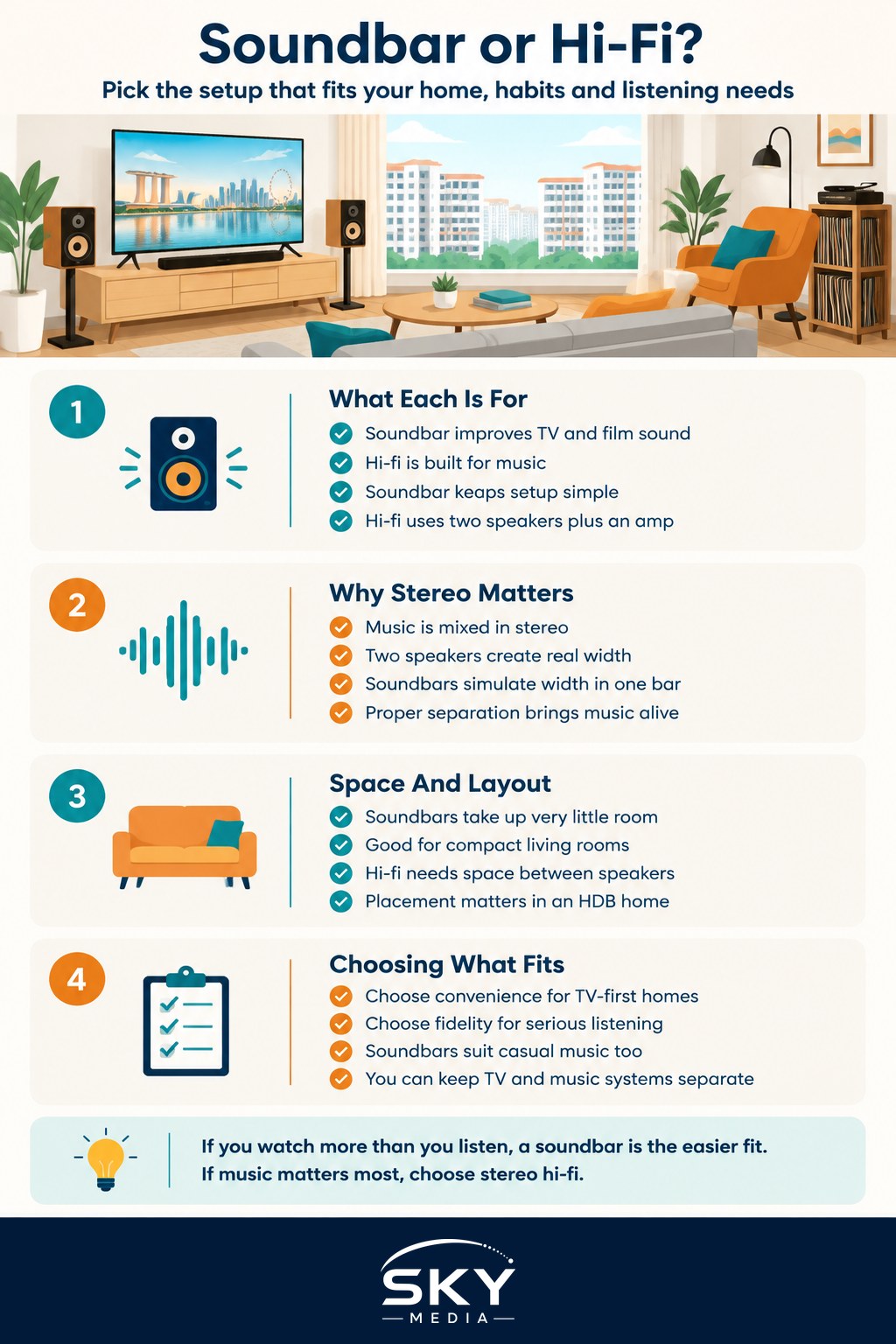
What each one is built to do
A soundbar is designed first and foremost to improve television and film sound. It packs several small drivers into one slim enclosure that sits under your screen, often paired with a wireless subwoofer for bass. Its whole reason to exist is convenience: one box, one cable, minimal fuss, and a big step up from built-in television speakers.
A hi-fi system is built for music. In its simplest form it is two speakers spaced apart and an amplifier feeding them. That physical separation is the key. Because the two speakers sit some distance from each other, they can paint a stereo image, placing a voice in the centre, a guitar to the left and a cymbal to the right. This sense of space and layering is where music comes to life.
Why separation matters for music
Recorded music is mixed in stereo, meaning the engineer deliberately places instruments across a left-to-right field. To hear that field, you need two sound sources with real distance between them. A soundbar, being a single bar, tries to simulate width using clever processing, and it can do a fair job. But simulation has limits, and it rarely matches the natural spread of two proper speakers placed well apart.
This is the heart of the soundbars vs hi-fi debate. A soundbar compresses everything into one place; a stereo pair spreads it out the way the music was meant to be heard.
| Consideration | Soundbar | Two-channel hi-fi |
|---|---|---|
| Main strength | Television and film sound | Music fidelity and imaging |
| Stereo separation | Simulated, limited | Genuine, from spaced speakers |
| Space needed | Minimal, one slim bar | Two speakers plus amp |
| Setup effort | Plug in and go | Placement and cabling matter |
| Upgrade path | Usually replace whole unit | Swap parts over time |
| Best fit | Small rooms, film-first homes | Dedicated music listening |
Space, layout and the HDB reality
Many Singapore homes are apartments where floor space and wall space are precious. A soundbar wins on footprint without question. It hides under the television and needs no speaker stands or floor room. For a compact living room, or a household that watches far more than it listens, that tidiness is a genuine benefit rather than a compromise.
A hi-fi system asks for more. The two speakers want breathing room from the wall and from each other, and ideally you sit roughly the same distance from each speaker as they sit from one another. In a shared living room this can mean planning around furniture and being mindful of neighbours. It is entirely doable in an HDB flat, but it takes a little intention.
Convenience versus fidelity
This is the real trade-off, and it is worth being honest with yourself.
- Choose convenience if your priority is fixing television sound, you want one simple purchase, and space is tight. A good soundbar covers casual music playback too, and for background listening it is more than enough.
- Choose fidelity if music is something you sit down for, if you want to hear detail and space in your favourite albums, and if you are happy to place speakers thoughtfully.
Neither answer is wrong. A soundbar owner who loves films and plays music casually has made a smart choice. A hi-fi owner who treats an evening album as an event has too.
Can you have both?
Yes, and many homes do. A soundbar handles the television while a separate stereo pair, perhaps in a study or bedroom, serves serious listening. Some hi-fi amplifiers even offer a home-theatre passthrough, letting a stereo system double as the front channels for film sound. If budget and space allow, keeping the two roles separate often gives the best of each rather than asking one device to do everything.
There are also compact all-in-one music systems and powered stereo speakers that sit between the two camps. These give you genuine stereo separation in a simpler package than full separates, which suits listeners who want better music than a soundbar offers without assembling a rack of components. Powered speakers, in particular, tuck the amplifier inside the speaker cabinets, so you get true left-and-right sound from two boxes and a power lead, with none of the extra components a traditional hi-fi asks for. For many flats this is the sweet spot: proper music separation, a small footprint, and setup that takes minutes rather than an afternoon.
Spending sensibly
Across budget, mid and premium tiers, a useful rule holds: money spent on a soundbar buys features and convenience, while money spent on hi-fi buys sound quality per dollar. A mid-tier stereo pair will usually out-sing a similarly priced soundbar on music, because its budget goes into two real speakers rather than into processing, connectivity and a slim shape.
So match the spend to the purpose. If films dominate your evenings, a mid-tier soundbar with a subwoofer is money well spent. If music is the reason you are shopping, put the same budget into a modest amplifier and a pair of speakers, and let the room fill out.
Making the call
Ask yourself one plain question: over a typical week, do you watch more or listen more? Let that answer lead. A soundbar is the sensible heart of a film-first, space-tight home. A stereo hi-fi is the heart of a home where music matters. Understand what each is built to do, and the soundbars vs hi-fi choice stops being a dilemma and becomes an easy fit for the way you actually live.
Explore more: Bookshelf vs Floorstanding Speakers · Building a Hi-Fi System on a Budget · How to Build a Great Playlist
Frequently Asked Questions
Do powered speakers need a separate amplifier? No. Powered speakers have the amplifier built into the cabinets, so you get genuine left and right sound from two boxes and a power lead. That makes them a handy middle ground for a flat, with better music separation than a soundbar and fewer components than traditional hi-fi.
Can I connect hi-fi speakers to my television? Often yes, depending on the inputs. Some hi-fi amplifiers offer a home-theatre passthrough, which lets a stereo system serve as the front channels for film sound. Check which inputs your amplifier and television share before buying.
How should I arrange hi-fi speakers in a small living room? Aim for a rough triangle, with your seat about as far from each speaker as they are from one another. Give the speakers breathing room from the walls. Furniture may force compromises, so adjust by ear until a voice sits in the centre.
Will a hi-fi system disturb my neighbours in an HDB flat? It can if you play loudly, since bass travels through walls and floors. Keep the volume considerate, especially at night, and avoid placing speakers hard against a shared wall. A modest system at sensible levels is entirely workable in a flat.
Can I buy a soundbar now and add hi-fi later? Yes, and many homes end up with both. The soundbar handles the television, while a separate stereo pair serves serious listening in a study or bedroom. Keeping the two roles separate often gives better results than asking one device to do everything.