

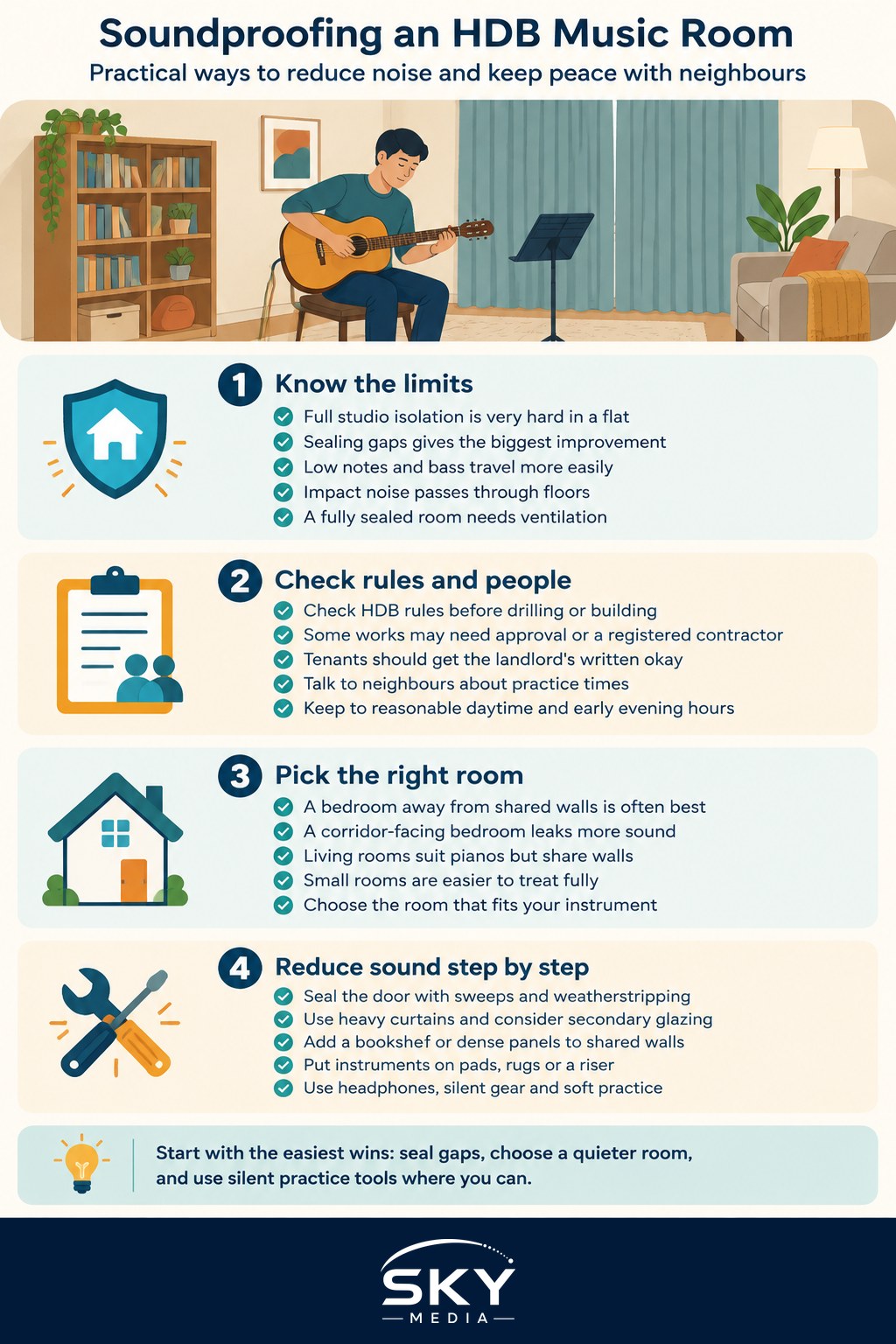
Practising music at home is one of the joys of learning an instrument, but HDB flats are compact, closely stacked and built with shared walls, floors and ceilings. Sound travels. If you want to soundproof a music room in an HDB flat, the most useful thing to know at the start is what is realistic. Full studio-grade isolation is very difficult in a typical flat. Meaningful reduction, combined with good habits and considerate scheduling, is very achievable. This guide explains the limits, the rules and neighbour issues to think about, and practical strategies room by room.
Soundproofing vs Acoustic Treatment
Many people buy foam panels expecting them to block sound. They do not. It helps to separate two different goals:
- Sound isolation (soundproofing) stops sound from passing through walls, doors, windows and floors. It relies on mass (heavy, dense materials), airtightness (sealing gaps) and decoupling (separating layers so vibration does not pass straight through).
- Acoustic treatment improves how the room sounds inside, by reducing echo and harsh reflections. Foam, fabric panels and bass traps do this well, but they let most sound through to the neighbours.
Both are useful. Treatment makes practice more pleasant and can stop you from playing louder to compensate for a boomy room. Isolation is what your neighbours will notice. If you are recording or mixing, our separate guides on studio treatment go deeper; here the focus is everyday practice.
Realistic Limits in an HDB Flat
Be honest with yourself about what is possible:
- Gaps are the weak point. Sound leaks through door gaps, window frames, air-conditioning holes and ventilation openings far more than through solid walls. Sealing these gives the biggest improvement for the effort.
- Low frequencies are stubborn. Bass guitar, kick drums, subwoofers and the lower notes of a piano travel through structure and are much harder to contain than higher sounds.
- Impact noise travels through the floor. Stomping, pedals, amplifiers on the floor and drum kits send vibration into the slab, which the unit below may hear clearly.
- Windows need to open. Singapore’s climate means most people rely on ventilation or air-conditioning. Fully sealing a room may be uncomfortable or unsafe without proper ventilation.
- A full “room within a room” is a major project. It involves building a separate, decoupled inner structure. In an HDB flat this raises questions about renovation approvals, weight, space and cost, so speak to qualified professionals before considering it.
Drums are a special case. For that instrument, read learning the drums in an HDB flat, which covers electronic kits and practice pads.
Renovation Rules, Landlords and Neighbours
Before you start drilling or building, check the rules.
Owners. HDB has guidelines on what renovation works are allowed, which works need a permit, and which contractors may carry them out. Some changes, such as hacking or building walls, or altering windows, may require approval or a contractor registered with HDB. Rules can change, so check the latest requirements on the HDB website or with your contractor before you begin. Our guide to renovating your HDB flat explains the general process.
Tenants. If you rent a room or a whole flat, get your landlord’s written agreement before installing anything fixed, even adhesive panels that may mark walls. Look for reversible solutions. Our article on subletting a room in your HDB flat gives useful context on what renting involves.
Neighbours. Noise between neighbours is a common source of friction in high-density housing. A friendly conversation goes a long way:
- Introduce yourself and mention that you play an instrument.
- Ask whether certain times are better for them, such as when babies nap or shift workers sleep.
- Share a way to contact you if the sound is ever a problem.
- Keep practice to reasonable daytime and early evening hours, and avoid late nights.
If a dispute does arise, community mediation services exist in Singapore, and the relevant authorities’ websites explain the options. Talking early usually prevents it from getting that far.
Room-by-Room Strategies
Which room you choose matters as much as what you put in it. The table below compares common options in a typical flat.
| Room choice | Advantages | Drawbacks | Best suited to |
|---|---|---|---|
| Bedroom away from shared walls | Usually furthest from the neighbour’s living space; easy to furnish softly | Window may face a corridor or neighbouring block | Most acoustic instruments, keyboards on headphones |
| Bedroom next to the common corridor | Convenient layout | Main door and corridor windows leak sound to passers-by and neighbours | Quiet practice only, or with heavy curtains and door seals |
| Living room | Largest space, good for pianos | Shares walls with the neighbour; family noise and visitors | Upright pianos with careful placement |
| Study or small utility room | Compact; easier to treat fully | Can get hot; limited ventilation | Vocals, guitar, digital setups |
General improvements for any room:
- Seal the door. Fit a door bottom seal or sweep and perimeter weatherstripping. If you own the flat, a solid-core door blocks far more sound than a hollow one.
- Treat the windows. Heavy, layered curtains help a little. Some owners add secondary glazing; check renovation rules and use an experienced contractor.
- Add mass to shared walls. A tall, full bookshelf against a shared wall, or dense panels, can reduce transmission somewhat without major works.
- Isolate from the floor. Put amps, pianos and stands on isolation pads or a thick rug with an underlay. A riser platform for amplifiers reduces vibration into the slab.
- Soften the inside. Rugs, upholstered furniture, curtains and fabric panels reduce echo, so you can play at lower volume and still hear yourself clearly.
- Mind the air-conditioner. Gaps around piping and units leak sound. Ask your servicing technician whether these can be sealed safely.
Practising Smarter, Not Just Louder
Sometimes the best “soundproofing” is changing how you practise:
- Go silent when you can. Digital pianos, electronic drum kits, silent guitars and practice mutes for brass and strings let you practise with headphones.
- Use amp modellers. For electric guitar and bass, headphone amps and audio interfaces let you hear full tone at zero room volume.
- Plan loud sessions. Save full-volume playing for agreed times, and consider booking a practice studio for band rehearsals.
- Turn it down. Many players practise louder than needed. A treated room and a good metronome or backing track help you play softly with control.
Bringing It Together
A practical, neighbour-friendly music room in an HDB flat comes from layering small measures: pick the best room, seal the gaps, add mass and soft furnishings, isolate from the floor, use quiet practice tools and keep a good relationship with the people around you. You will not create a professional studio, but you can create a room where you practise happily and your neighbours barely notice. If you are planning bigger works, consult HDB’s guidelines and a qualified contractor first so the result is both effective and compliant.
Further reading: Silent and Hybrid Pianos: Practising Quietly in an HDB Flat · Choosing an Electronic Drum Kit for an HDB Flat · Best Keyboard Stands and Benches for Small Rooms