

Plenty of newcomers arrive with a natural advantage: they know the mainland’s factories, wholesale platforms, and supplier networks far better than most local sellers ever will. Turning that knowledge into a small Singapore business is a common and sensible path. But sourcing products from China to sell here is not simply a matter of shipping a box across the sea. You need a properly registered business, an understanding of import rules, and a plan for quality and cost. This guide is general information, not legal or tax advice, and it points you to the official bodies you must confirm details with before you commit money.
Deciding What to Sell and Finding Suppliers
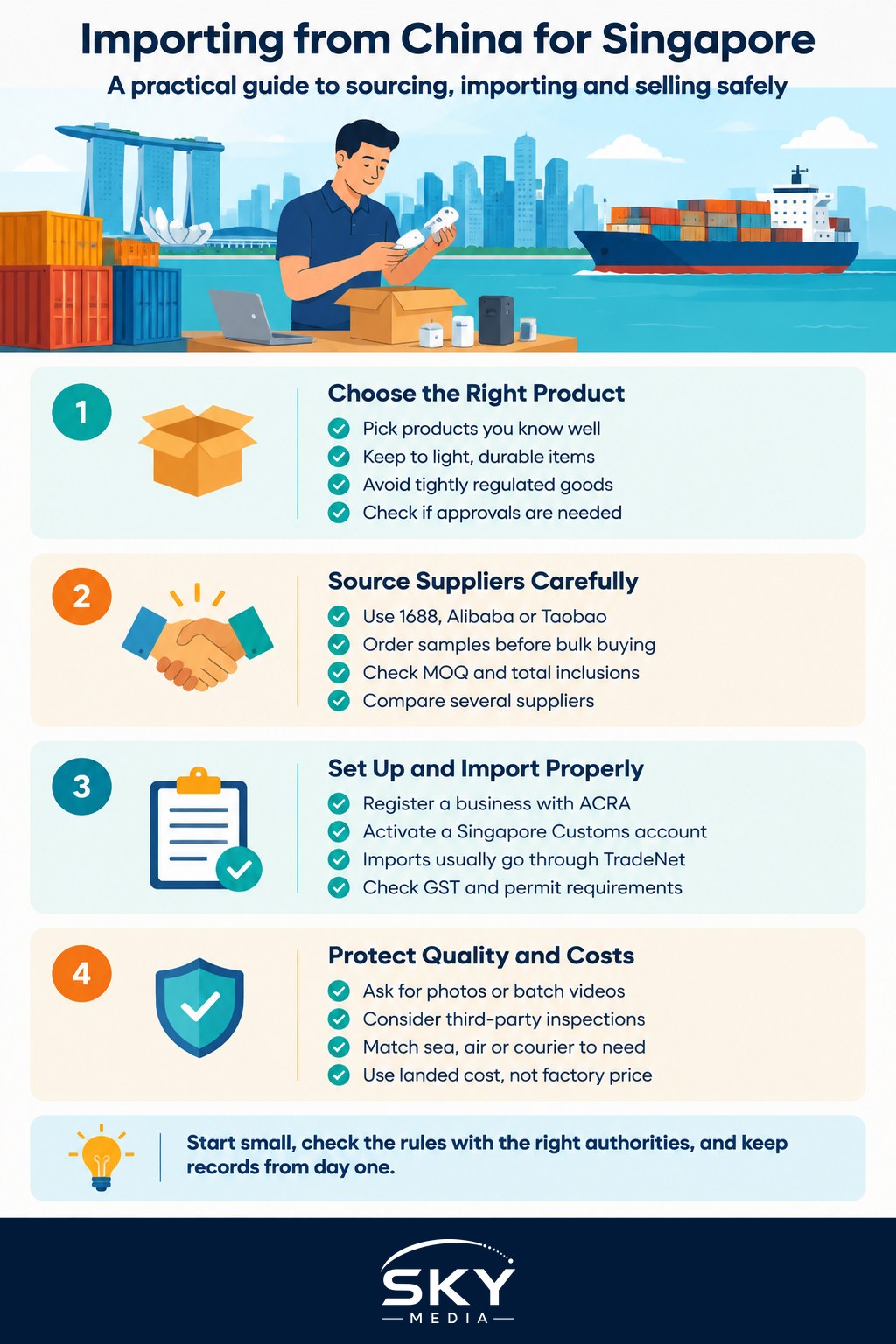
Start with the product, not the platform. The best first products are things you understand, that are light and durable enough to ship affordably, and that are not tightly regulated. Avoid stepping straight into categories such as food, cosmetics, health products, electrical goods, or anything safety-related, because these can carry extra approval requirements from Singapore’s competent authorities.
For finding suppliers, mainland founders often have the edge. Platforms such as 1688, Alibaba, and Taobao, along with trade contacts back home, give you direct factory access that competitors sourcing in English rarely match. A few habits protect you:
- Order samples first. Never buy a bulk lot from photographs alone.
- Check the minimum order quantity, or MOQ, and whether it fits a cautious first run.
- Compare several suppliers rather than committing to the first responsive one.
- Confirm exactly what the price includes, since packaging, tooling, or export handling may be extra.
Treat your first order as a paid experiment. It is better to lose a little on a small trial than to fill a storeroom with stock you cannot move.
Getting Your Business Set Up Properly
Before you import to sell, you generally need a registered business in Singapore. The Accounting and Corporate Regulatory Authority (ACRA) is the body that registers businesses, whether you choose a sole proprietorship or a private limited company. As a foreigner, the structure you can register and the roles you can hold depend on your residency status and pass, so check ACRA’s current requirements, and if you are a foreign founder, look into whether you need local support to set the company up.
You will also need to activate a Customs Account with Singapore Customs before you can import commercially, and most goods move through the national TradeNet system, usually with the help of a freight forwarder or declaring agent. Getting registered correctly from the start keeps you on the right side of the rules and makes later steps, from opening a business bank account to claiming expenses, far simpler.
Importing: Customs, GST and Permits
This is where careful newcomers save themselves trouble. When goods enter Singapore, they are subject to the rules administered by Singapore Customs. Two ideas matter most.
First, Goods and Services Tax (GST) is generally payable on imports, calculated on the value of the goods plus certain costs. Rates and thresholds change over time, so do not rely on a figure a friend quoted; confirm the current position with Singapore Customs and the Inland Revenue Authority of Singapore (IRAS).
Second, some goods need permits or are controlled by a competent authority even if they seem ordinary. Import permits are declared through TradeNet, and certain categories are restricted or prohibited. Before you order, check whether your product is controlled, because discovering this after the shipment has left China is an expensive lesson.
A declaring agent or freight forwarder can handle the mechanics of the declaration for you, but the responsibility for compliance still sits with you as the importer, so understand the basics rather than outsourcing your understanding entirely.
Quality Control and Shipping From China
Distance is the hidden cost of sourcing abroad. You cannot inspect the goods in person, so build checks into the process. Ask for photographs or a video of the finished batch before it ships, and for larger orders consider a third-party inspection service in China. Agree clearly on what happens if items arrive damaged or wrong.
On shipping, sea freight is cheaper but slow, while air freight is fast but costly, and small parcels can go by courier. Match the method to the product’s value and how quickly you need it. Factor in the full landed cost, not just the factory price, when you decide whether a product can sell profitably here.
China Versus Singapore: What Changes When You Sell Here
Selling into the Singapore market is not the same as selling on a mainland platform. This comparison highlights the shifts that catch newcomers out.
| Aspect | Selling in mainland China | Selling in Singapore |
|---|---|---|
| Business registration | Local licence and platform rules | Register with ACRA |
| Import duties and tax | Domestic supply, no import step | GST generally payable on imports |
| Payments | WeChat Pay and Alipay dominant | PayNow, cards, local gateways |
| Consumer protection | Mainland consumer law | CASE and Singapore consumer rules |
| Marketplaces | Taobao, JD, Pinduoduo | Local and regional platforms |
The habits that worked at home do not all transfer. In particular, consumer expectations, returns culture, and the payment mix are different, so plan for the Singapore buyer rather than assuming your mainland playbook applies unchanged.
Costs and Compliance to Verify
Before you scale up, sit down and list the numbers you must confirm from official sources rather than estimate. That includes GST on imports and your GST obligations with IRAS, any permit or licensing needs for your specific product, and your business filing duties with ACRA. If you are advertising claims about a product, make sure they are honest and defensible, since misleading marketing can draw complaints through the Consumers Association of Singapore (CASE).
Keep clean records from day one: supplier invoices, shipping documents, permits, and sales. Good bookkeeping is not glamorous, but it turns a side hustle into a business you can grow, and it makes tax time painless. Start small, verify each rule with the right authority, and let the venture prove itself before you commit serious capital.
Explore more
Setting up the company correctly is the foundation of any import venture. If you are a foreigner incorporating here, read our companion guide on whether you need a local nominee director as a foreign founder. And when you travel to meet suppliers in person, our tips on planning your trip back to China from Singapore will help you make the journey count.
Frequently Asked Questions
Do I need a licence to sell imported products online in Singapore? You generally need to register the business with ACRA, and some products need permits or approvals from the relevant authority. Selling online does not remove these requirements. Confirm the rules for your product category before you order stock.
How much money do I need to start importing from China? There is no single figure. Budget for the products and minimum order, shipping, GST on imports, packaging, platform fees and marketing, with a buffer. Start with a small trial order rather than committing large capital before you know the product sells.
Should I sell through a local marketplace or my own website? Marketplaces give you ready traffic but charge fees and limit your control, while your own site gives control and costs effort to promote. Many beginners test on a marketplace first. Compare fees and rules before choosing.
How should I handle returns and refunds for customers in Singapore? Set a clear return policy before you sell, and state it on your listing. Local buyers expect honest descriptions and reasonable remedies for faulty goods. Check CASE’s guidance and the consumer rules, and factor return costs into your pricing.
Is dropshipping from China a good way to start? It reduces stock risk but brings long delivery times, quality you cannot check and thin margins. Customs rules and GST still apply, and you remain responsible to the customer. Order samples and test the delivery time yourself first.
Official sources: Enterprise Singapore
Further reading: How to Get a GS1 Barcode for Your Products in Singapore