
Launching a skincare line, importing a beauty brand or selling handmade soaps online sounds simple until you discover that cosmetics in Singapore are regulated. Before a cosmetic product can be sold here, the company responsible for it generally has to submit an HSA cosmetic product notification to the Health Sciences Authority (HSA), the national regulator for health products.
This guide explains the notification system from a seller’s point of view: who is responsible, what counts as a cosmetic, labelling, prohibited ingredients and the records you must keep. It is general information, not legal advice. HSA updates its requirements and fees from time to time, so always confirm the current rules on the HSA website before you launch.
How Singapore Regulates Cosmetics
Singapore regulates cosmetics under the Health Products Act and its cosmetic regulations, which follow the ASEAN Cosmetic Directive (ACD). The ACD is a harmonised framework shared by ASEAN member countries, covering what a cosmetic is, which ingredients are banned or restricted, and how products must be labelled.
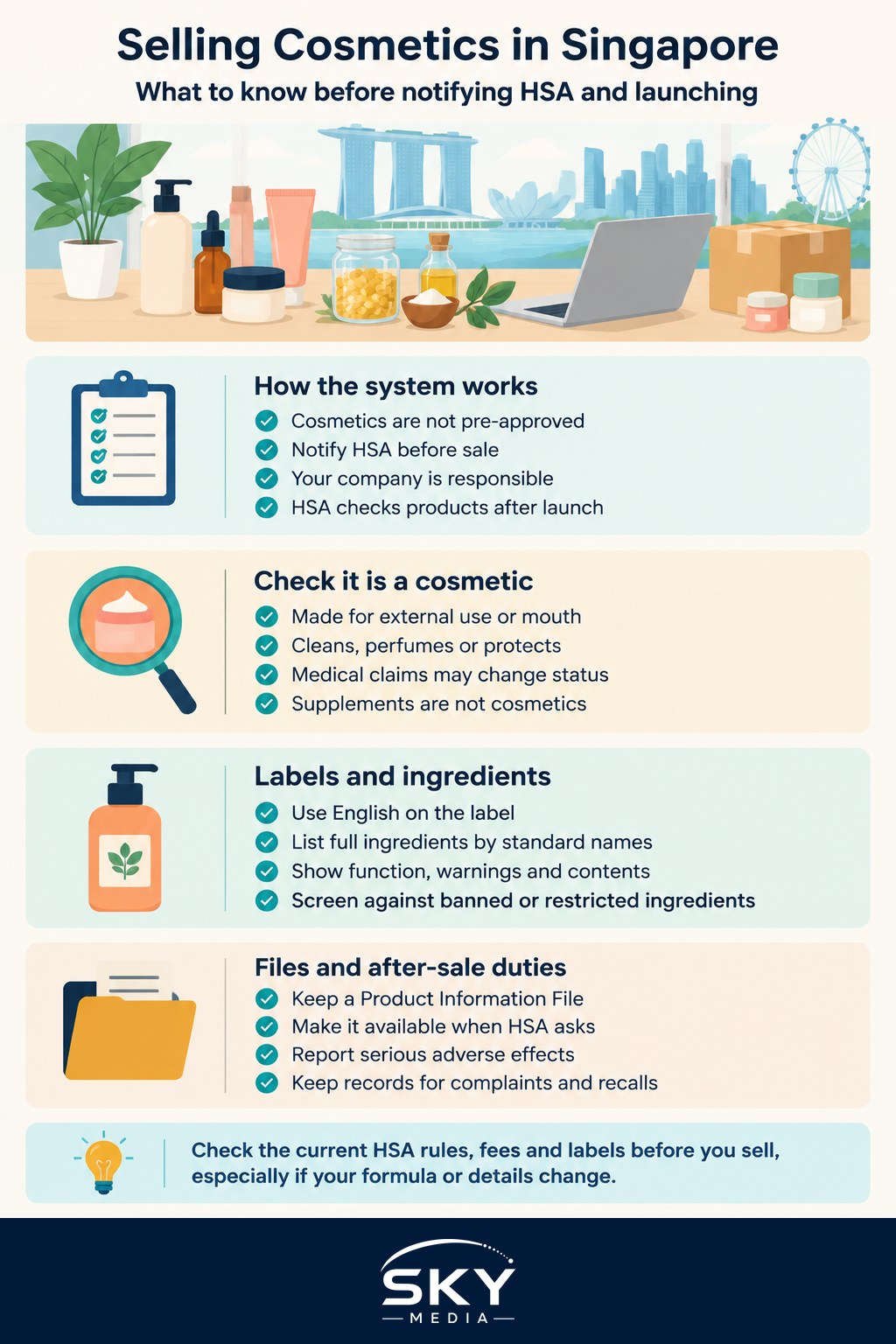
The key idea is that cosmetics are not pre-approved by HSA. Instead, the system works on notification and responsibility:
- The company placing the product on the Singapore market notifies HSA before sale.
- That company is responsible for making sure the product is safe and complies with the rules.
- HSA carries out post-market checks, such as testing products and acting on complaints, and can order recalls or take enforcement action.
An acknowledgement of your notification is not an endorsement or approval of the product. You should not market it as “HSA approved”.
Is Your Product a Cosmetic at All?
Before notifying, check that your product is actually a cosmetic. Broadly, a cosmetic is a product applied to external parts of the body (skin, hair, nails, lips, external genitals) or teeth and mouth, mainly to clean, perfume, change the appearance, protect or keep them in good condition.
Typical cosmetics include cleansers, moisturisers, make-up, shampoos, deodorants, perfumes, toothpaste and nail polish. The grey areas are where sellers get into trouble:
- Claims matter. A cream that “moisturises” is a cosmetic. One claiming to “treat eczema”, “cure acne” or “heal wounds” makes a medical claim and may be regulated differently, for example as a medicine.
- Some product types fall under other rules, such as certain medicated products or products containing ingredients controlled as medicines.
- Supplements and ingestibles are not cosmetics, even if marketed for “beauty from within”.
If you are unsure how your product is classified, check HSA’s guidance or contact HSA before you sell.
Who Notifies and How the Process Works
The notification is submitted by the company responsible for placing the product on the market in Singapore, typically the local manufacturer, importer or distributor. In practice this is a company registered in Singapore with the Accounting and Corporate Regulatory Authority (ACRA), and submissions are made online through HSA’s system using the company’s Corppass (the government login for businesses).
| Step | What you do | What to watch |
|---|---|---|
| 1. Classify | Confirm the product is a cosmetic, not a medicine or other health product | Avoid treatment or medical claims |
| 2. Check ingredients | Screen the full formula against the ACD annexes | Banned substances, restricted limits, permitted colours and preservatives |
| 3. Prepare labels | Draft labels that meet ACD and HSA requirements | English labelling and the full ingredient list |
| 4. Build the product file | Assemble the Product Information File (PIF) | It must be available when HSA asks |
| 5. Submit notification | Notify HSA online and pay the applicable fee | One notification per product as HSA defines it |
| 6. Sell and monitor | Keep records and track complaints | Report serious adverse effects and act on recalls |
A few practical points:
- Notify before sale, including online sales, pop-up markets and social media shops.
- Variants such as shades or scents may be grouped or need separate notifications depending on HSA’s rules, so check how your range should be submitted.
- Changes to the formula, product name or company details may require you to update or resubmit the notification.
- Fees apply and can change. Check the current schedule on the HSA website rather than relying on old figures.
Labelling Rules Sellers Commonly Miss
Labels are one of the most common reasons products fall foul of the rules. Under the ACD framework, labels generally need to show information such as:
- Product name and its function, unless obvious from the presentation
- Instructions for use and any special precautions or warnings
- Full ingredient list using standard ingredient names
- Country of manufacture
- Name and address of the company responsible in Singapore
- Net contents by weight or volume
- Manufacturer’s batch number
- Date of manufacture or expiry, as required for the product’s shelf life
Labels should be in English, though other languages can appear alongside. If the container is too small to carry everything, some information may go on outer packaging or an insert, following the rules. Do not use misleading claims, such as implying a product is a medicine or using “chemical-free” in a way that misleads consumers. Check HSA’s labelling guidance for the full, current list.
Prohibited and Restricted Ingredients
The ACD annexes list substances that are prohibited in cosmetics and those allowed only with restrictions, such as maximum concentrations, permitted product types or required warnings. There are also positive lists for colourants, preservatives and UV filters.
For sellers, this means:
- Get the full formula from your manufacturer, including fragrance components where relevant, and screen it against the current annexes.
- Beware of imported products made for other markets. A product legal elsewhere may contain an ingredient that is banned or restricted here.
- Watch for undeclared adulterants. HSA has issued public alerts over the years about cosmetics, especially some whitening creams, found to contain banned substances like mercury or undeclared medicinal ingredients. As the company responsible, you carry the liability even if your supplier misled you.
- Consider lab testing for higher-risk categories, and keep certificates of analysis from suppliers.
Annex lists are updated periodically, so a formula that complied when you launched may need review later.
The Product Information File and After-Sale Duties
You must keep a Product Information File (PIF) for each product and make it available if HSA requests it. A PIF typically includes the formula, manufacturing details, safety assessment, evidence for claims, and specifications. Many small brands rely on their manufacturer to supply much of this, so put that obligation in your supply contract.
After launch, your duties continue:
- Adverse effects: report serious adverse reactions to HSA as required and keep records of consumer complaints.
- Recalls: have a plan to trace batches and pull products quickly if needed.
- Records: keep sales and distribution records so you know where each batch went.
Customers increasingly check safety themselves, so it helps to understand how they look up products. See our guide on how to check if a cosmetic product is safe in Singapore, and if you are positioning your range as eco-friendly, our piece on sustainable home products in Singapore covers how consumers weigh green claims.
Before You Launch: A Quick Checklist
- Company registered with ACRA and Corppass access ready
- Product confirmed as a cosmetic, with no medical claims
- Formula screened against the current ACD annexes
- Compliant English labels drafted and checked
- PIF assembled and supplier obligations in writing
- Notification submitted and acknowledged before the first sale
Rules, forms and fees can change, so treat this as a starting point and confirm every detail with HSA directly. For complex products or claims, consider speaking to a regulatory consultant or lawyer before you invest in stock.
Official sources: Health Sciences Authority (HSA)
Further reading: Selling Health Supplements in Singapore: HSA Rules for Retailers and Online Sellers · How to Get a GS1 Barcode for Your Products in Singapore · Registering a Medical Device With HSA Before Selling It in Singapore