
If you sell physical goods online in Singapore, whether through your own website, Shopee, Lazada, Carousell or a social media shop, you are treated as a supplier under the country’s product safety rules. Many small sellers know that electrical items need a Safety Mark, but fewer realise that general consumer goods such as toys, baby products, kitchenware and furniture also carry legal safety obligations. This guide explains consumer product safety for online sellers: what the general rules are, who enforces them, and what to do if something goes wrong.
This is general information, not legal advice. Rules and lists of regulated products are updated from time to time, so confirm the current requirements with Enterprise Singapore’s Consumer Product Safety Office before you list or import goods.
Who Regulates Consumer Product Safety in Singapore
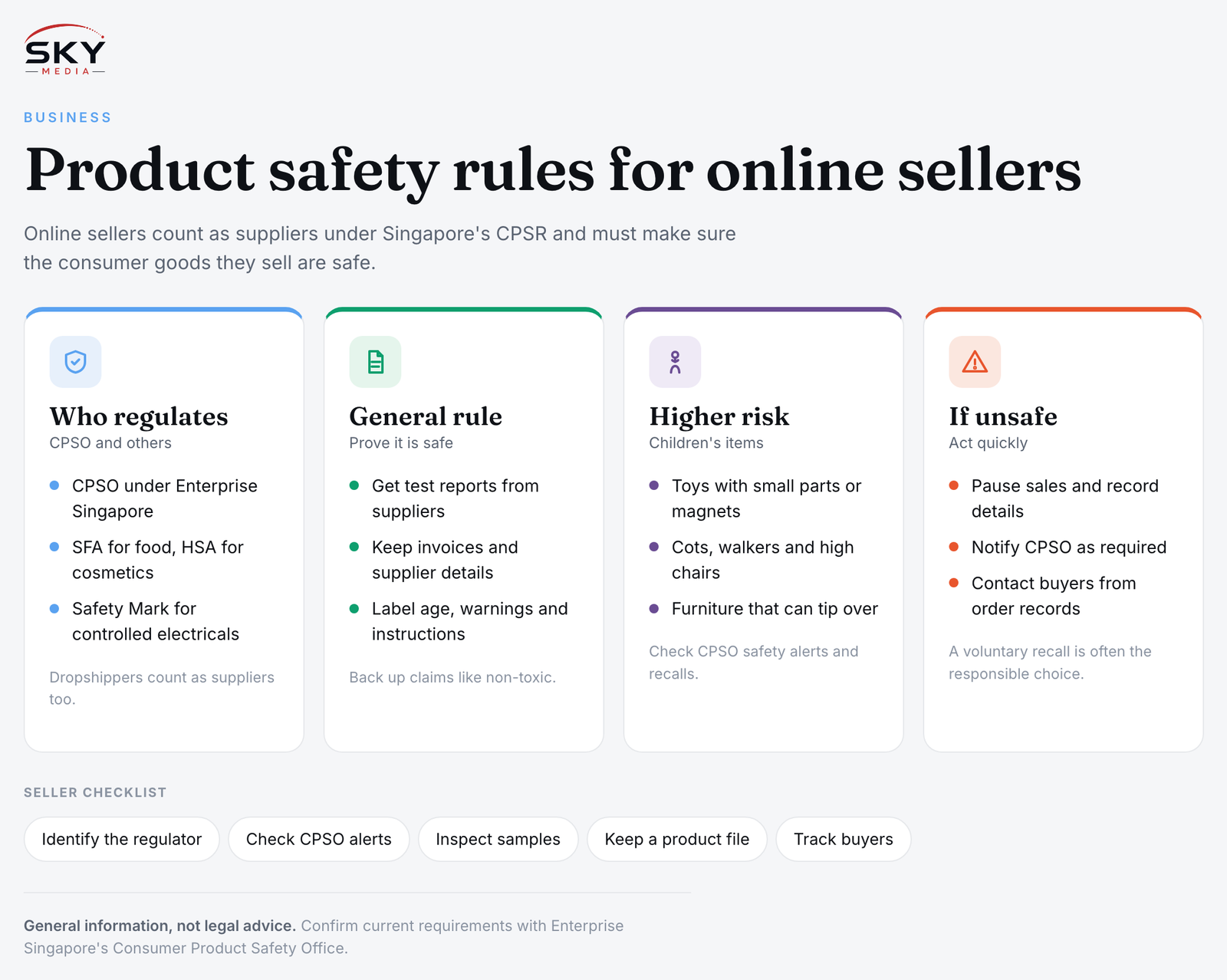
The main framework for general consumer goods is the Consumer Protection (Safety Requirements) Regulations, often shortened to CPSR. It is administered by the Consumer Product Safety Office (CPSO), which sits under Enterprise Singapore.
The CPSR covers a broad range of consumer goods meant for household or personal use. Some product types have their own regulators instead, so it helps to know where your goods fall:
- Food and food contact rules are generally handled by the Singapore Food Agency (SFA).
- Cosmetics, health supplements and medicines fall under the Health Sciences Authority (HSA).
- Pet food and animal products may involve the Animal and Veterinary Service (AVS) under NParks.
- Controlled electrical, electronic and gas goods need registration and a Safety Mark under a separate scheme, covered in our guide to Safety Mark registration for electrical products.
Everything else that is a general consumer product, from children’s toys to bicycles and stationery, is likely to sit under the CPSR’s general safety requirement.
The General Safety Requirement Explained
The core idea of the CPSR is simple: suppliers must ensure that the consumer goods they supply are safe. In practice, CPSO generally expects products to meet relevant international, regional or national safety standards where these exist. For example, toys are commonly tested against well-known international toy safety standards that cover sharp edges, small parts, flammability and chemical content.
“Supplier” is a wide term. It can include manufacturers, importers, distributors and retailers, including online sellers who never physically handle the goods because they use dropshipping. If you put a product into the hands of Singapore consumers, assume the obligation applies to you.
What this means for an online seller:
- Know your source. Buy from manufacturers or wholesalers who can provide test reports or certificates against recognised safety standards.
- Keep documents. Store test reports, invoices and supplier details in case CPSO asks for evidence that your products are safe.
- Label clearly. Provide age grading, warnings, instructions for use and assembly, and any choking hazard notices that the standard requires, in English.
- Read the listing as a regulator would. Claims such as “non-toxic” or “baby safe” should be backed by evidence, not copied from a supplier’s catalogue.
Higher Risk Products: Toys, Baby Goods and Children’s Items
CPSO pays particular attention to products used by young children, because small parts, loose magnets, button batteries, cords and unstable furniture can cause serious injuries. Categories that sellers should treat with extra care include:
- Toys, especially those with small detachable parts, small high-powered magnets or button cell batteries
- Childcare articles such as cots, baby walkers, high chairs, prams and bath seats
- Children’s clothing with drawstrings around the hood or neck
- Furniture that can tip over, such as tall chests of drawers and TV stands
- Novelty products that look like food but are not, which children may try to eat
From time to time, CPSO may publish safety alerts or require specific products or designs to be withdrawn from sale. Some product types may be prohibited outright where they are judged too dangerous. Because these lists change, check the CPSO website for current safety alerts, recalls and any prohibited product lists before you source a new product line.
What Happens When a Product Is Unsafe
If a product you sell turns out to be unsafe, you have obligations beyond simply removing the listing. CPSO can investigate, require suppliers to provide information, and direct them to stop supplying a product, notify buyers or carry out a recall.
| Situation | What it means for you | Sensible first step |
|---|---|---|
| You learn of an injury or near miss | Possible safety defect in your product | Pause sales, record details and notify CPSO as required |
| CPSO issues a safety alert on your product type | Your stock may fall within the alert | Check model numbers and batches, contact your supplier |
| You are directed to recall a product | You must stop supply and help bring units back | Contact buyers using your order records and follow CPSO’s directions |
| A customer complains of a minor issue | May be a quality rather than safety problem | Handle under your returns policy and keep a record in case of a pattern |
A voluntary recall, where you act before being told to, is often the most responsible choice when you discover a genuine hazard. Online sellers are in a good position here because order records give you direct contact with buyers. Keep those records organised so you can reach every affected customer quickly.
Penalties can apply for breaching the CPSR. Rather than estimate them, check the current regulations and CPSO’s guidance, and speak to a lawyer if you face an investigation.
Practical Compliance Checklist for Small Online Sellers
Before you list a new product:
- Identify the regulator. Is it food, a cosmetic, a controlled electrical item or a general consumer product?
- Check CPSO’s site for current safety alerts, recalls and any restricted or prohibited products in that category.
- Ask your supplier for test reports against a recognised safety standard, and check that the report matches the exact model you are buying.
- Inspect samples yourself. Look for loose small parts, sharp edges, strong chemical smells, missing labels or flimsy battery compartments.
- Write accurate listings with age grading, warnings and instructions. Avoid safety claims you cannot prove.
- Keep a product file with the supplier’s details, test reports, batch numbers and import documents.
- Track who bought what. Make sure you can contact buyers of each batch if a recall is ever needed.
- Set a response plan. Decide in advance who handles safety complaints and how quickly you will pause sales.
Marketplace Rules and Your Own Responsibility
Large e-commerce platforms usually have their own prohibited items lists and may remove listings that breach local laws. Some also cooperate with CPSO on safety alerts. Do not rely on the platform as your safety net, though. Platform checks are not a substitute for your obligations as a supplier, and an approved listing does not mean a product is compliant.
Sellers who build trust on safety tend to see fewer returns and better reviews. Shoppers increasingly know how to check if an online seller is legit, and clear safety information is part of what makes a shop look credible. For more on the marketplace side of running a shop, see our guide to buying and selling safely on online marketplaces.
Where to Get Official Guidance
The most reliable source is the Consumer Product Safety Office on the Enterprise Singapore website, which publishes the regulations, guidance for suppliers, safety alerts and recall notices. For cosmetics, the HSA website applies, and our guide on how to check if a cosmetic product is safe explains the consumer view. For food, check with the SFA.
If you import goods in larger volumes or sell products for young children, it is worth getting advice from a testing laboratory or a lawyer familiar with product safety before you launch. Building safety checks into your sourcing from day one is far cheaper than dealing with a recall later.
Official sources: Enterprise Singapore
Further reading: Selling Health Supplements in Singapore: HSA Rules for Retailers and Online Sellers · What the Consumer Protection (Fair Trading) Act Means for Singapore Retailers · Food Labelling Rules for Packaged Food Sold in Singapore