

When parents separate, one of the first worries is what will happen to the children. In Singapore family law, those arrangements are described using three terms that sound similar but mean quite different things: custody, care and control, and access. Understanding custody, care and control in Singapore helps you make sense of what a lawyer, mediator or judge is saying, and lets you focus your energy on what really matters, which is a stable life for your child.
This article is general information, not legal advice. Every family’s situation is different, and the rules and procedures can change. For your own case, speak to a family lawyer or check the Family Justice Courts website. If you or your children are unsafe, contact the police or seek help immediately.
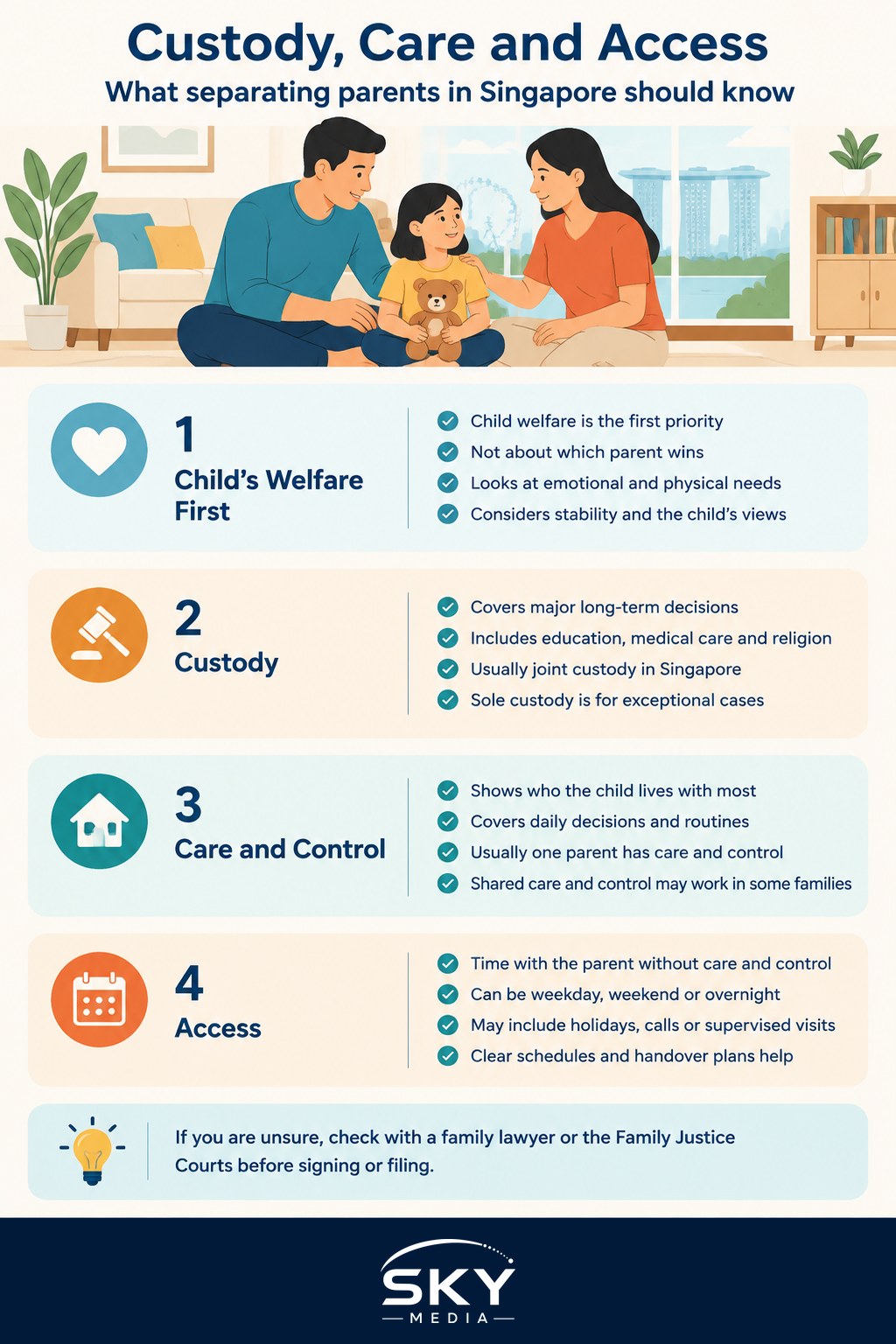
The Principle Behind Every Decision: The Child’s Welfare
Before looking at the three terms, it helps to know the principle that sits above them all. In Singapore, when the court decides any question about a child’s upbringing, the welfare of the child is the first and paramount consideration. It is not about which parent “wins”.
In practice this means the court looks at things like:
- the child’s emotional and physical needs
- who has been the main caregiver so far
- the child’s ties with each parent, siblings and extended family
- continuity of schooling, routine and home
- each parent’s ability to support the child’s relationship with the other parent
- the child’s own views, depending on age and maturity
Keeping this principle in mind makes the three concepts easier to understand, because each one is simply a way of organising a child’s life around their welfare.
What Each Term Means
The table below gives a quick side-by-side view.
| Term | What it covers | Common arrangement |
|---|---|---|
| Custody | The right to make major, long-term decisions about the child | Joint custody, where both parents decide together |
| Care and control | Which parent the child mainly lives with and who handles daily decisions | Sole care and control to one parent, or shared care and control |
| Access | Time the child spends with the parent who does not have care and control | Regular weekday, weekend, overnight and holiday time |
Custody: Big-Picture Decisions
Custody is about the important decisions in a child’s life, such as education, major medical treatment and religion. It is not about where the child lives.
The courts in Singapore generally favour joint custody, so that both parents stay involved in big decisions even after the marriage ends. Sole custody, where one parent decides alone, is usually reserved for exceptional situations, for example where one parent poses a risk to the child or where co-operation has broken down so badly that it harms the child. Joint custody means you are expected to consult and agree on major matters, not that you need permission for every small thing.
Care and Control: Daily Life
Care and control decides which parent the child lives with most of the time, and who makes day-to-day decisions such as meals, bedtimes, homework routines and which enrichment classes fit the week.
Usually one parent is given care and control, and the other parent has access. In some families, the court may order shared care and control, where the child spends substantial time living with each parent. Whether that works depends heavily on practical factors: how close the two homes are, how well the parents communicate, the child’s school location and the child’s temperament.
Access: Time With the Other Parent
Access is the time the child spends with the parent who does not have care and control. It recognises that children benefit from a meaningful relationship with both parents. Access can include:
- day access, such as weekday dinners or weekend outings
- overnight access, where the child stays at the other parent’s home
- holiday access, splitting school holidays, Chinese New Year, Hari Raya, Deepavali, Christmas or birthdays
- virtual access, such as video calls on agreed evenings
- supervised access, where a trained third party or centre is present, used where there are safety or bonding concerns
Access arrangements can be very detailed. A clear schedule, including handover times and places, reduces arguments later.
How Parents Reach These Arrangements
Many separating parents agree on arrangements themselves, often with help, and the court then records the agreement in an order. Where parents cannot agree, the court decides.
Along the way, parents may come across:
- Parenting programmes. Parents with children below a certain age who are filing for divorce and have not agreed on all matters may be required to attend a parenting programme before filing. Check current requirements with the Family Justice Courts or the Ministry of Social and Family Development (MSF).
- Mediation and counselling. The Family Justice Courts encourage parents to resolve children’s issues through mediation and counselling rather than a contested hearing. Many parents find this less stressful and more flexible.
- Divorce support agencies. MSF-appointed agencies and Family Service Centres offer counselling, co-parenting support and, in some cases, supervised access and exchange services.
- Child-focused professionals. In some cases the court may involve a child representative or ask for reports from social workers or psychologists to understand the child’s needs.
If you are moving between countries, the issues become more complex. Our guide to cross-border child custody between China and Singapore looks at that specific situation.
Writing a Practical Parenting Plan
Whatever the legal label, the day-to-day reality is what your child will feel. A written parenting plan helps both parents know what to expect. Consider including:
- Weekly schedule. Which nights the child spends where, and handover times and locations.
- School and enrichment. Who handles pick-ups, homework, parent-teacher meetings and class fees.
- Holidays and festivals. How you share school holidays and celebrations, alternating each year if helpful.
- Communication. How parents will talk to each other, for example a shared calendar app, and how the child keeps in touch with the other parent.
- Travel. How much notice is needed for overseas trips, and handling of passports.
- Changes. How you will review the plan as the child grows, starts primary school or enters secondary school.
- Money. Maintenance is a separate legal issue, but agreeing how everyday costs are shared reduces friction.
Keep the plan child-centred. Avoid discussing disputes in front of children, and never ask a child to pass messages or choose sides.
Supporting Your Child Through the Change
Legal terms aside, children often cope best when they have routine, honesty suited to their age, and reassurance that both parents still love them.
- Tell children together, if possible, using simple language.
- Keep school, friends and routines as stable as you can.
- Expect some changes in behaviour, sleep or schoolwork, and be patient.
- Let the school counsellor or form teacher know, so they can look out for your child.
- Seek professional help, such as a counsellor or psychologist, if your child seems persistently anxious, withdrawn or distressed.
Looking after yourself also matters. Our guide to recharging and self-care for parents has practical ideas for stressful seasons. If you need time off for children’s needs during this period, it may also help to read up on childcare and parent-care leave.
Key Points to Remember
Custody covers major decisions and is usually joint. Care and control covers where the child lives and daily decisions. Access is the time the child spends with the other parent. All three revolve around the child’s welfare. Arrangements can be agreed by parents or decided by the court, and they can be varied later if circumstances change significantly. Before you sign anything or file papers, get advice from a family lawyer or the Family Justice Courts so you understand exactly how these terms apply to your family.
Official sources: Singapore Courts
Further reading: Child Maintenance in Singapore: How It Is Decided and Enforced