

Understanding the stages of dementia helps families plan ahead instead of reacting to each crisis as it comes. Dementia is a progressive condition, which means changes in memory, thinking and daily abilities usually build up over time. Knowing roughly what lies ahead lets you make decisions while your loved one can still take part, arrange the right help at the right point, and look after your own wellbeing as a caregiver.
This guide describes the changes commonly seen in the early, middle and late stages, and the care needs that tend to go with each. It is general information, not medical advice. Every person’s journey is different, and a doctor or memory clinic is the right place to discuss diagnosis, treatment and what to expect in a specific case.
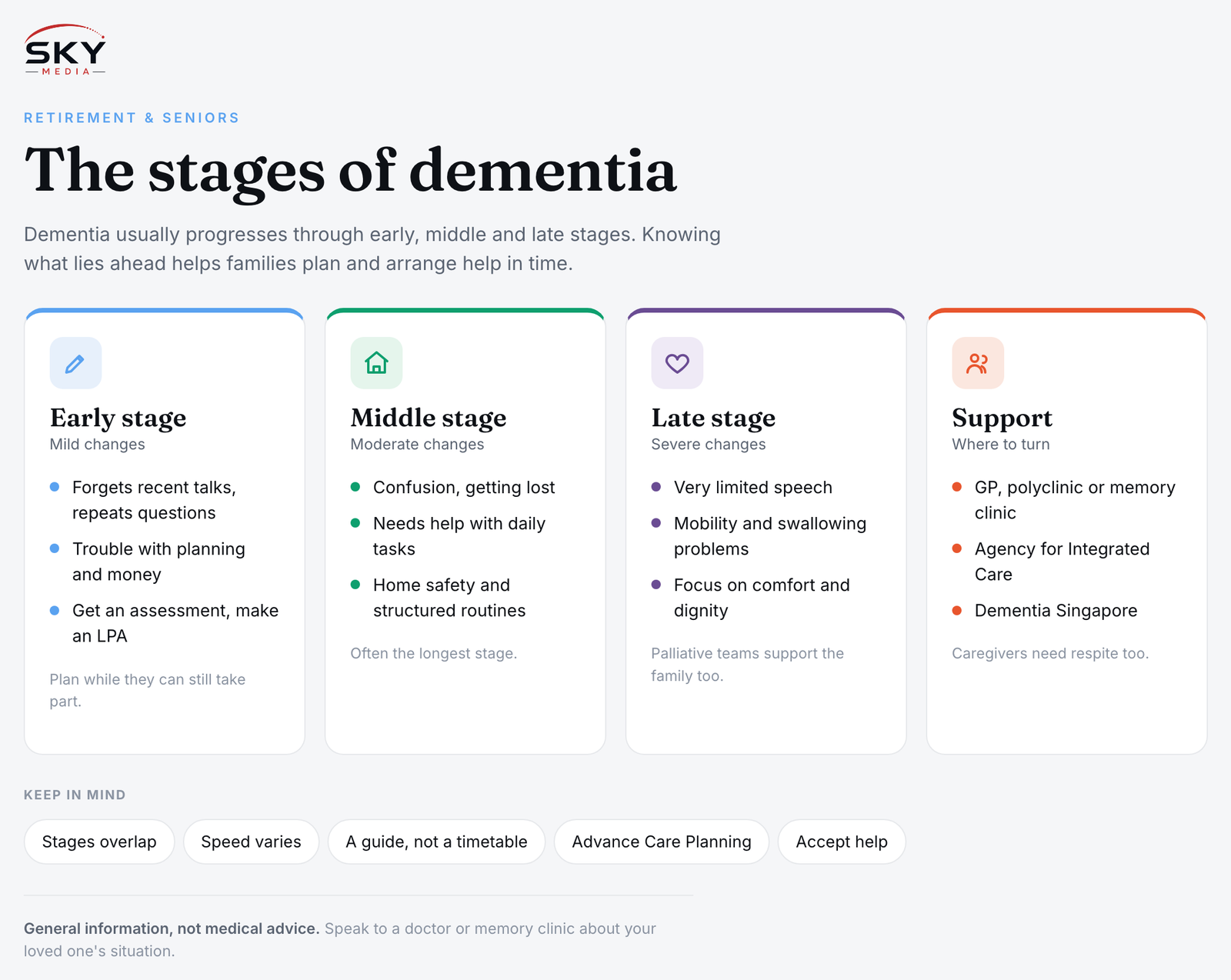
Why Dementia Is Described in Stages
Dementia is an umbrella term for conditions that affect the brain, such as Alzheimer’s disease and vascular dementia. Doctors and care organisations often describe its course in three broad stages: early (mild), middle (moderate) and late (severe). Some clinical scales use more detailed steps, but the three-stage view is the easiest way for families to plan.
A few points are worth keeping in mind:
- Stages overlap. A person may show signs from two stages at once, and abilities can vary from day to day.
- Speed varies widely. Some people change slowly over many years, others more quickly. The type of dementia, other health conditions and support all play a part.
- Stages are a guide, not a timetable. They help you prepare, not predict exact dates.
Before a diagnosis, some people go through a phase of mild memory changes that do not yet affect daily life much. Our guide on mild cognitive impairment explains how this differs from normal ageing and early dementia.
Early Stage Dementia: Changes and Care Needs
In the early stage, a person can usually still live fairly independently. The changes may be subtle and are sometimes mistaken for stress or ageing.
Common signs include:
- Forgetting recent conversations or appointments, and repeating questions
- Difficulty finding the right word or following a complex discussion
- Trouble with planning, managing money or handling new tasks
- Misplacing items more often
- Mood changes such as anxiety, irritability or withdrawal from activities
Care focus in this stage:
- Get a proper assessment. Start with a GP or polyclinic doctor, who can refer to a memory clinic at a hospital if needed. Some causes of memory problems are treatable, so a check is always worthwhile.
- Plan legal and financial matters. This is the best time to make a Lasting Power of Attorney (LPA) through the Office of the Public Guardian, and to have Advance Care Planning conversations about future care preferences. These decisions need the person’s own mental capacity.
- Support independence. Use calendars, pill organisers, phone reminders and simple routines. Let the person do as much as they can.
- Stay active and social. Regular exercise, hobbies and community activities help wellbeing.
Middle Stage Dementia: Changes and Care Needs
The middle stage is often the longest. Changes become more obvious, and the person needs more day-to-day help.
Common signs include:
- Greater memory loss, including forgetting personal history or familiar people at times
- Confusion about time and place, and getting lost in familiar areas
- Needing help with dressing, bathing, toileting and meals
- Changes in sleep, including restlessness at night
- Behaviour changes such as agitation, suspicion, wandering or repeating actions
Many families notice increased confusion or agitation in the late afternoon and evening. Our guide on sundowning in dementia covers practical ways to manage this at home.
Care focus in this stage:
- Safety at home. Remove trip hazards, add grab bars, consider stove safety measures and keep medicines secured. If wandering is a risk, keep a recent photo and identification on hand.
- Structured routines. Regular times for meals, activities and rest reduce confusion and distress.
- Communication. Use short sentences, one question at a time, and a calm tone. Avoid arguing about facts; respond to the feeling behind the words.
- Extra support. Dementia day care centres, home care services and caregiver training can ease the load. The Agency for Integrated Care (AIC) can guide you to services and any schemes or grants you may be eligible for.
- Caregiver health. This stage is demanding. Arrange respite, share tasks among family and seek support groups early.
Late Stage Dementia: Changes and Care Needs
In the late stage, the person needs help with almost every aspect of daily life. Communication becomes very limited, and physical abilities decline.
Common signs include:
- Very limited speech, though the person may still respond to voice, touch and music
- Difficulty walking, sitting up or eventually moving without help
- Problems with swallowing, which can affect eating and drinking
- Greater risk of infections, falls and pressure sores
- Loss of bladder and bowel control
Care focus in this stage:
- Comfort and dignity. Gentle touch, familiar music, a calm environment and good personal care matter greatly.
- Specialist input. Doctors, nurses, speech therapists and dietitians can advise on swallowing, nutrition, skin care and positioning. Follow their guidance rather than adjusting feeding or medication on your own.
- Care setting decisions. Families may need to consider home nursing, a nursing home or palliative care services. Revisit any Advance Care Plan made earlier.
- Palliative support. Palliative and hospice teams focus on comfort and can support both the person and family.
Comparing the Stages at a Glance
| Stage | Typical changes | Main care focus |
|---|---|---|
| Early (mild) | Short-term memory lapses, word-finding trouble, difficulty with planning | Diagnosis, LPA and care planning, supporting independence |
| Middle (moderate) | More confusion, needs help with daily tasks, behaviour and sleep changes | Home safety, routines, day care, caregiver respite |
| Late (severe) | Very limited speech, mobility loss, swallowing problems | Comfort, specialist nursing input, palliative care |
Where Families in Singapore Can Find Support
You do not have to manage alone at any stage. Useful starting points include:
- Your GP, polyclinic or memory clinic for diagnosis, medication reviews and referrals
- The Agency for Integrated Care (AIC) for information on eldercare services, day care, home care, nursing homes and financial support schemes
- Dementia Singapore for caregiver training, support groups and helplines
- HealthHub and the Ministry of Health for reliable health information
Schemes, eligibility criteria and service options change, so check the latest details with AIC or the relevant agency. For a fuller look at services, see our guides on dementia care in Singapore and dementia and caregiver support.
Above all, look after yourself as well. Caring for someone through the stages of dementia is a long journey, and accepting help is a strength, not a failure.
Official sources: HealthHub
Further reading: How to Talk to a Parent With Dementia: Repeated Questions, Denial and Confusion · Vascular Dementia: Signs, Stroke Links and Care in Singapore · Lewy Body Dementia Explained for Singapore Families