

Most career advice compares small companies with big corporations. Yet many Singapore job seekers face a different choice: an offer from a young, venture-funded startup on one side and an offer from an established small or medium-sized enterprise (SME) on the other. Both are small, both expect you to wear several hats, and both look similar on paper. The startup vs SME job decision comes down to differences that are easy to miss in an interview.
This guide sets out how the two really differ, what to ask before you sign, and how to match the choice to your stage of life.
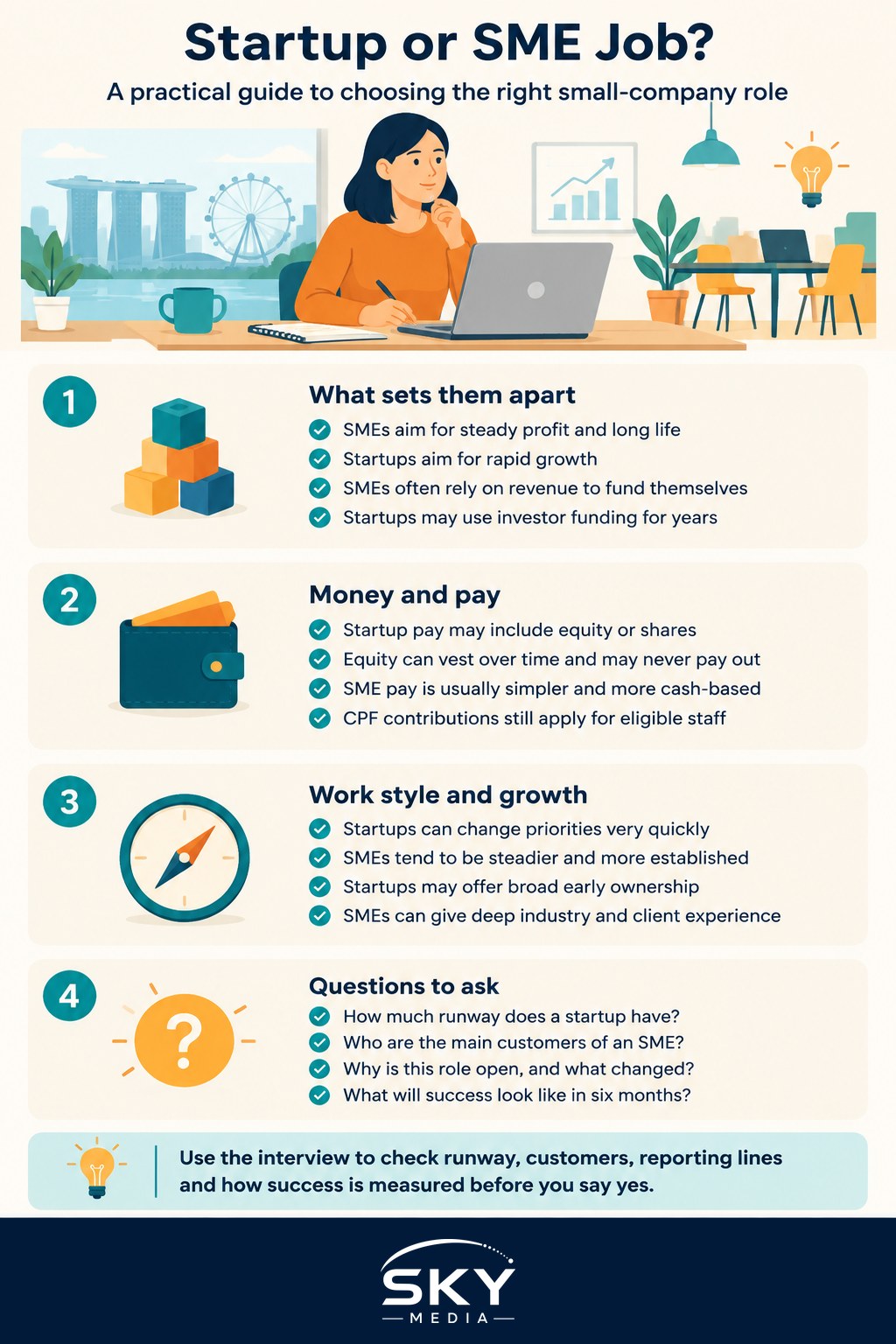
Startups and SMEs Are Not the Same Thing
It helps to be clear on the terms. In Singapore, an SME is generally a company below certain size limits for annual sales or headcount, as defined by Enterprise Singapore, the government agency that supports local businesses. Many SMEs are family-run firms that have traded for decades: a logistics company, a trading house, an engineering contractor, a chain of clinics or a regional distributor.
A startup is defined less by size and more by intent. It is a young company trying to find a business model that can grow very fast, often funded by investors who expect a large return. Many startups are technically SMEs by headcount, but they behave very differently.
The simplest way to think about it:
- An SME is usually built to be profitable and to last. Growth is steady, decisions are often made by the owner or a small management team, and the business funds itself from revenue.
- A startup is built to grow quickly. It may spend more than it earns for years, relying on rounds of investor funding, and it accepts a higher risk of failure in exchange for the chance of rapid growth.
How the Two Compare Day to Day
The table below compares the factors that most often decide this choice. Every company is different, so use it as a starting point for your own questions, not as a rule.
| Factor | Startup | SME |
|---|---|---|
| Stability | Depends on funding runway; layoffs can follow a missed fundraise | Often steadier, tied to existing customers and cash flow |
| Pay structure | Base salary may be lower, sometimes topped up with equity | Mostly cash, sometimes with a performance or year-end bonus |
| Pace of change | Fast; priorities and even products can shift monthly | Slower, with established ways of doing things |
| Learning | Broad exposure, new tools, high ownership early | Deep industry knowledge, client relationships, practical operations |
| Decision-making | Founders and a flat team, often data or investor driven | Owner or senior management, sometimes informal |
| Career signalling | Valued in tech and product circles | Valued within its industry and by regional partners |
Neither column is better. A person who wants to learn how a real trading business runs might grow more at an SME, while someone keen on product management in tech may find a startup the faster route.
Money: Salary, Equity and Hidden Trade-offs
Pay is where the two paths differ most, and where job seekers make the most mistakes.
At a startup, part of your package may be equity, such as stock options or shares that vest over time. Before you value equity at anything, ask:
- How many options or shares am I being offered, and what percentage of the company is that?
- What is the vesting schedule, and is there a cliff before anything vests?
- What happens to unvested and vested options if I leave?
- What would I need to pay to exercise the options, and are there tax consequences? Check with IRAS or a tax professional, as treatment depends on the scheme.
Many startups never reach an outcome where equity pays out, so treat it as a bonus, not as part of the salary you need to live on.
At an SME, the package is usually simpler, but check how bonuses are decided. Some SMEs pay a year-end bonus that depends on company results or the owner’s discretion. Ask how it has been paid in recent years rather than assuming.
In both cases, your employer must make CPF contributions for Singapore Citizens and Permanent Residents in line with CPF Board rules, so compare packages on the full picture, not just the headline salary. Our guide to comparing and choosing between job offers has a fuller checklist.
Culture, Workload and Growth
Both types of company are small enough that one manager can shape your whole experience. Look for these signals:
At a startup
- Long hours can be normal, especially around product launches or fundraising. Ask what a typical week looks like.
- Roles shift quickly. Your job title might change twice in a year, which is great for learning but can make your CV harder to read.
- Founders’ personalities shape everything. Meet as many of the leadership team as you can.
At an SME
- Processes may rely on a few long-serving staff. You can learn a lot from them, but change can be slow.
- Promotions may depend on the owner’s view and on openings at the top, which can be limited in a family-run firm.
- Training may be on the job rather than formal. Ask whether the company supports courses, including those eligible for SkillsFuture credit.
Questions to Ask Before You Accept
Use the interview to test the company, not only to sell yourself. Good questions include:
- For a startup: How much runway does the company have, and when is the next fundraise expected? Who are the investors?
- For an SME: How long has the business been running, and who are its main customers? Is it planning to expand, and how?
- For both: Why is this role open? What happened to the last person in it?
- For both: What would success look like in my first six months?
- For both: Who would I report to, and how often would we meet?
If a startup will not discuss its runway at all, or an SME cannot explain where its business comes from, treat that as a warning sign.
Matching the Choice to Your Situation
Your circumstances matter as much as the company. A few common patterns:
- Fresh graduates who can handle some risk often gain a lot from a startup’s breadth, while an SME can give a solid grounding in one industry.
- Mid-career switchers may find an SME values their past industry experience more, while a startup may value transferable skills and speed of learning.
- People with heavy financial commitments, such as a mortgage or supporting parents, should weigh stability seriously. Building a buffer helps whichever you pick, and our guide to managing your finances between jobs explains how.
If you are also weighing larger employers, read our comparison of startup vs corporate careers to see where they fit alongside these two paths.
There is no universally right answer. Pick the company whose risks you can live with and whose lessons you most want to learn, then reassess after a year or two. This article is general career information, not financial or tax advice, so confirm specific CPF and tax questions with CPF Board and IRAS.
Frequently Asked Questions
Is a startup job riskier than an SME job? Often, yes, because a startup depends on funding and may spend more than it earns, so layoffs can follow a missed fundraise. SMEs tend to be steadier but vary widely. Ask how much runway or how long-standing the customer base is.
How should I value startup stock options in a job offer? Treat them as a possible bonus, not as part of the salary you live on, since many startups never reach a payout. Ask about the vesting schedule, any cliff, what happens if you leave and the cost and tax of exercising.
Which looks better on a CV, a startup or an SME? Neither is automatically better. Startups are often valued in tech and product circles, while SME experience carries weight within its industry. Frequent title changes at a startup can make a CV harder to read, so explain your achievements clearly.
Can I use SkillsFuture credit for training if I join an SME? You can, since SkillsFuture credit belongs to you, not your employer. Some SMEs also support courses for staff. Ask in the interview what training is offered, and check eligible courses on the official SkillsFuture website.
What warning signs should I look out for during interviews? Be careful if a startup will not discuss its runway or an SME cannot explain where its business comes from. Vague answers on why the role is open or what happened to the last person are also worth probing.