
When you remarry with children in the picture, the wedding is not just about two people. It is the public start of a new family, and the children are part of that whether they are four or twenty-four. Thinking carefully about stepchildren in wedding planning can help them feel welcomed rather than sidelined, and can set a warm tone for the years ahead.
This guide focuses on the day itself: roles children can take, ways to include them in the ceremony, and the sensitivities that often come up. It is not a guide to blended family life in general, and every family is different, so take what fits and leave the rest.
Start With a Conversation, Not a Plan
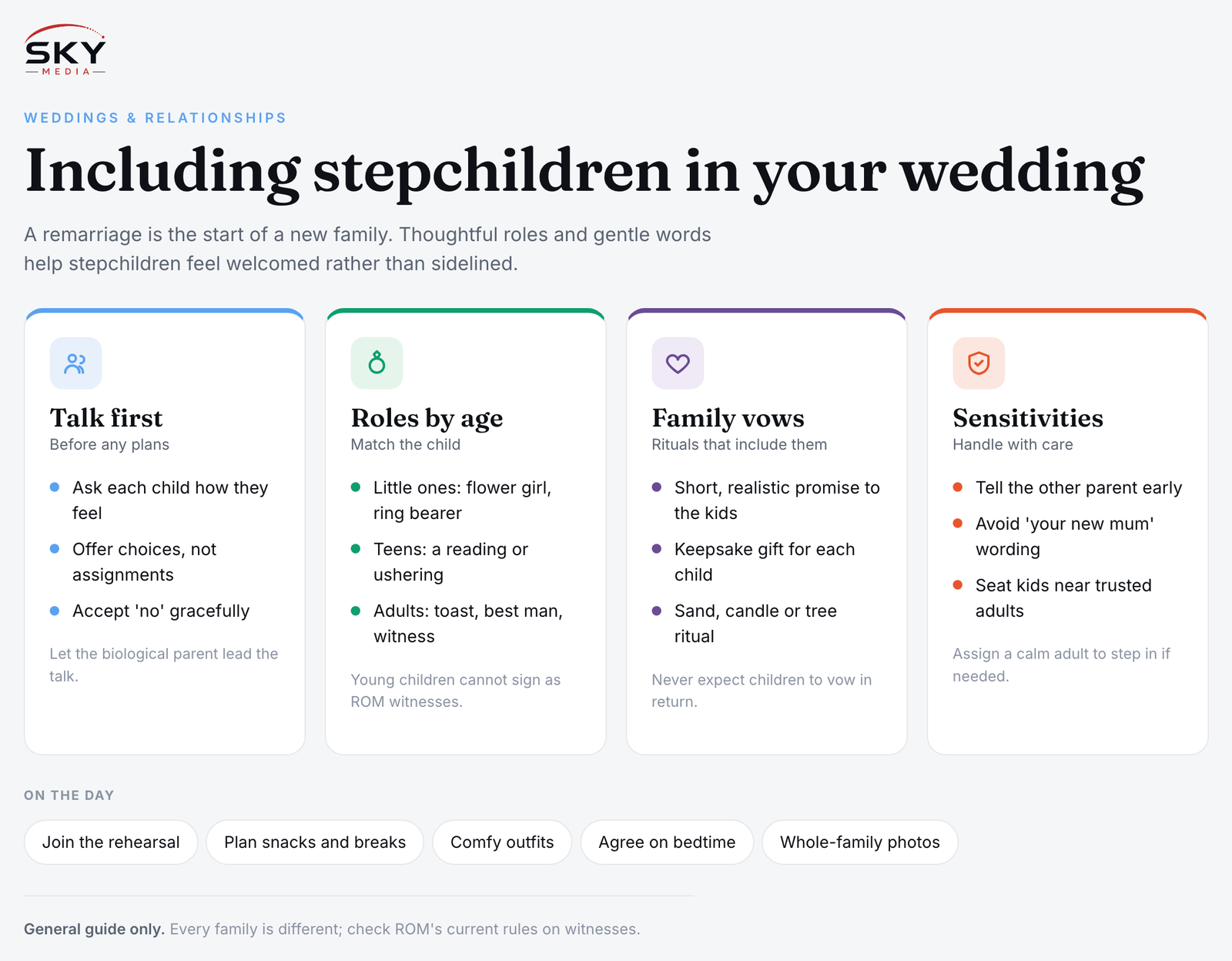
The most common mistake is deciding a child’s role and then announcing it. Children in blended families often have complicated feelings: excitement, loyalty to their other parent, grief over the old family, worry about where they fit. Being handed a basket of petals does not resolve any of that.
Before you plan anything, talk to each child separately, in an age-appropriate way:
- Ask how they feel about the wedding, and listen without correcting.
- Offer choices, not assignments. “Would you like to walk with us, do a reading, or help with the guest book?” gives them some control.
- Accept “no” gracefully. A teenager who would rather sit with grandparents is still part of the day. Pushing can turn a neutral child into a resentful one.
- Let the biological parent lead the conversation with their own children, with the step-parent joining once the child is comfortable.
If a child is struggling significantly with the remarriage, it may help to involve a family counsellor before the wedding, rather than hoping the day itself will fix things.
Meaningful Roles by Age
Roles work best when they match a child’s age, temperament and relationship with both partners. Here is a rough guide.
| Age group | Roles that often work | Things to keep in mind |
|---|---|---|
| Toddlers and preschoolers | Flower girl, ring bearer (with a replica ring), walking in with a parent | Keep it short, have a trusted adult on standby, and expect the unexpected |
| Primary school children | Junior bridesmaid or groomsman, handing out programmes, lighting a candle in a unity ritual | Rehearse once or twice, and give them a clear, simple job |
| Teenagers | Doing a reading, giving a short speech, walking a parent down the aisle, helping as an usher | Respect their comfort level with attention; never force a speech |
| Adult children | Best man or maid of honour, a toast at the banquet, a witness where eligible | Treat them as adults with their own views, and include their partners or children |
A note on official witnesses: at a Registry of Marriages (ROM) solemnisation, witnesses must meet ROM’s requirements, including a minimum age, so younger children cannot sign as legal witnesses. Check the current rules on the ROM website. Children can still stand beside you, and some couples hold a symbolic “signing” of a family certificate that the children add their names to.
Family Vows and Unity Rituals
Many couples now add a short moment in the ceremony that speaks directly to the children. This can be one of the most memorable parts of the day.
Family vows. After the couple’s vows, the step-parent (and sometimes the parent too) makes a short promise to the children. Keep it realistic and respectful. Promising to “be there, listen, and respect your relationship with your mum or dad” lands better than claiming to replace anyone. Older children may wish to say something in return, but it should never be expected.
Gifts or tokens. Some step-parents give each child a small keepsake during the ceremony, such as a necklace, bracelet, watch or engraved item, as a symbol of welcome.
Unity rituals. Common options include:
- A sand ceremony, where each family member pours coloured sand into a shared vessel
- A candle ceremony, with family members lighting a single candle together
- A family handshake or group hug at the end of the ceremony
- A shared tree planting in a pot, which can go home with you afterwards
Choose something that suits your family’s culture and faith. If you are holding a religious ceremony, check with your officiant what is appropriate.
Chinese Tea Ceremony and Other Customs
Many Singapore weddings include a tea ceremony, where the couple serves tea to elders and receives blessings. Customs vary a lot between families and dialect groups, so there is no single “correct” way to involve stepchildren. Some approaches families use:
- Children stand with the couple while tea is served, or help pass cups.
- Adult children may be served tea or offer tea depending on family seniority, which is worth discussing with the elders beforehand.
- Elders on both sides are briefed on the children’s place in the family so no one is caught off guard.
For couples marrying across cultures, our guide to intercultural weddings covers how to blend traditions from both sides, which applies to children’s roles too.
Handling the Other Parent and Extended Family
This is often the most delicate part. A few principles help:
- Inform the other parent early, especially if the children will need to be available on a particular date. Custody or access arrangements may affect the weekend you can choose, so check them before you book a venue.
- Never ask a child to keep the wedding a secret or to carry messages between adults.
- Avoid wording that erases a parent. Phrases like “your new mum” or “now you have a real family” can hurt. “Our family” or “you are part of this” is gentler.
- Think about seating. Children should sit near someone they are comfortable with, not alone at a head table. Grandparents from the other side of the family, if invited, deserve thoughtful placement too.
- Prepare for mixed emotions. A child may cry, withdraw or act up. Assign a calm adult the job of stepping in so the couple is not trying to manage it mid-ceremony.
At the banquet, be mindful that speeches mention all the children by name, and that photos include both “couple” shots and “whole family” shots. Brief your photographer with the children’s names and the combinations you want.
Practical Details on the Day
Small logistics make a big difference for younger children:
- Include them in the rehearsal. Our guide to the wedding rehearsal explains how it works; children benefit most from walking through it once.
- Plan breaks and food. Long banquets are hard on small children. A quiet corner with snacks, colouring books or a tablet helps.
- Dress them comfortably. Let older children have a say in their outfits so they feel like themselves.
- Agree on bedtime. Decide in advance who will take young children home if the evening runs late.
- Budget for them. Outfits, gifts and a babysitter all add up; our guide to who pays for what at a wedding can help you plan.
After the Wedding
The day is a beginning. Children often remember how they were treated in the weeks around the wedding more than the ceremony itself. Keep one-to-one time with each child, avoid big changes in routine immediately afterwards, and let the step-parent relationship develop at the child’s pace.
Including stepchildren well is less about perfect rituals and more about making each child feel seen. If they look back on the photos and remember being asked, listened to and welcomed, you have done it right.
Further reading: The Role of the Flower Girl and Ring Bearer