

When two lives start to merge, it is easy for one of them to quietly fade. You share a calendar, a group chat, maybe one day a BTO flat, and slowly the things that made you you can slip down the list. Keeping your identity in a relationship is not about holding back or keeping one foot out the door. It is about staying whole, so that the person your partner fell for is still there years from now, and so that you actually enjoy the life you are building.
This guide is for anyone who wants closeness without disappearing into it. You can be deeply committed and still be entirely yourself. In fact, that combination tends to make the relationship stronger, not weaker.
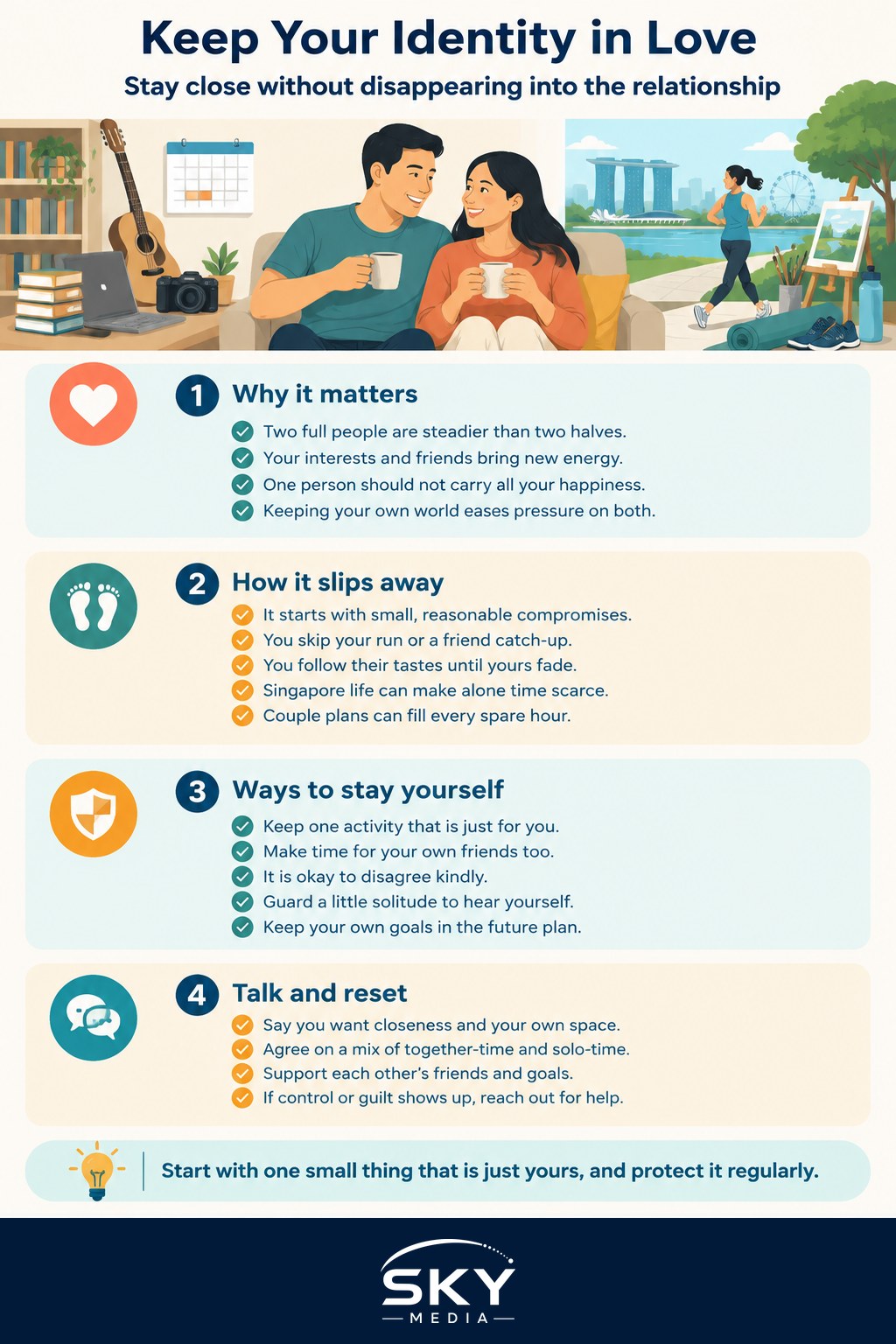
Why Your Sense of Self Matters to the Relationship
It can feel romantic to become a matching set, to do everything together and want the same things. Some of that is lovely. But a relationship made of two full people is steadier than one made of two halves. When you keep your own interests, friendships and opinions, you bring something back to the partnership: stories, energy, a point of view. You are interesting to each other because you are not identical.
There is a practical side too. Leaning your entire happiness, social life and self-worth on one person is a heavy load for any relationship to carry. If everything you enjoy depends on your partner being free, you will feel stuck whenever they are busy, tired or simply want a quiet night. Keeping some of your world your own takes that pressure off both of you. It also means that if a hard season comes, you are not left with nothing that is yours.
How Identity Quietly Slips Away
Losing yourself rarely happens in one big moment. It happens in small, reasonable-sounding steps. You skip the run because they are not in the mood. You stop seeing an old friend because plans as a couple are easier. You go along with their taste in food, films and weekends until you can no longer remember your own preferences. None of these choices is wrong on its own. Added up over a year, they can leave you wondering where you went.
In Singapore, a few pressures speed this up. Life moves fast, careers are demanding, and once a couple starts planning a flat and a future, the relationship can swallow every spare hour. Living with parents into adulthood means alone time is already scarce, so the little you have often defaults to your partner. Family and friends may start treating you as a unit, inviting and referring to you as one. All of this is normal. It just means you have to be a bit more deliberate about protecting the parts of life that are simply yours.
Small Ways to Stay Yourself
You do not need a dramatic gesture to keep your identity. You need a handful of steady habits that you actually keep.
- Protect one thing that is yours. A sport, a class, a craft, a faith community, a Saturday hobby. Keep at least one activity that is about you, not the couple.
- Hold on to your friendships. See your own friends without your partner sometimes. These people knew you first and help you stay grounded.
- Keep your own opinions. You are allowed to disagree about films, politics, food and how to spend a Sunday. Agreeing on everything is not intimacy, it is erasure.
- Guard a little solitude. Even a quiet MRT ride, a walk, or an hour with a book helps you hear your own thoughts again.
- Keep your own goals. Your studies, career hopes and personal plans still count. Build them into the shared future rather than dropping them into it.
The point is not to carve off a secret life. It is to make sure that the life you share is joined by two people who are still clearly themselves.
Togetherness Without Losing Yourself
Healthy closeness is not the enemy of identity. The two can sit side by side once you can tell the difference between merging and connecting. The table below shows how the same relationship can feel depending on which way it leans.
| Area | Losing yourself | Keeping your identity |
|---|---|---|
| Friends | You only socialise as a couple now | You keep your own friends and shared ones |
| Interests | You dropped your hobbies to match theirs | You keep at least one thing that is yours |
| Time | Every free hour is spent together | You value both together-time and solo-time |
| Opinions | You agree to avoid any friction | You can differ kindly and still feel close |
| Decisions | One person’s plans always win | Both futures are weighed and respected |
Notice that the right-hand column is not colder or more distant. It is warmer, because both people show up as themselves and choose each other on purpose, again and again.
Talking About It With Your Partner
If you have drifted from yourself, you can find your way back, and a good partner will want that for you. Raise it gently and without blame. You might say that you love your life together and also want to keep up a hobby or see a friend more often. Framed that way, it is not a complaint, it is you telling them how to help you stay happy. Most partners are relieved, because it gives them permission to keep a little of their own world too.
Then make it real by agreeing on a simple rhythm: a mix of together-time and solo-time, room for each person’s friends, and support for one another’s goals. Check in now and then, because needs shift when work, study or family circumstances change. Compromise runs both ways here, and small adjustments beat silent resentment every time.
There is a difference, though, between a relationship that has drifted and one that controls. If a partner discourages your friendships, mocks your interests, tracks your movements, or makes you feel guilty for any time apart, that is not closeness and it is not your fault. Everyone deserves to feel free and respected inside a relationship. If that is your experience and it worries you, please talk to a trusted friend or a counsellor, and reach out to a Family Service Centre or a support helpline if you feel unsafe.
For most couples, though, this is simply gentle maintenance. Stay curious about your own life, keep the people and pursuits that make you feel like yourself, and let your partner do the same. Two whole people, choosing to share a life, is about the best foundation there is.
Explore more
Keeping yourself and keeping the peace go together, so our guide to the art of compromise in relationships pairs well with this one. If busy schedules make solo-time feel selfish, see quality time in a busy relationship, and to keep your own circle strong, read the role of friendship in a relationship.