

If you have noticed small, firm, skin-coloured bumps clustered under your eyes that never seem to go away, you may be looking at syringomas. They are harmless, but many people find them bothersome, especially when concealer sits awkwardly over them. This guide explains what syringomas are, how syringoma removal is usually done in Singapore, what recovery looks like, and why patience matters because they can come back.
This is general information, not medical advice. Only a doctor who examines your skin can confirm what the bumps are and which treatment suits you.
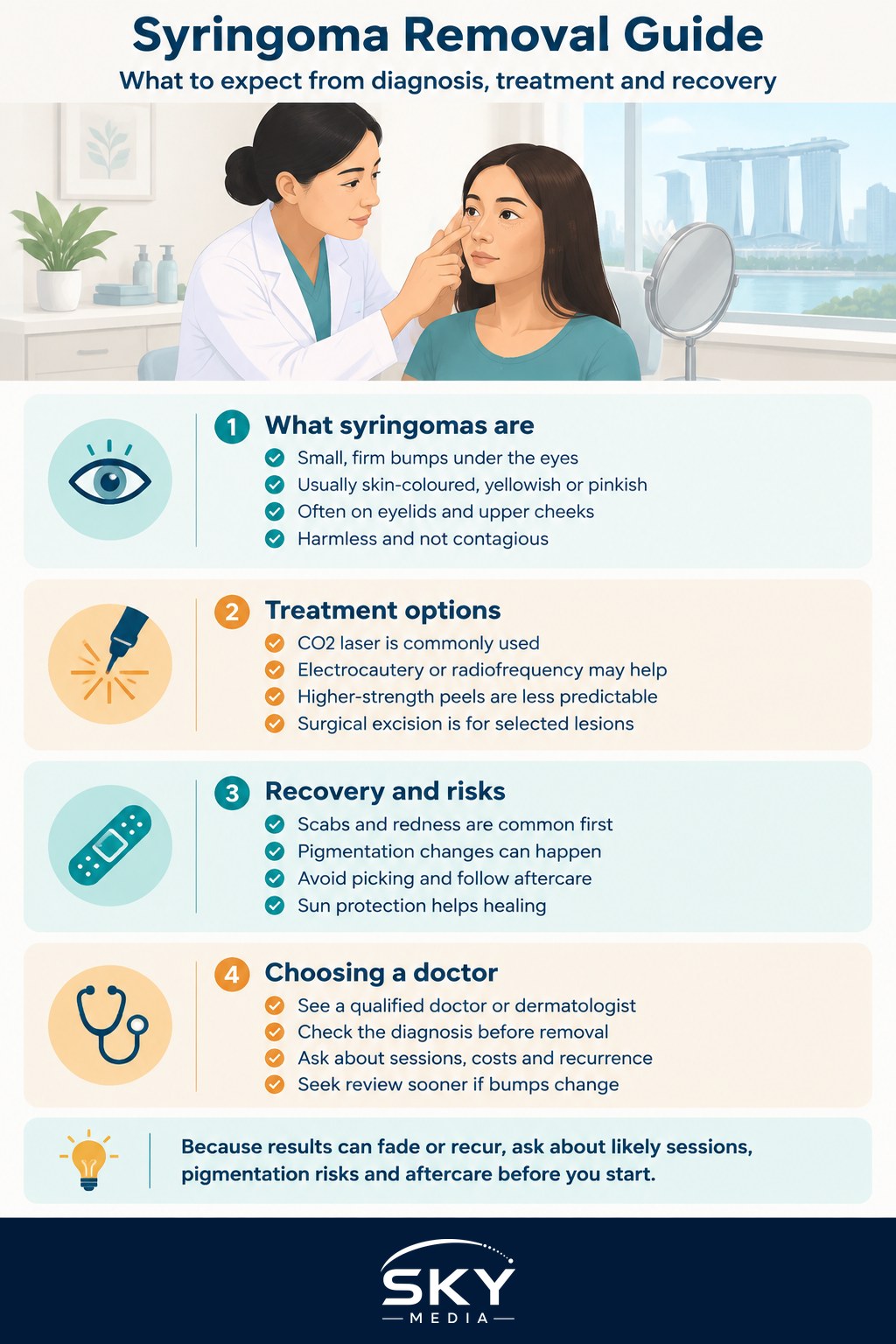
What Syringomas Are (and What They Are Not)
Syringomas are small benign growths that arise from the sweat ducts in the skin. They typically appear as:
- Tiny bumps, usually a few millimetres across
- Skin-coloured, slightly yellowish or pinkish
- Firm to the touch rather than soft
- Clustered on the lower eyelids and upper cheeks, though they can appear on the forehead, neck, chest or elsewhere
They often show up from adolescence onward and are more commonly seen in women. They are frequently reported in people of Asian descent, which is one reason many Singaporeans ask about them. Some people have a family history. They are not contagious and are not caused by poor skincare.
Syringomas are easily confused with other common bumps around the eyes:
- Milia are tiny white cysts filled with keratin. They look like little white pearls and can often be extracted. Syringomas sit deeper in the skin and cannot simply be squeezed out.
- Xanthelasma are soft yellow plaques, usually on the inner eyelids, and may be linked to cholesterol levels, so a doctor may suggest blood tests.
- Sebaceous hyperplasia usually appears on the forehead and cheeks with a small central dip.
- Skin tags are soft, hanging growths attached by a stalk.
Because the right treatment depends on the diagnosis, get the bumps checked before booking any removal. If you are dealing with soft hanging growths instead, our skin tag removal guide covers those.
Treatment Options for Syringoma Removal
There is no cream that reliably dissolves syringomas, because they sit within the dermis, the deeper layer of skin. Treatment aims to destroy or remove the growth while protecting the delicate eyelid skin. The main approaches a dermatologist may discuss are compared below.
| Method | How it works | Typical downtime | Points to consider |
|---|---|---|---|
| CO2 laser (ablative, pinpoint or fractional) | Vaporises the bump layer by layer | Several days of small scabs and redness | The most commonly used option; experience matters for eyelid skin |
| Electrocautery or radiofrequency | Uses a fine needle and electrical energy to destroy the lesion | Similar to laser, with small crusts | Precise for individual bumps; skill-dependent |
| Chemical peels (higher strength) | Strong acid applied to break down tissue | Varies with strength | Less predictable for deep lesions; risk of pigment change |
| Surgical excision | Cuts out the lesion and closes the skin | Stitches and longer healing | Occasionally used for larger or isolated lesions |
Why CO2 laser is often the first choice
Many clinics favour the CO2 laser because it allows the doctor to remove tissue in controlled, shallow passes, targeting each bump while sparing the surrounding skin. Some doctors treat each lesion individually with a pinpoint technique, while others combine this with fractional laser to soften the overall texture. Several sessions spaced weeks apart are common, as treating too aggressively in one go raises the risk of scarring.
Expect improvement, not perfection
Most people see the bumps flatten and become less noticeable. However, complete clearance in a single session is uncommon, and syringomas sometimes recur over months or years. A good doctor will set realistic expectations rather than promise permanent results.
Risks for Asian Skin and How to Lower Them
The main concern with any ablative treatment on darker or Asian skin types is post-inflammatory hyperpigmentation, where treated spots heal darker than the surrounding skin. This usually fades with time and sun protection, but it can take months. Other possible effects include:
- Persistent redness that lasts a few weeks
- Small depressed scars, especially if lesions are treated too deeply
- Lighter patches of skin (hypopigmentation), which is less common
- Infection if aftercare is not followed
To reduce these risks:
- Choose a doctor experienced in treating the eyelid area and your skin type
- Ask whether a test spot is advisable before treating the whole area
- Avoid tanning and strong sun exposure before and after treatment
- Tell the doctor if you are prone to cold sores, keloids or have recently used certain acne medications, as these may affect timing
Recovery and Aftercare
Aftercare instructions vary by clinic and method, so follow your own doctor’s advice. In general, people can expect:
- First few days: treated spots look like tiny pink or brown scabs. Mild swelling around the eyes is common.
- Around one week: scabs usually fall off on their own. Picking them increases the risk of marks.
- Following weeks: the skin may look pink or slightly darker before settling.
Common instructions include gentle cleansing, applying any prescribed ointment, avoiding eye makeup on treated areas until healed, and wearing sunscreen and sunglasses daily. Singapore’s strong year-round sun makes this last point especially important. Many people schedule treatment before a quieter week at home, since small scabs on the eyelids are visible.
Choosing a Doctor and Questions to Ask
Syringoma removal is a medical procedure, so it should be performed or supervised by a qualified doctor, ideally a dermatologist or an aesthetic doctor with eyelid experience. You can check a doctor’s registration on the Singapore Medical Council’s register. Avoid beauty salons offering to “burn off” eye bumps with home-style devices, as this can cause scarring.
Useful questions at your consultation:
- Are you confident these are syringomas, or could they be something else?
- Which method do you recommend for my skin type, and why?
- How many sessions should I expect, and how far apart?
- What is your approach to preventing and treating pigmentation?
- What happens if they come back?
- What is the full cost, including follow-ups and medication?
Since syringoma removal is usually considered cosmetic, it is generally not covered by insurance or MediSave. Fees vary between clinics and with the number of lesions, so ask for a written quote. If you are also considering broader under-eye work, our guide to eye bag removal options explains how surgical and non-surgical approaches differ.
When to See a Doctor Sooner
Most under-eye bumps are harmless, but book a medical review promptly if a bump grows quickly, bleeds, becomes painful, changes colour, or looks different from the others. A sudden appearance of many bumps over a wide area of the body is also worth checking. Your GP can refer you to a dermatologist, including at public hospital specialist clinics, if needed.
Explore more: Cosmetic Mole Removal in Singapore: Methods and Aftercare
Frequently Asked Questions
How are syringomas different from milia under the eyes? Milia are tiny white cysts that look like pearls and can often be extracted, while syringomas are firm, skin-coloured bumps that sit deeper in the skin and cannot be squeezed out. A doctor should confirm which you have before any treatment.
Why do syringomas come back after removal? Syringomas arise from the sweat ducts, and recurrence over months or years is not unusual. Complete clearance in one session is uncommon, so a good doctor will set realistic expectations rather than promise permanent results.
Is there a cream that can get rid of syringomas? No cream reliably dissolves them, because they sit within the dermis, the deeper layer of skin. Treatment aims to destroy or remove the growth while protecting the delicate eyelid skin, and is done by a doctor.
How can I reduce the risk of dark marks after treatment? Choose a doctor experienced with eyelid skin and your skin type, and ask about a test spot. Avoid tanning and strong sun before and after, wear sunscreen and sunglasses daily, and do not pick the scabs.
Which doctor should I see for syringoma removal? A qualified doctor, ideally a dermatologist or an aesthetic doctor with eyelid experience. You can check registration on the Singapore Medical Council’s register. Avoid salons offering to burn off eye bumps with home-style devices, as this can cause scarring.
Further reading: Xanthelasma: Yellow Patches Around the Eyes and How They Are Removed