

Puffy lower eyelids can make you look tired even after a good night’s sleep. If creams, cold compresses and more rest have not helped, you may be looking into eye bag removal in Singapore. The options range from surgery that removes or repositions fat to non-surgical treatments that disguise or tighten the area. Each suits a different cause, and choosing the wrong one can waste money or give a disappointing result.
This guide explains the main medical and aesthetic options, what recovery tends to look like, and how to think about cost. It is general information, not medical advice. Only a qualified doctor who examines you can say which treatment, if any, is right for you.
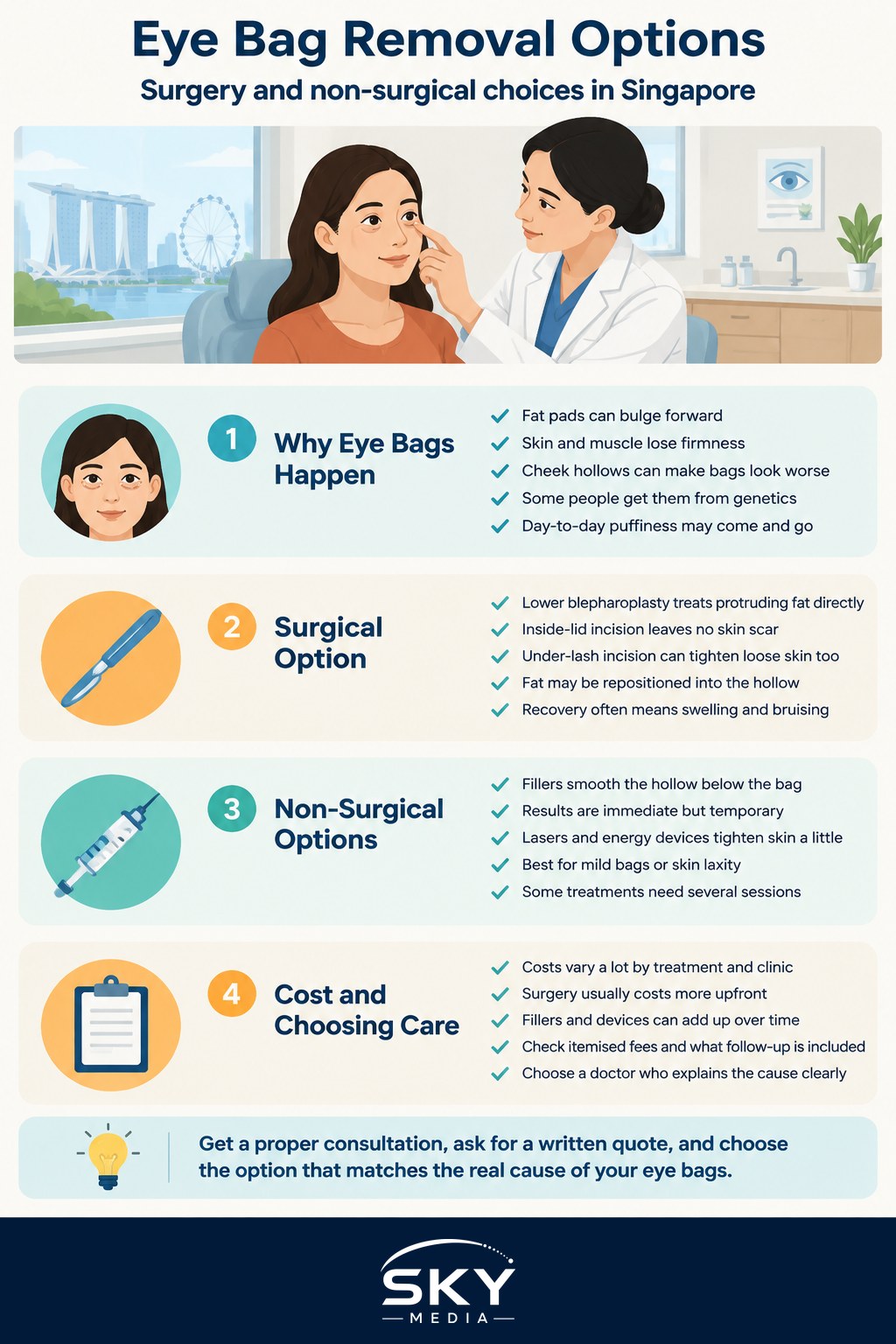
What Actually Causes Eye Bags
Skincare articles often lump eye bags together with dark circles, but they are different problems. True eye bags are usually structural:
- Fat pads that bulge forward. The fat cushioning the eyeball sits behind a thin membrane. With age, that membrane weakens and the fat pushes outward.
- Loose, thinner skin and muscle. The lower lid loses firmness over time.
- Volume loss in the cheek. As the upper cheek flattens, a hollow (often called a tear trough) forms below the bag, making the bulge look worse.
- Genetics. Some people have prominent eye bags from their twenties.
Temporary puffiness from salt, alcohol, allergies or poor sleep usually comes and goes. If yours varies a lot from day to day, it may not be a structural bag at all. Swelling can also be linked to thyroid, kidney or allergy issues, so it is worth seeing a GP if it appears suddenly or affects other areas.
Lower Blepharoplasty: The Surgical Option
Lower blepharoplasty is surgery on the lower eyelid. It is the only option that deals directly with protruding fat, so it tends to give the most lasting change for well-defined bags.
There are two broad approaches:
- Transconjunctival. The surgeon works through an incision on the inside of the lower lid, so there is no visible scar on the skin. It is often used for younger patients whose main problem is fat rather than loose skin.
- Transcutaneous. The incision runs just below the lash line. This allows the surgeon to remove or tighten excess skin as well as address the fat, and is more common in older patients.
Many surgeons now reposition fat into the hollow beneath the bag rather than simply removing it, to avoid a sunken look. The procedure is usually done under local anaesthetic with sedation, or general anaesthetic, depending on the patient and the doctor.
Recovery commonly involves swelling and bruising for a week or two, with residual swelling settling over the following weeks. Your surgeon will give specific instructions on cleaning, cold compresses, sleeping position and when you can wear make-up, exercise or return to work. Possible risks include asymmetry, dry eye, changes in lid position, infection and scarring, which is why choosing an experienced surgeon matters.
Non-Surgical Options
Non-surgical treatments do not remove fat. Instead, they smooth the transition between the bag and the cheek, or tighten the skin a little. They work best for mild bags or when the main issue is hollowness.
Tear trough fillers. A doctor injects a hyaluronic acid filler into the hollow below the bag so the area looks flatter and smoother. Results are immediate but temporary, and touch-ups are needed. The under-eye area is delicate, so technique matters: poorly placed filler can look lumpy or puffy, and rare but serious complications can occur if filler enters a blood vessel. Hyaluronic acid fillers can be dissolved by a doctor if needed.
Lasers and energy-based devices. Fractional lasers, radiofrequency and ultrasound-based treatments aim to stimulate collagen and tighten lower-lid skin. They can improve fine lines and slight laxity but will not flatten a significant fat bulge. Most need a course of sessions, and results build gradually.
Other approaches. Some clinics offer skin boosters or combination plans. Ask the doctor to explain plainly what each step is meant to achieve and what evidence supports it.
Comparing Your Main Options
| Option | Best suited to | Typical downtime | How long results last |
|---|---|---|---|
| Lower blepharoplasty | Clear fat bulges, with or without loose skin | Bruising and swelling for one to two weeks, longer to fully settle | Long-lasting, though ageing continues |
| Tear trough filler | Mild bags with a hollow below them | Usually minimal, with possible bruising for a few days | Temporary, needs repeat treatment |
| Laser or energy device | Fine lines and mild skin laxity | Usually none to a few days of redness | Gradual and modest, may need maintenance |
Costs and What Affects Them
Prices for eye bag removal in Singapore vary widely, so be cautious of any single figure you see quoted online. What drives cost:
- Type of treatment. Surgery generally costs more upfront than a single filler session, but repeated non-surgical treatments add up over the years.
- Doctor and setting. Fees differ between private specialists, aesthetic clinics and hospital day surgery centres. Surgery may include separate charges for the operating theatre, anaesthesia and follow-up reviews.
- Amount of product or sessions. Fillers are often charged by syringe, and device treatments by session or package.
Purely cosmetic procedures are generally not covered by MediShield Life, MediSave or most insurance plans. Ask the clinic for an itemised written quote, check what follow-up is included, and confirm coverage directly with your insurer.
How to Choose a Doctor and Clinic
A careful consultation is the most important step. Things to look for:
- Qualifications. Eyelid surgery is commonly done by plastic surgeons and oculoplastic (eye plastic) surgeons. You can check a doctor’s registration on the Singapore Medical Council’s register.
- An honest assessment. A good doctor will explain the cause of your eye bags and may tell you that a cheaper option will not work, or that surgery is not necessary.
- Realistic photos and explanations. Advertising by doctors in Singapore is regulated, so expect factual information rather than dramatic promises.
- A clear plan for complications. Ask what happens if you are unhappy with the result or something goes wrong.
- No pressure. Be wary of time-limited package deals or upselling on the day.
If you are exploring other cosmetic treatments, our honest guide to non-surgical body contouring uses the same questioning approach, and tattoo removal explained is a useful read on what laser treatments can and cannot do.
Before You Book
Give yourself time to decide. Get a consultation, take the quote home, and consider a second opinion for surgery. Think about your schedule too: if you are having surgery, plan around the bruising period rather than booking just before a wedding or a big work event. The best result is the one that matches the real cause of your eye bags and your comfort with downtime and risk.
Further reading: Can You Use MediSave or Insurance for Cosmetic Procedures in Singapore? · Rhinoplasty in Singapore: Surgical Nose Jobs, Costs and Recovery · Xanthelasma: Yellow Patches Around the Eyes and How They Are Removed