

Not every learning goal needs three years and a full degree. For a busy working adult in Singapore, short courses and microcredentials have become one of the most practical ways to pick up a specific skill, prove it, and move on with your life. They are shorter, cheaper, and far more focused than a traditional qualification, and when they are chosen well they can shift your work in a matter of weeks rather than years.
This guide explains what these shorter options actually are, when they are the smarter choice, how stackable certificates build up over time, and how to judge whether a course is worth your money and hours. The aim is to help you spend your effort where it counts, without over-buying a qualification you do not need or wasting time on a certificate that carries no weight.
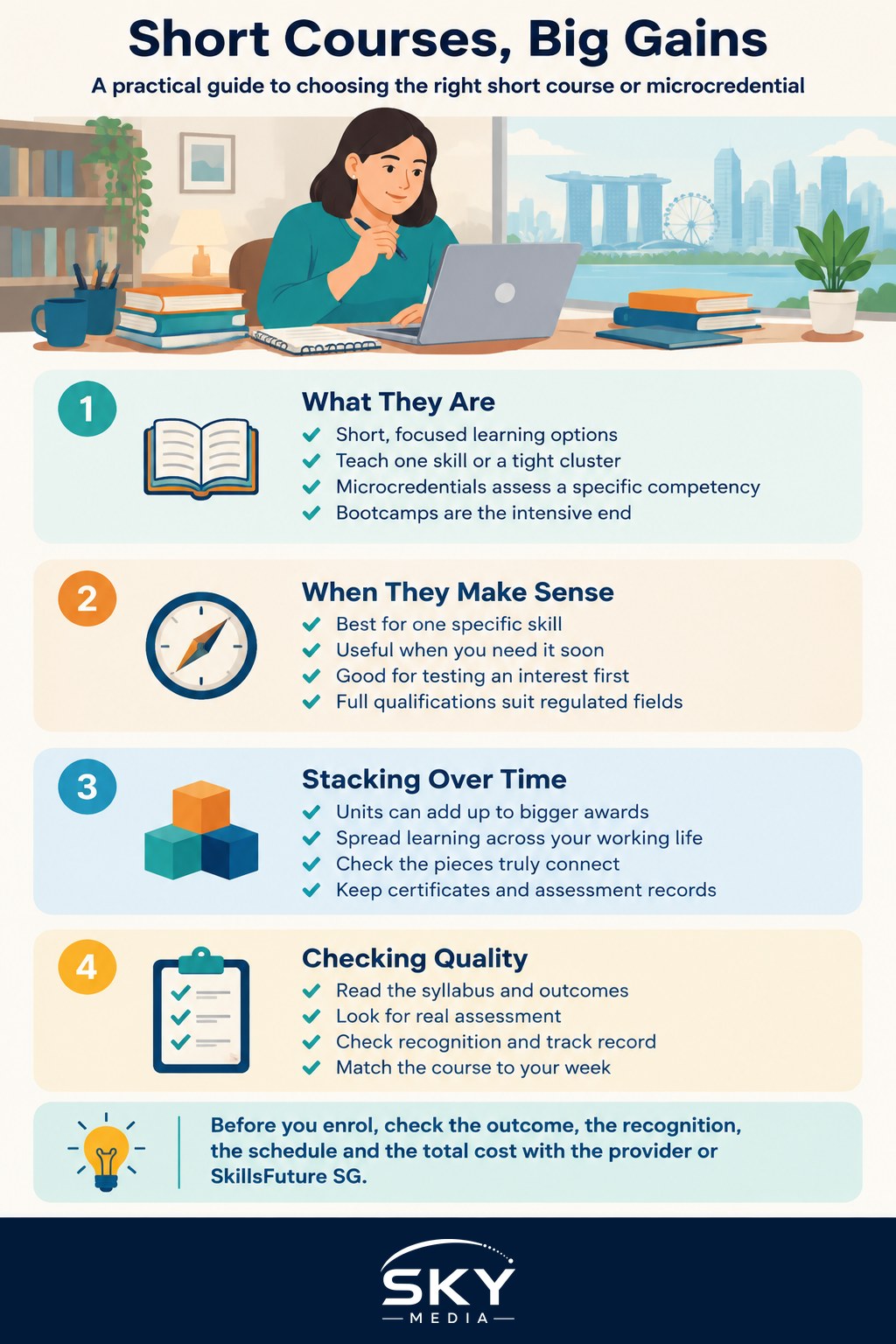
What Short Courses and Microcredentials Actually Are
A short course is exactly what it sounds like: a focused programme, often a few days to a few months, that teaches one skill or a tight cluster of skills. A workshop on spreadsheets, a weekend on digital marketing, or an evening class in basic coding all count. The point is depth on a narrow topic rather than breadth across a whole field.
A microcredential is a slightly newer idea. It is a small, recognised unit of learning that certifies you can do a specific thing, usually with some form of assessment at the end. Think of it as a certificate for a single competency rather than a whole subject. A bootcamp sits at the more intensive end of this family, packing a large amount of practice into a short, demanding stretch, often to prepare people for a career switch.
What ties them together is size and purpose. All of them are built to close a particular gap quickly. In Singapore, many are delivered by polytechnics, ITE, private training providers, universities’ continuing education arms, and online platforms. Some carry the WSQ framework’s recognition, and many are eligible for SkillsFuture support. The exact list of eligible courses, credits, and subsidies changes over time and differs by provider, so treat any figure you see as a starting point and confirm the current terms with SkillsFuture SG or the training provider before you enrol.
When a Short Course Beats a Full Qualification
The honest answer is that it depends on your goal, and being clear about that goal saves you a lot of money. A short course or microcredential tends to win when you need one specific skill, when you need it soon, or when you want to test an interest before committing to something bigger. A full qualification earns its longer timeline when you are entering a regulated profession, making a complete career change into an unfamiliar field, or seeking a recognised degree that employers in that field expect.
Here is a simple way to compare the three main options side by side.
| Option | Typical length | Best for | What to watch |
|---|---|---|---|
| Short course or bootcamp | Days to a few months | A specific skill or a fast career pivot | Recognition varies; check who values it |
| Microcredential | Weeks, often stackable | Proving one competency clearly | Confirm it stacks toward something bigger |
| Full qualification | One to several years | Regulated fields and deep expertise | Larger cost and time commitment |
Notice that none of these is simply better than the others. A microcredential in a niche tool can move your career faster than a broad diploma if that tool is exactly what your workplace needs. Equally, no stack of weekend courses replaces the depth a full programme gives a future engineer or accountant. Match the size of the learning to the size of the goal, and resist the urge to over-qualify for a job that only asks for one skill.
It also helps to ask who will be reading the certificate. If a specific employer or industry values a particular credential, that matters more than how impressive the course sounds.
How Stackable Certificates Build Over Time
One of the most useful ideas in adult learning is stacking. Instead of committing to a long programme at the start, you take smaller units one at a time, and several of them add up to something larger, such as a certificate, an advanced certificate, or eventually a diploma. This lets you learn in the gaps of a working life while still building toward a recognised whole.
Stacking works well because it lowers the risk of each step. You can pause between units when work or family gets heavy, spread the cost across months rather than paying it all upfront, and change direction if your goals shift. Each completed unit is a small win you can already use and put on your record, rather than a distant reward you only collect at the very end.
A few things make stacking work in practice:
- Check that the pieces connect. Before you start, confirm with the provider that the units genuinely count toward the larger qualification you have in mind, and how long you have to complete them.
- Keep your records. Save every certificate and assessment result, because a stack is only as useful as your ability to prove it.
- Follow a sensible order. Some units assume knowledge from earlier ones, so ask which to take first rather than picking the most interesting one out of sequence.
- Mind the expiry. Skills and some credentials date, especially in fast-moving fields, so aim to complete a stack within a reasonable window rather than leaving years between units.
Stacking is not compulsory. Plenty of people take a single short course, get what they need, and stop. But if you suspect a small skill today could grow into a bigger role later, choosing stackable units from the start keeps that door open without forcing you through it.
How to Check a Course Is Worth It
Because short courses and microcredentials are a crowded market, the quality varies widely, and a confident website is not proof of a good programme. A little checking before you pay protects both your money and your time.
Start with the substance. Look at the syllabus in detail and ask what you will actually be able to do by the end, not just what topics are listed. A good course states clear, practical outcomes. Ask whether there is real assessment, since a certificate you earn by simply attending carries less weight than one that tests whether you can perform.
Then look at recognition and the people behind it. Consider who runs the course, what their track record is, and whether the credential is recognised by employers in your field or sits within a framework like WSQ. Where you can, seek honest feedback from past participants rather than relying on testimonials chosen by the provider. Ask about class size, how much hands-on practice you get, and whether you can reach an instructor when you are stuck.
Finally, weigh the practical fit. Check the schedule against your real week, confirm whether sessions are live or self-paced, and understand the total cost before any support you may be eligible for. Remember that subsidies, credits, and eligibility rules change and vary by course, so verify the current position with SkillsFuture SG or the provider rather than assuming last year’s terms still apply. A course that fits your life and teaches a skill you will use beats a prestigious one you cannot attend or apply.
Chosen with a little care, a short course or microcredential is one of the best-value moves a working adult can make. It is a small, focused bet on yourself, and small bets, repeated over a career, add up to a great deal of growth.
Explore more
Before you enrol, it helps to know where each course fits, so start with building a learning plan as an adult in Singapore. If you are eyeing a fast-moving field, our guide to learning in-demand tech skills in Singapore pairs well with a bootcamp, and when the studying starts to crowd your week, read balancing work, study and family in Singapore to keep it all sustainable.
Frequently Asked Questions
What is the difference between a short course and a microcredential? A short course is a focused programme lasting days to a few months that teaches one skill. A microcredential is a small, recognised unit that certifies a specific competency, usually with an assessment. A bootcamp is the intensive end of this family.
How do stackable certificates work? You take smaller units one at a time and several add up to a larger certificate or diploma. This lowers the risk of each step and spreads cost. Confirm with the provider that the units count toward the qualification you want and how long you have to finish.
When is a full qualification better than a short course? A full qualification earns its longer timeline when you are entering a regulated profession, making a complete career change into an unfamiliar field, or seeking a degree employers expect. A short course wins when you need one specific skill soon.
How can I tell if a short course is worth the money? Look at the syllabus in detail and ask what you will actually be able to do by the end. Check whether there is real assessment, who runs it, and whether employers in your field recognise the credential. Seek honest feedback from past participants.
Should I keep my certificates after finishing a course? Yes, save every certificate and assessment result, because a stack is only as useful as your ability to prove it. Also mind expiry, since skills and some credentials date quickly in fast-moving fields.
Official sources: SkillsFuture (SWDA)
Further reading: Business and Finance Courses for Professionals