
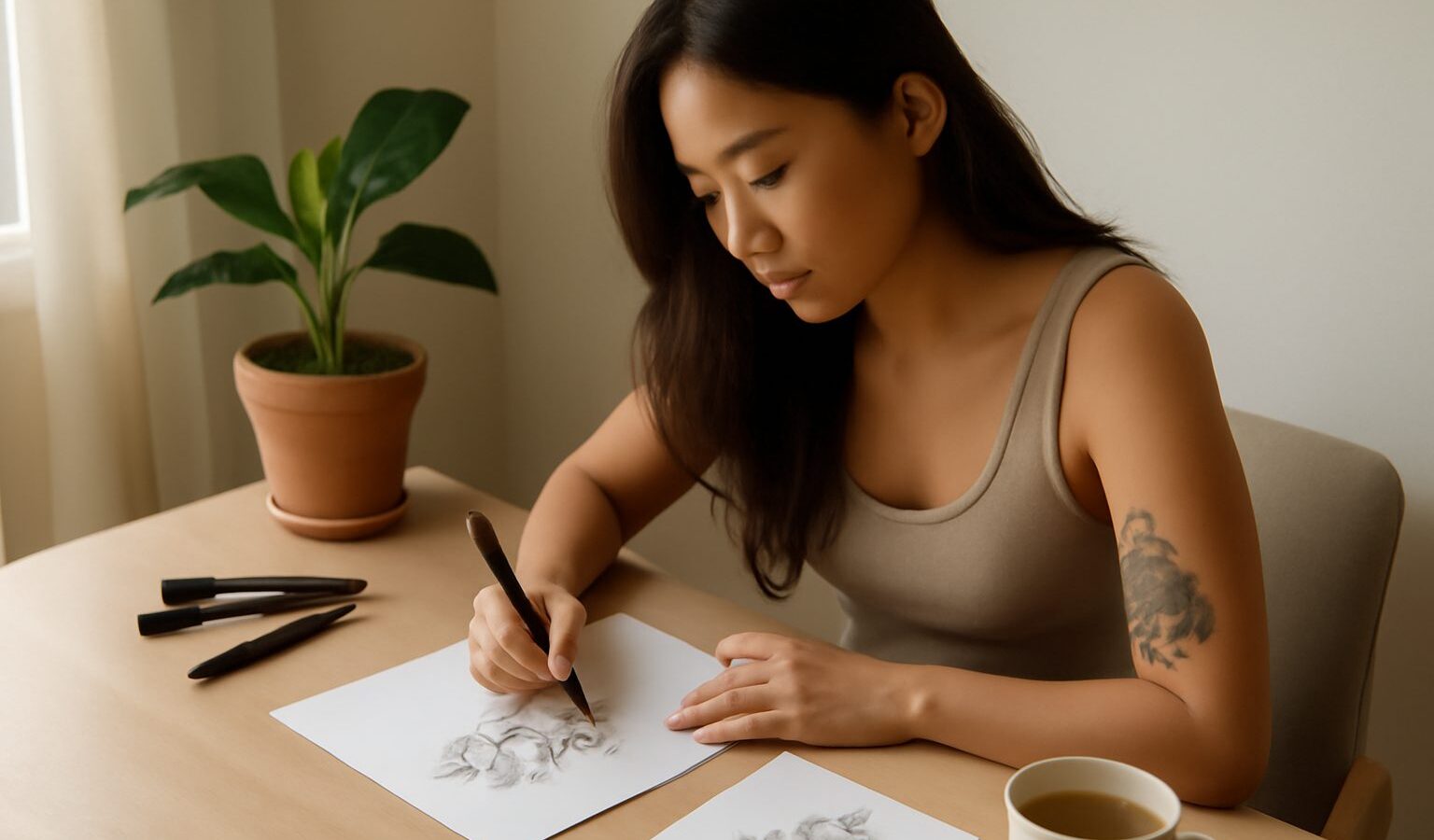
Bold outlines, flat colour, swallows, roses, koi and daggers: tattoo art has a visual language all of its own, and you do not need to ink anyone to enjoy it. Tattoo design drawing is a growing hobby for people who love the look of flash sheets, want a structured way to improve their linework, or simply enjoy designing images that are clean, readable and full of meaning.
This guide is about drawing tattoo-style designs on paper or a tablet. It does not teach tattooing on skin, which in Singapore is a professional trade done in studios with proper hygiene and training. Think of this as a creative hobby that borrows the rules and motifs of tattoo art.
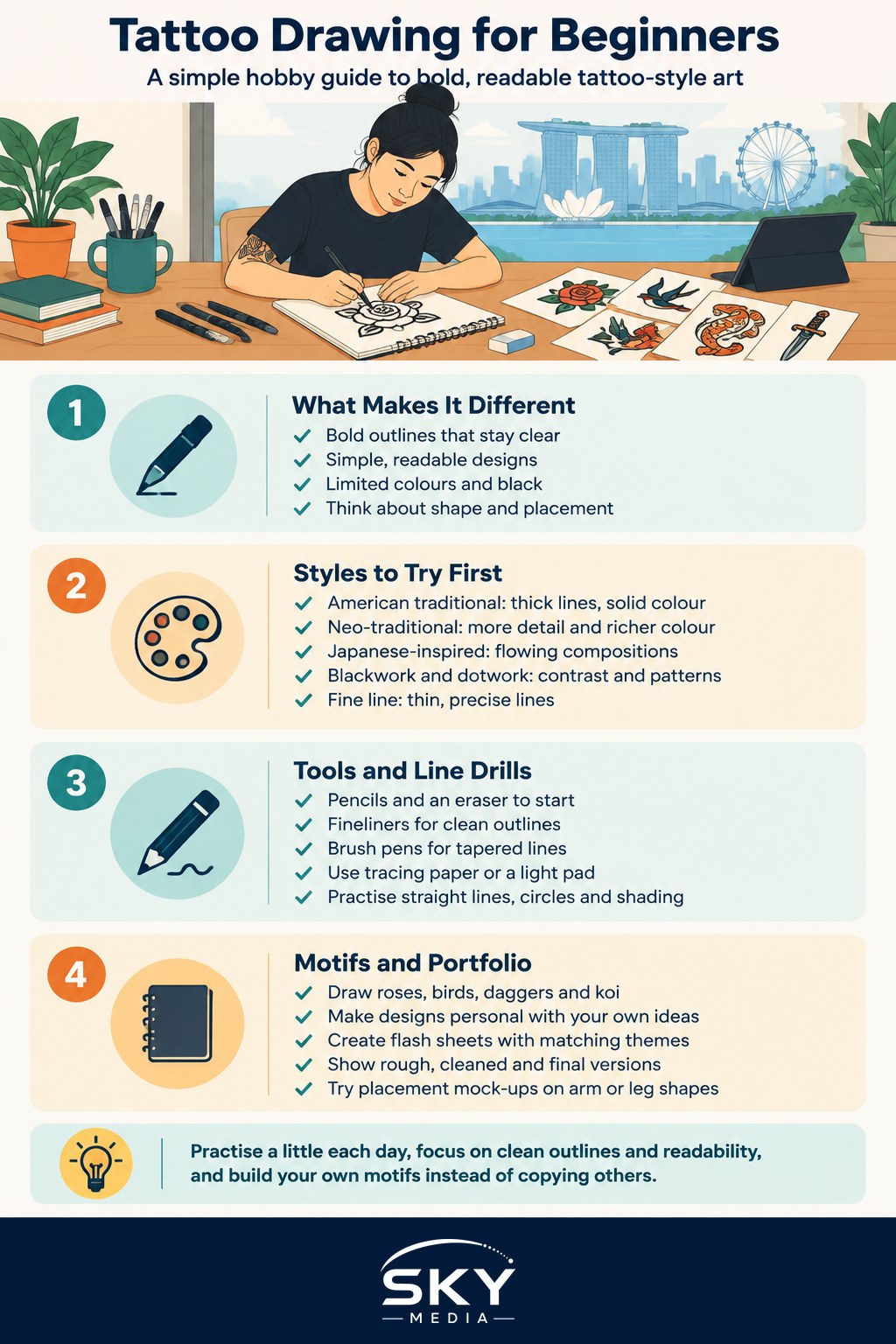
What Makes Tattoo-Style Drawing Different
Tattoo art is designed to be applied to skin, which changes over time. That practical origin shapes the style, even when you are only drawing on paper.
- Strong, confident outlines. Lines must hold up when viewed from a distance and as skin ages, so designs rely on bold, even outlines.
- Readability. A good tattoo design reads clearly at a glance. Fine, fussy details are kept to a minimum, especially in traditional styles.
- Limited palettes. Many classic styles use a small set of solid colours plus black.
- Designed for placement. Artists think about how a design wraps around an arm, sits on a shoulder blade or fits a calf. Even as a hobbyist, considering shape and flow makes designs feel authentic.
- Flash. Flash sheets are pages of ready-to-use designs, historically displayed on studio walls. Drawing your own flash sheets is a great hobby project.
Compared with general sketching or drawing comics and manga, tattoo drawing is less about storytelling and more about crafting single, iconic images.
Popular Tattoo Styles to Explore
Trying a few styles helps you find what you enjoy. Here is a quick comparison of common ones beginners study.
| Style | Key features | Beginner friendliness | Good practice for |
|---|---|---|---|
| American traditional | Thick black outlines, solid colour, simple shading | High | Clean linework and bold composition |
| Neo-traditional | Traditional base with more detail, varied line weight, richer colour | Medium | Line weight control and decorative elements |
| Japanese-inspired | Large flowing compositions, waves, clouds, wind bars | Medium to low | Composition, movement and background flow |
| Blackwork and dotwork | Solid black areas, patterns, stippled shading | Medium | Patience, pattern design and contrast |
| Fine line | Thin lines, delicate details, minimal shading | Low at first | Steady hand and precision |
When studying cultural styles such as Japanese-inspired work, read about the meaning of motifs and treat them with respect rather than copying symbols you do not understand.
Tools You Need to Start
You can begin with very little, then upgrade as you find your style.
- Pencils and a good eraser for rough sketches and layout.
- Fineliners or technical pens in several thicknesses for outlining. Practising with fixed widths teaches line weight.
- Brush pens for bold traditional outlines and tapered lines.
- Markers or watercolour for flat colour fills. Alcohol markers give smooth, even colour similar to classic flash.
- Tracing paper or a light pad for refining a rough sketch into a clean final drawing, a standard step in tattoo design.
- A sketchbook dedicated to tattoo ideas, so you can see progress over time.
If you prefer digital work, a tablet and drawing app let you use layers, stabilise lines and test colours quickly. See our guide to choosing a graphics tablet for drawing before you buy.
Linework Drills That Build Skill Fast
Linework is the backbone of tattoo design drawing. Spend a few minutes on drills at the start of each session.
- Straight and curved strokes. Fill a page with parallel lines and smooth arcs. Move from your shoulder and elbow, not just your wrist.
- Even circles and ovals. Draw them in one confident stroke. Repeat until the shapes look clean.
- Line weight practice. Outline the same simple shape three times: thin, medium and thick. Notice how a heavier outer line makes the design pop.
- Tapered lines. With a brush pen, practise lines that start thin, swell and end thin, useful for petals, leaves and flames.
- Single-pass outlines. Redraw a finished sketch in ink, aiming to trace each line in one stroke rather than many small scratchy ones.
- Shading drills. Try solid black fills, whip shading made of short flicking strokes, and dot shading.
Short daily practice tends to help more than one long session a week. Mindful, repetitive linework also pairs well with Zentangle and meditative drawing if you enjoy the calming side.
Classic Motifs and How to Make Them Your Own
Traditional flash has a recognisable set of motifs. Drawing them is a great way to learn the style:
- Roses, peonies and lotus flowers
- Swallows, eagles and other birds
- Daggers, hearts and banners with lettering
- Snakes, tigers, panthers and koi
- Ships, anchors and nautical stars
- Skulls and hourglasses
To make them personal, change the composition, combine two motifs, or add elements that mean something to you, like a local flower or a favourite animal. Always create your own designs rather than copying another artist’s work directly. If you study a specific artist’s piece for practice, keep it as private study and credit them if you ever share it.
Building a Portfolio Without Tattooing Skin
A portfolio gives your hobby direction and shows your progress.
- Make flash sheets. Fill a page with five to ten themed designs, for example a nautical sheet or a floral sheet. Use consistent outlines and a matching colour palette.
- Show your process. Keep rough sketch, cleaned linework and final colour versions. Process shots show growth.
- Try placement mock-ups. Draw your designs over simple outlines of arms, backs or legs to practise flow, without involving real skin.
- Share thoughtfully. Post to social media or art communities if you like, and ask for feedback on line quality and readability.
- Join a community. Drawing groups and art classes, including our list of life drawing and art classes in Singapore, help you stay motivated.
If you ever want to turn the hobby into a career, the route usually involves professional apprenticeship and strict hygiene training through a licensed studio. Research current requirements carefully before taking that step. For now, enjoy the hobby for what it is: a satisfying way to sharpen your linework and create bold, timeless images.