

Going freelance or running your own small trade brings freedom, and it also brings a responsibility that employees rarely think about. Nobody is deducting tax for you or filing anything on your behalf. Getting your head around self employed tax singapore rules early saves a lot of stress later, so this guide walks through the general principles of how tax works when you work for yourself.
One thing to be very clear about upfront. This is general information and education, not tax or financial advice, and it is not tailored to your situation. Tax rules, rates, reliefs, and thresholds are set by the Inland Revenue Authority of Singapore (IRAS) and can change, so we have deliberately not quoted any figures. For anything specific to you, check the IRAS website or speak to a qualified tax professional. IRAS is always the authoritative source.
How Self-Employed Income Is Treated
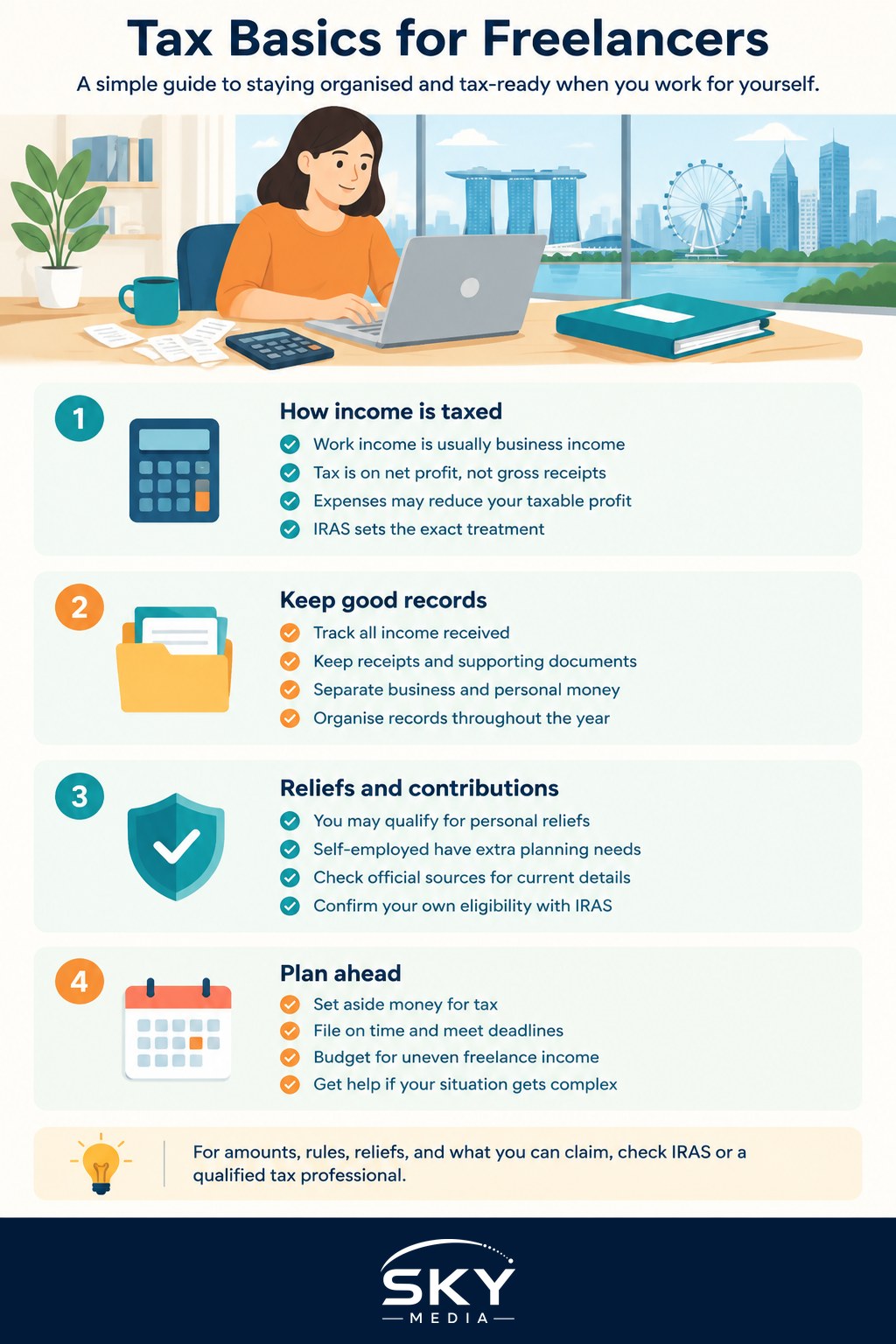
When you are self-employed, whether as a sole proprietor, freelancer, or independent contractor, the money you earn from your work is generally treated as trade or business income rather than salary. That means you are typically taxed on your net profit, which is your income after allowable business expenses, rather than on every dollar that comes in. The exact treatment depends on your circumstances, and IRAS sets out how to determine and report this.
This is a meaningful difference from being an employee. An employee usually just receives a payslip with tax matters largely handled around them, whereas a self-employed person is responsible for working out their profit, keeping the records to back it up, and reporting it correctly. If you have recently moved from employment, it can help to first understand the employee side of the system through how income tax works in Singapore, which gives useful background before you layer on the self-employed specifics.
Because your tax is based on profit, two things matter enormously: recording your income accurately and understanding which expenses you can legitimately deduct. Guessing at either is risky. The rules on what counts are defined by IRAS, so when in doubt, check rather than assume.
Records, Expenses, and Staying Organised
Good record-keeping is the backbone of getting self-employed tax right. It is far easier to file accurately, and to answer any questions, when your paperwork is in order throughout the year rather than scrambled together at the last minute.
A sensible setup usually includes:
- A clear record of all income received from your work, with invoices or receipts.
- A record of business expenses, with supporting documents kept safely.
- A separate bank account for your work, which makes it far easier to see what is business and what is personal.
That last point is a small habit with a big payoff. Keeping business and personal money apart removes a lot of confusion at tax time, and it pairs naturally with broader financial planning for freelancers in Singapore, which looks at managing irregular income more generally.
On expenses, the guiding idea is that costs incurred wholly and exclusively in earning your income may generally be deductible, while private or capital costs are treated differently. The precise rules, including what qualifies and any conditions, are set by IRAS, so use their guidance rather than a rule of thumb you heard elsewhere. Claiming expenses you are not entitled to can cause problems, and missing legitimate ones means paying more than you need to. This is one area where a qualified tax professional can genuinely earn their fee.
Reliefs, Contributions, and Planning Ahead
Individuals may be able to reduce their taxable income through various personal reliefs, and the self-employed have their own considerations around retirement and healthcare contributions. Rather than quote any amounts, which change and are set by the authorities, the key message is to find out what applies to you from official sources. A general overview of the concept is available in income tax reliefs in Singapore, but always confirm the current details and your own eligibility with IRAS.
Beyond reliefs, three planning habits make self-employed life much smoother:
- Set money aside for tax. Because tax is not deducted as you earn, it is wise to hold back a portion of your income so the bill does not catch you out. Treat it as money that was never really yours to spend.
- Keep up with obligations and deadlines. Filing on time and meeting your responsibilities is entirely on you now. Note the key dates from IRAS and diarise them.
- Plan for the lumpiness. Freelance income often arrives unevenly, which makes budgeting and setting aside tax harder. Building a buffer helps, and building an emergency fund in Singapore is a good companion read for smoothing out the bumps.
If your work grows, your situation can become more complex, for example if you take on help or your turnover rises past certain points that affect other obligations. These thresholds and rules are all defined officially, so revisit IRAS guidance as your business evolves, and consider professional help once things get more involved.
A Practical Wrap-Up
Being self-employed means you are your own payroll, bookkeeper, and tax manager rolled into one. The good news is that the core habits are simple: record your income and expenses carefully, keep business and personal money separate, set aside cash for your tax bill, and meet your deadlines.
For everything specific, the amounts, the rules, the reliefs, and what you can claim, go straight to IRAS or a qualified tax professional. This article gives you the general lay of the land only, and tax rules change, so treat the official sources as the final word. It is general information and is not tax or financial advice tailored to your circumstances.
Official sources: IRAS
Further reading: What Self-Employed People Need to Know About CPF