

If your child got separated from you in a crowded mall, at a hawker centre or on the MRT, could they tell a helper how to reach you? Teaching a child to memorise contact details is one of the simplest safety skills you can give them, and it takes only a few minutes a day.
This guide focuses on three pieces of information: a parent’s full name, a phone number and the home address. It covers when to start, how to make it stick, and how to practise what to do with that information if they ever need it.
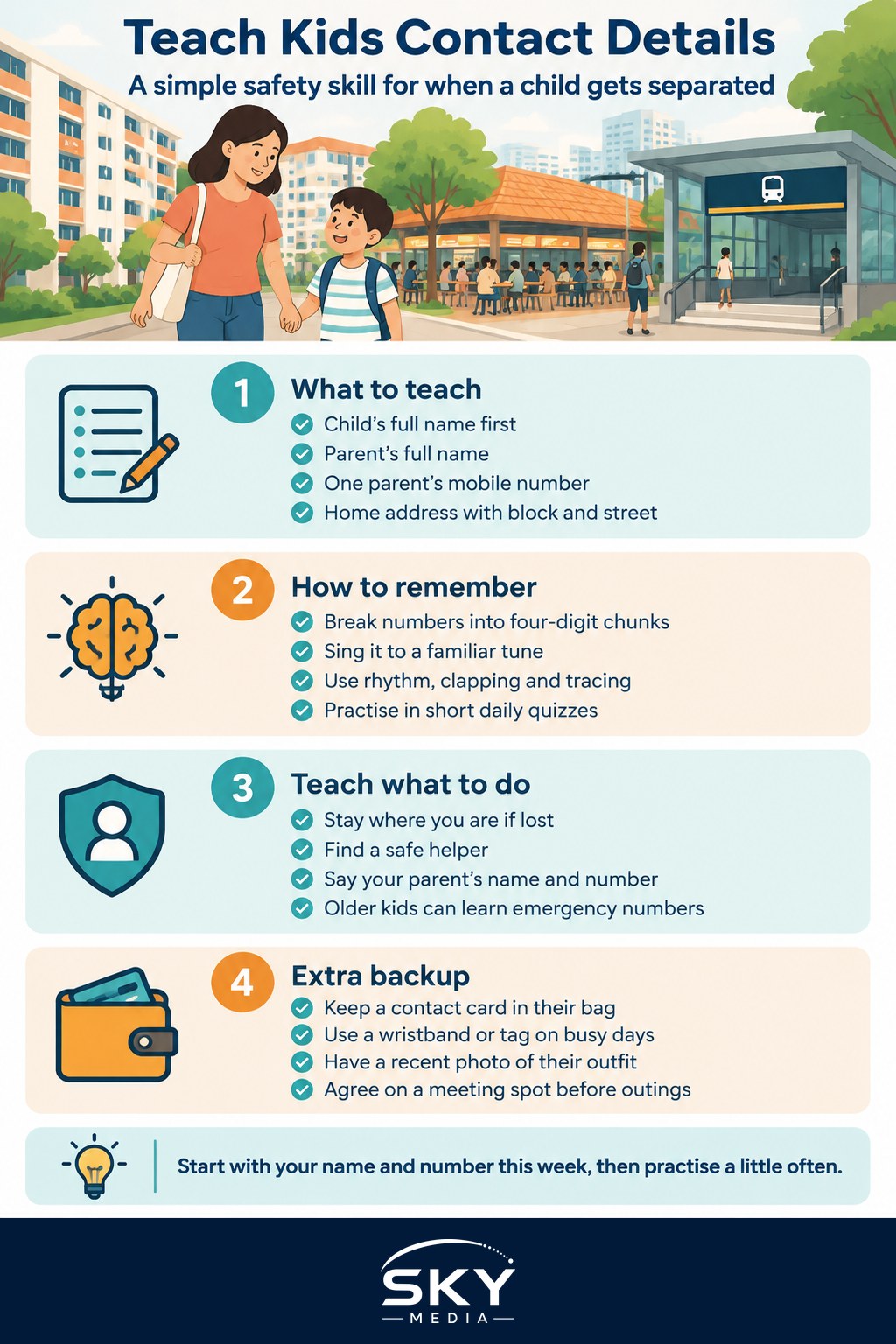
Why This Skill Matters Even in a Safe City
Singapore is generally a safe place, and most children who get separated from a parent are reunited quickly. But quickly is much easier when the child can say, “My mum’s name is …, and her number is …”. Phones run out of battery, children may not carry a phone, and a toddler’s “Mummy” is not enough for staff at a busy venue to find the right adult.
Knowing contact details also builds confidence. Children who know what to say are less likely to panic, and that calm makes everything else easier.
What to Teach, and Roughly When
Every child develops at their own pace, so treat ages as a loose guide. Start with what your child can manage and build up.
| Detail | Typical starting point | Practice tip |
|---|---|---|
| Their own full name | Toddler years | Use it in songs and when you introduce them to others |
| Parent’s full name, not just “Mummy” or “Daddy” | Around 3 to 4 years | Role-play: “What is your daddy’s real name?” |
| One parent’s mobile number | Around 4 to 6 years | Turn it into a rhythm or song, practise daily |
| Home address with block and street | Around 5 to 7 years | Point out the block number and street sign on walks |
| A second contact’s number | Around 6 to 8 years | Add a grandparent or other trusted adult once the first is solid |
For Singapore addresses, start with the most useful parts. A block number and street name, plus the estate or neighbourhood, will help someone locate you far more than a postal code a young child might muddle.
Make Phone Numbers Stick: Games and Tricks
An eight-digit mobile number is a lot for a small child. Breaking it into chunks and making it playful helps.
- Chunk it. Say the number as two groups of four, the way it is often written. Practise the first four, then the second four, then join them.
- Sing it. Put the number to a familiar tune, such as a nursery rhyme. Many parents find this is the method that works best.
- Use rhythm and clapping. Clap on each digit, pause between the chunks.
- Write and trace. For children who are learning to write, let them copy the number in big digits, or trace it with a finger.
- Dial practice. Let them press the digits on your phone with the screen locked, or on a toy phone, saying each number aloud.
- Daily quick quiz. Ask at a regular moment, such as in the lift, while waiting for the bus or at bedtime. Little and often beats one long session.
Keep it light. If your child gets a digit wrong, say the correct number together and move on. The goal is confidence, not a test.
Teaching the Home Address
Addresses are easier when children can see them.
- Walk the route. On the way home, point out the block number painted on your building and the street name sign.
- Make a home card. Draw your block with its number, the street name and your unit floor. Children often enjoy colouring it.
- Play “where do we live?” Ask them to tell a soft toy their address, or to guide you home from the bus stop.
- Keep it in order. Teach the address in the same order every time, for example block, street, then neighbourhood.
If you have recently moved, expect to repeat this. Children can mix old and new addresses for a while.
Practise What to Do With the Information
Knowing the details is only half of the skill. Children also need to know who to tell and when.
- Stay where you are. Teach a simple rule: if you get lost, stop and stay in one place so the grown-up can come back to find you.
- Find a safe helper. Good choices include a police officer, a security guard, staff at a shop counter or information desk, or a parent with children. Practise spotting these people on outings.
- Say the key details. Role-play the script: “I am lost. My mum is [name]. Her number is [number].”
- Know the emergency number. Older children can learn that 999 is for police and 995 for ambulance and fire in Singapore, and that these are for real emergencies only.
Role-play makes this real. Take turns being the lost child and the helper at home, then point out helpers when you are out at a mall or event.
Backup Plans for Younger Children
While your child is still learning, add a backup so a helper can reach you.
- A contact card in their bag or pocket with your name and number. Keep it somewhere a child can show it, not fixed visibly on clothing where anyone can read it.
- A wristband or tag with your number, which some families use on busy days out.
- A photo on your phone taken on the day, so you can show staff exactly what your child is wearing.
- A meeting spot agreed at the start of any outing, such as a particular entrance or information counter.
Your own phone setup matters too. Our guide to emergency contacts and Medical ID on your phone explains how to make key numbers easy for others to find.
Keeping It Calm and Positive
This skill should feel like a fun achievement, not a scary warning. Avoid frightening stories about what might happen. Instead, frame it as something “big kids” know, the same way they learn their colours or how to cross the road safely.
Celebrate progress. When your child can say your full number without help, make a small fuss. Then keep it fresh with occasional quizzes, because memory fades if it is not used.
Review the details whenever something changes, such as a new phone number, a move, or a new caregiver joining the family. If you are new to Singapore, this is also a good time to set up a wider family plan. Our guide to building an emergency contact list as a newcomer helps you decide which numbers every family member should have.
A few minutes of practice now can make a stressful moment much shorter if it ever happens. Start with your name and number this week, and build from there.
Frequently Asked Questions
Should I write my phone number on my child’s clothing? It is better not to display it where anyone can read it. A contact card kept in a bag or pocket, which your child can show to a safe helper, is a safer option. Some families use a wristband on busy days out.
How can I test if my child really knows my number? Ask casually at a regular moment, such as in the lift or at bedtime, and let them say it or press the digits on a locked phone. Little and often works better than one long test. If they slip, say the number together and move on.
Who counts as a safe helper if my child gets lost? Good choices are a police officer, a security guard, staff at a shop counter or information desk, or a parent with children. Practise spotting these people on outings so your child recognises them. Role-play helps make it real.
When should my child call 999 or 995? Older children can learn that 999 is for police and 995 for ambulance and fire in Singapore. These lines are for real emergencies only. Being lost for a short while in a mall is usually better handled by approaching a safe helper.
What if my child forgets the number after a few weeks? That is normal, because memory fades without use. Bring it back with short, playful quizzes and review whenever something changes, such as a new phone number or move. Keep a backup card in their bag while they are still learning.
Further reading: How to Teach Kids to Answer the Door Safely