

Most of us do not struggle to find things worth doing. We struggle because there are too many. Career goals, side projects, hobbies, courses, fitness plans, and a dozen worthy ideas all compete for the same limited hours. The warren buffett priority rule is a simple mental tool, widely attributed to the well known investor, for cutting through that crowd and protecting your focus for what matters most. Whether or not the story behind it is exact, the idea itself is genuinely useful, and that is why it has spread so widely.
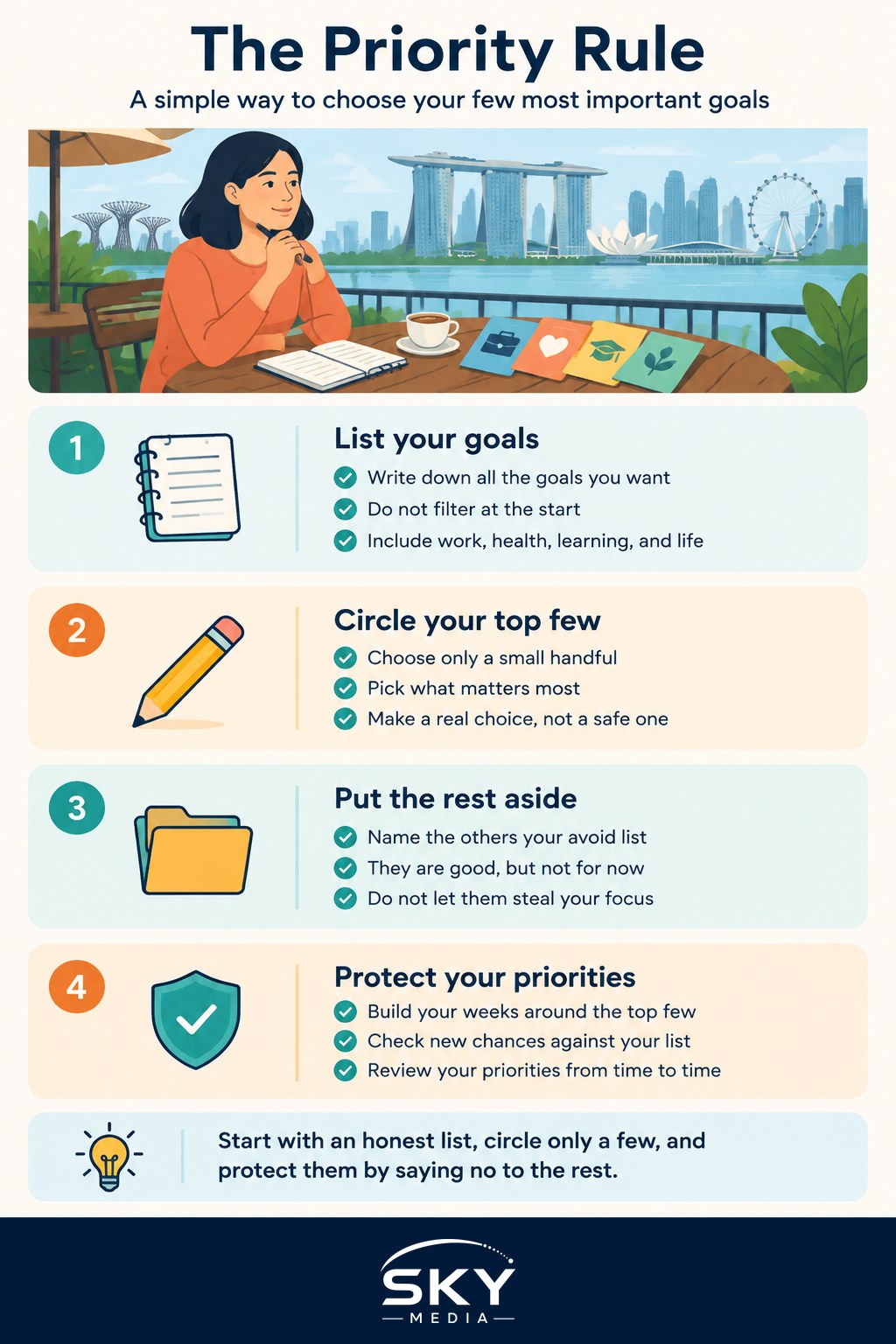
The rule is often shared as a short exercise. First, list out the many goals you would like to achieve. Then circle the small handful that matter most to you, the very top few. Everything you did not circle becomes your “avoid at all costs” list. The counterintuitive part is that these leftover goals are not junk to be ignored casually. They are the good, tempting, worthwhile things that will quietly steal time and attention from your true priorities. Precisely because they are appealing, they are the real danger.
Why good goals are the real distraction
It is easy to say no to obviously bad ideas. The hard part is saying no to good ones. A worthwhile course, a promising side hustle, an interesting committee, a new skill you would genuinely enjoy. Each one is reasonable on its own. Together, they scatter your energy so thinly that your most important goals never get the deep, sustained attention they need to succeed.
This is the insight at the heart of the rule. Focus is not just about avoiding waste. It is about having the discipline to turn down attractive options so your best few goals get your best effort. The things on your second list are not failures. They are simply not this season’s priorities, and treating them as active pursuits will cost you the thing you care about most.
How to apply the rule for yourself
You can run this exercise in about twenty minutes over a quiet kopi break. Here is a simple way to do it:
- Write down your goals. List everything you genuinely want to achieve over the next year or few years. Do not filter yet. Aim for a decent spread, career, health, relationships, learning, and personal projects.
- Circle your top few. Choose only a small handful, the ones that would matter most if you could only achieve those. This is deliberately hard. The point is to force a real choice.
- Name the rest as your avoid list. Everything else goes on the list of things to actively resist for now. Not because they are unworthy, but because they threaten your focus on the top few.
- Protect the top few. Build your weeks around them. When a new opportunity appears, check it against your short list before saying yes.
The exercise works because it makes the trade-off visible. You are not choosing between good and bad. You are choosing between good and best. If you find it hard to pick, spend some time first on finding your personal values, because clear priorities flow naturally from a clear sense of what you care about.
Fitting the rule into a busy Singapore life
For many of us here, the pressure is not too few options but far too many. There is always another certification to chase, another networking event, another improving hobby that everyone seems to be doing. Long working hours and a packed calendar make it even more important to guard your focus, because you simply do not have unlimited energy to spread around.
The warren buffett priority rule gives you permission to say no with a clear conscience. When you turn down a good opportunity, you are not being lazy or unambitious. You are protecting your commitment to the few things you have decided matter most. That is a mark of seriousness, not a lack of it. If saying no makes you uneasy, it helps to practise how to say no without guilt as a skill in its own right.
Keeping the rule honest
A few gentle cautions. First, treat your short list as something you revisit, not a life sentence. Priorities shift as seasons of life change, and a goal on your avoid list this year might rightly move up next year. Reviewing it now and then keeps it honest.
Second, do not use the rule as an excuse to drop rest, relationships, or health in the name of ambition. Those often belong on your top list, not your avoid list. Focus is meant to serve a good life, not crowd it out. And remember that this is a tool for thinking, not a magic formula. It will not do the hard work of choosing for you, but it will make the choice clearer.
Focusing on what truly matters
The real gift of this rule is clarity. Instead of drifting between many half-pursued goals, you commit fully to a few and let the rest wait. That focus is what allows real progress, because meaningful things usually need sustained attention rather than scattered bursts.
If you struggle to narrow things down, pairing this with a habit of learning how to prioritise your tasks day to day helps you carry the same clarity from your big yearly goals right down to your morning to-do list. Start with the honest list, circle only a few, and give those your best. The things you choose not to chase are the price of doing the important things well, and it is usually a price worth paying.
Further reading: How to Create Better Life Rules for Everyday Decisions