
Few objects capture the Malay world quite like the keris. Instantly recognisable by its rippling blade, this dagger is far more than a piece of metal. For centuries it has stood as a symbol of dignity, identity, and spiritual belief across the Malay Archipelago, including Singapore. Today the keris is treasured as heritage rather than as a weapon, appearing in ceremonies, museums, and cultural displays. This guide explains what the keris is, where it comes from, the craft and meaning behind it, and how it is honoured in Singapore today.
What the Keris Is and Its Origins
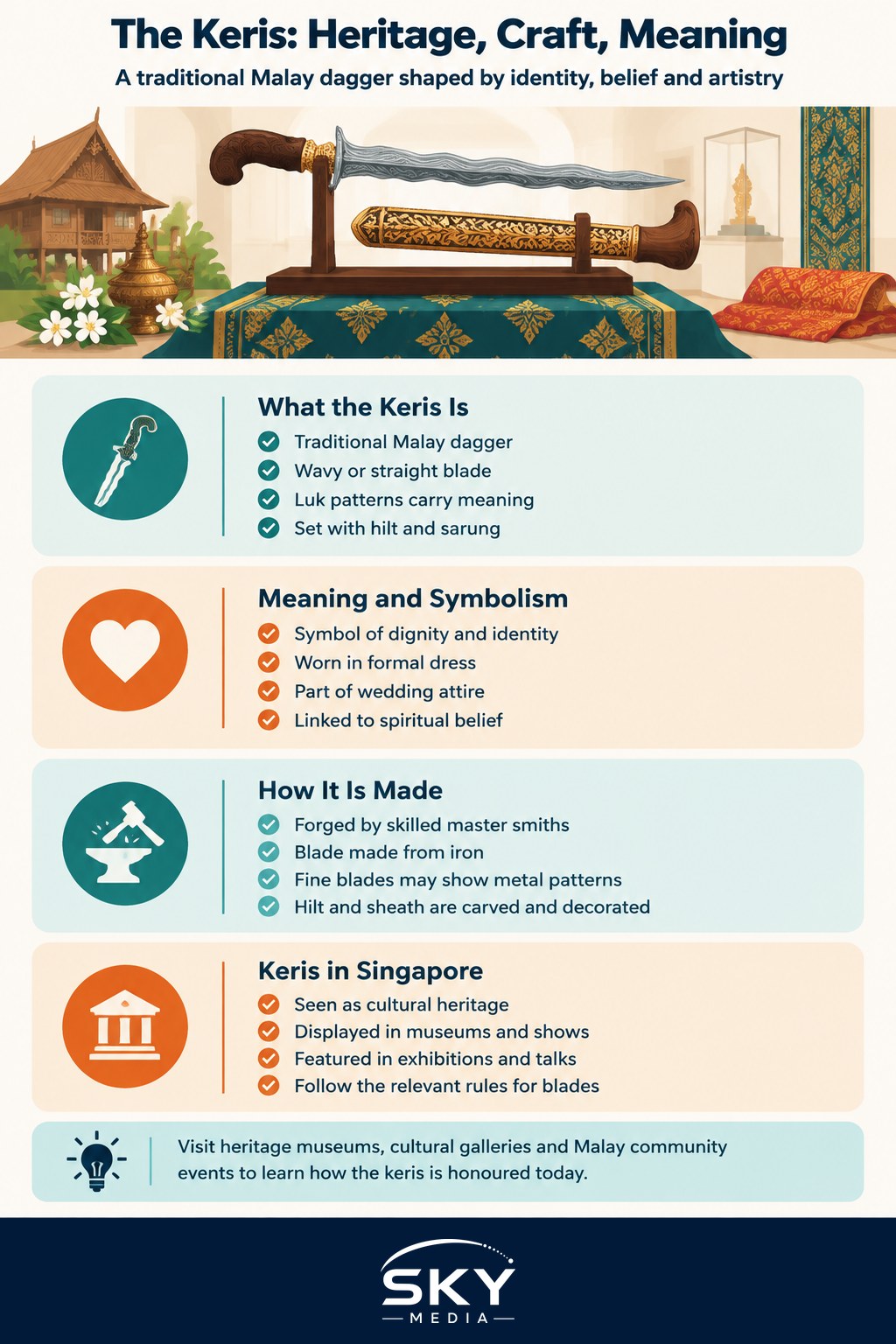
The keris, sometimes spelt kris, is a traditional dagger distinguished by an asymmetrical blade that may be either straight or, most famously, wavy. The waves are known as luk, and their number carries meaning in traditional lore. The blade is set into a decorated hilt and rests in a matching sheath, or sarung, so that the finished object is as much an artwork as an implement. It belongs to a wider family of Malay bladed heritage that also includes items such as the parang and the sundang, though the keris holds pride of place.
The origins of the keris reach back many centuries into the history of the Malay Archipelago, with early forms associated with the great kingdoms of the region. As trade, migration, and empire spread across the seas, the keris travelled with Malay culture throughout what is now Indonesia, Malaysia, Singapore, and beyond. It became embedded in courtly life, ceremony, and daily identity. The keris was so significant to the cultures of the region that it has been recognised internationally as a masterpiece of intangible cultural heritage, a mark of its importance to humanity as a whole.
Cultural and Spiritual Significance
To understand the keris, it helps to set aside the idea of a mere blade and think instead of a cultural heirloom. In traditional Malay society the keris was worn as part of formal dress, tucked into the waist as a sign of a man’s status, maturity, and honour. It was passed down through families as an heirloom, carrying the memory of ancestors and the standing of a lineage. Even today a keris features in traditional Malay wedding attire, where the groom may wear one as part of his ceremonial costume, and it appears in formal cultural regalia.
The keris also carries a deep spiritual dimension. In traditional belief a keris could hold an inner power or spirit, and a well made blade was thought to possess character and even a protective quality for its owner. Certain forms and the number of waves were associated with particular qualities. This reverence means that the keris has always been treated with respect and ceremony rather than casual handling. Its symbolic role sits comfortably within the broader tapestry of Malay arts, close in spirit to shadow theatre traditions such as wayang kulit shadow puppetry in Singapore, which draw on the same reservoir of legend and belief.
How a Keris Is Made
Crafting a keris is a demanding art that traditionally combined the skills of a master smith, known in some traditions as an empu, with those of carvers and decorators. The blade is forged from iron, and in fine examples different metals are folded and worked together so that a pattern emerges on the surface, sometimes brought out through careful treatment of the metal. This patterning, along with the shaping of the waves, requires great skill and patience, and each blade is essentially unique.
The hilt and sheath are arts in their own right. Hilts may be carved from wood, horn, or other materials into flowing forms, sometimes stylised into shapes drawn from nature or legend, and they can be inlaid or decorated with fine detail. The sheath is shaped to fit the blade and often features a broad decorative top. The result is a harmonious whole in which metalwork, carving, and ornament come together. This union of many crafts places the keris among the great achievements of regional handwork, alongside the enduring skills celebrated in traditional trades in Singapore.
The Keris in Singapore Today
In modern Singapore the keris is firmly understood and respected as cultural heritage. It appears in the national coat of arms of the region’s history, in museum collections, in cultural performances, and in traditional dress at weddings and formal occasions. Malay cultural organisations, heritage institutions, and community groups help keep knowledge of the keris alive through exhibitions, talks, and demonstrations that explain its history and symbolism to new generations.
It is worth noting that, as with bladed items generally, the keris is subject to the laws and regulations that govern such objects in Singapore, and those interested in owning or displaying one should always follow the relevant rules and handle any blade responsibly and respectfully. The proper place for the keris today is as a treasured symbol of heritage, not as a weapon.
How to Learn More and Experience It
Anyone curious about the keris can begin at Singapore’s heritage museums and cultural galleries, where historic examples are displayed with explanations of their meaning and craft. Malay heritage centres and cultural festivals often feature the keris in exhibitions and talks, sometimes alongside demonstrations of traditional dress and ceremony. Cultural performances and heritage programmes offer another window into its role in weddings and courtly tradition.
For a deeper appreciation, look out for current heritage exhibitions, community workshops, and cultural events run by Malay heritage groups and museums, and seek out knowledgeable practitioners and educators who continue to study and share this art. Understanding the keris is a rewarding way to connect with the wider effort of preserving Singapore heritage, and to see how a single object can hold the identity, artistry, and beliefs of an entire culture.
Frequently Asked Questions
What do the waves on a keris blade mean? The waves are known as luk, and their number carries meaning in traditional lore. Certain forms and numbers of waves were associated with particular qualities. Blades may also be straight, though the wavy form is the most famous.
Is it legal to own a keris in Singapore? The keris is subject to the laws and regulations that govern bladed items in Singapore. Anyone interested in owning or displaying one should follow the relevant rules and handle it responsibly. Check with the authorities if in doubt.
Where can I see a keris in Singapore? Heritage museums and cultural galleries display historic examples with explanations of their meaning and craft. Malay heritage centres and cultural festivals often feature the keris in exhibitions and talks. Check current programmes.
Why is the keris part of traditional wedding attire? It was worn as part of formal dress as a sign of a man’s status, maturity and honour, and today a groom may wear one as part of his ceremonial costume at a traditional Malay wedding.
Who makes a keris? Traditionally a master smith, known in some traditions as an empu, working together with carvers and decorators. The blade is forged from iron, and fine examples fold different metals together to bring out a surface pattern, so each blade is essentially unique.
Further reading: Malay Silat: A Martial Art And Cultural Heritage