
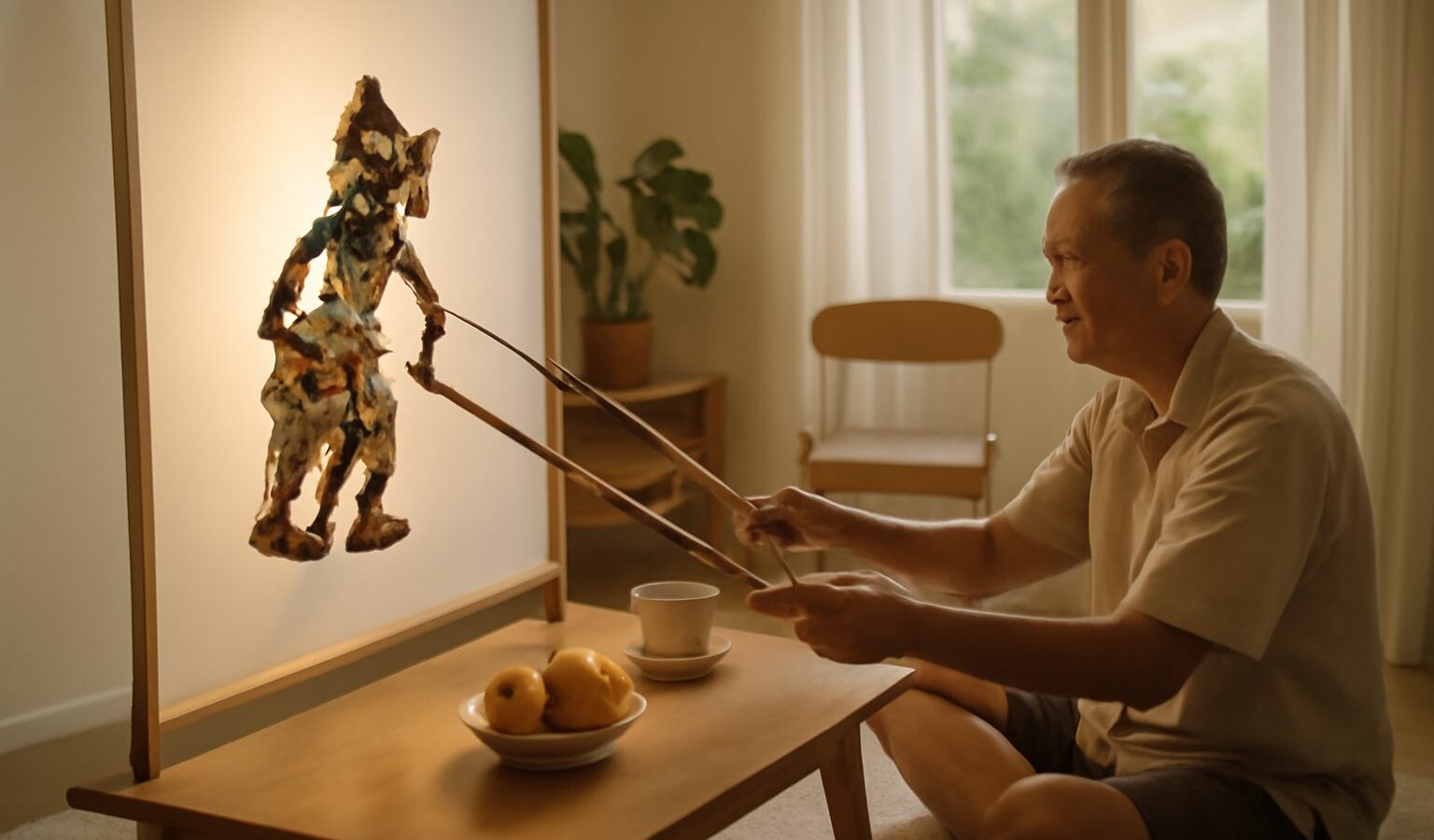
Few art forms capture the imagination quite like wayang kulit, the shadow puppetry tradition of the Malay world. The name comes from Malay, where “wayang” means theatre or show and “kulit” means skin or leather, a nod to the intricately cut leather puppets whose shadows dance across a lit screen. For newcomers to Singapore, an evening of wayang kulit is a window into stories, music and craft that have travelled across the region for centuries and still find a home here.
What wayang kulit is and where it comes from
Wayang kulit is a form of shadow theatre in which flat, articulated puppets, cut and painted from treated leather, are held against a stretched white cloth screen. A lamp behind the puppets throws their shapes forward as shadows, so the audience traditionally watches the silhouettes rather than the puppets themselves. The effect is atmospheric and dreamlike, with figures that seem to breathe as the puppeteer tilts and trembles them.
The art form is spread across the Malay Archipelago, with well known traditions in the Malay Peninsula, Java and Bali, each with its own puppet styles, music and repertoire. Many of the stories draw on the great Indian epics, the Ramayana and the Mahabharata, adapted over generations into local versions. In the Malay tradition, a much loved cycle is the Hikayat Seri Rama, a retelling of the Ramayana. Alongside these epics sit local legends, comic interludes and moral tales, so a night of wayang kulit can move from high drama to broad humour.
Because it grew up in the same cultural region that shaped Singapore, wayang kulit is part of the wider Malay heritage that newcomers encounter across the island, from language and food to music and dress.
How a performance is made and performed
At the heart of every performance is the puppeteer, known in Malay as the dalang, or respectfully as the tok dalang. The dalang is remarkably versatile, voicing every character, narrating the story, cueing the musicians and manipulating the puppets, often for hours at a stretch. This single performer holds the whole world of the play together, which is why skilled practitioners are so highly regarded.
The puppets themselves are works of craft. They are traditionally cut from treated buffalo or cow hide, chiselled with fine perforations that let light through, then painted and mounted on a central rod of horn or bamboo, with thinner rods to move the arms. The lacework of tiny holes is what gives the shadows their delicate, filigree quality.
Music is inseparable from the drama. Performances are accompanied by a gamelan, a Southeast Asian ensemble built around tuned bronze gongs, metallophones and drums, whose shimmering, cyclical patterns underscore the action and mark entrances, battles and moments of calm. The general shape of a performance often runs like this:
- The screen is set up with the lamp behind it and the puppets arranged to either side, with a “tree of life” figure planted at the centre.
- The dalang opens with an invocation and introduces the setting and characters.
- The story unfolds through dialogue, narration and movement, punctuated by the gamelan.
- Comic and everyday characters lighten the mood between the grander scenes.
- The tale reaches its resolution, and the tree of life closes the performance.
Where to see and learn wayang kulit in Singapore today
In multiracial Singapore, wayang kulit lives on as part of the Malay cultural calendar and the wider arts scene. Curious newcomers can look out for it in a few kinds of settings:
- Heritage institutions and community showcases, where performances and demonstrations are staged for family audiences.
- Arts venues and festivals, where traditional forms are sometimes reimagined by contemporary theatre makers alongside more classical stagings.
- Schools, community clubs and gamelan groups, where workshops introduce the puppets, the music and the storytelling.
A natural starting point is the Malay Heritage Centre, which interprets the history and living culture of the Malay community in Singapore and is a good anchor for understanding where wayang kulit sits within it. Institutions supported by the National Heritage Board also programme talks, demonstrations and family activities from time to time, so it is worth checking current listings rather than relying on fixed dates.
If you want to go beyond watching, look for hands on workshops that let you handle a puppet, try a simple movement, or sit with a gamelan ensemble. Even a short session makes the skill of the dalang far easier to appreciate.
| Element | Malay term | What it is |
|---|---|---|
| The puppeteer | Dalang | The single performer who voices, narrates and moves every puppet |
| The puppets | Wayang | Leather figures, cut and perforated, mounted on rods |
| The screen | Kelir | The stretched white cloth on which the shadows appear |
| The music | Gamelan | A tuned percussion ensemble of gongs, metallophones and drums |
| A core story | Hikayat Seri Rama | The Malay retelling of the Ramayana epic |
Why the tradition matters and how it is kept alive
Wayang kulit is more than entertainment. It is a way of carrying stories, values and humour across generations, and of gathering a community around a shared night of music and light. The tales often turn on themes of duty, loyalty, love and the tension between right and wrong, delivered with enough comedy and spectacle to keep everyone, from children to elders, absorbed.
Like many traditional crafts, it faces the pressures of a fast moving, screen filled world, and skilled practitioners are not easy to replace. That is exactly why the work of passing it on matters. Heritage bodies, community groups and individual artists keep the form alive through performances, teaching and by experimenting with new stories and staging, so that the art stays relevant rather than frozen. When newcomers turn up, watch with curiosity and bring friends along, they become part of that quiet act of preservation too.
For anyone keen to explore Singapore’s living traditions, wayang kulit pairs naturally with other Malay and Peranakan crafts. Explore more: read our guides to songket weaving, the nyonya kebaya, and traditional lantern making, or plan a visit using our Malay Heritage Centre guide.
Approached with respect and an open mind, an evening of shadow puppetry offers newcomers a memorable, unhurried way into one of the region’s oldest and most enchanting storytelling arts, and a reminder of how much heritage still flickers to life on a simple lit screen.