
If you have ever watched a band change songs on the spot, transpose a tune to suit a singer, and never once flip a page of sheet music, you have probably seen the Nashville number system at work. For anyone learning to play in worship bands, jam nights, or covers gigs, the Nashville number system in Singapore is one of the most practical shortcuts you can pick up. Instead of writing out chord names, you write numbers that describe each chord’s position in the key. Once you understand it, you can play the same song in any key without rewriting a thing.
What the Numbers Actually Mean
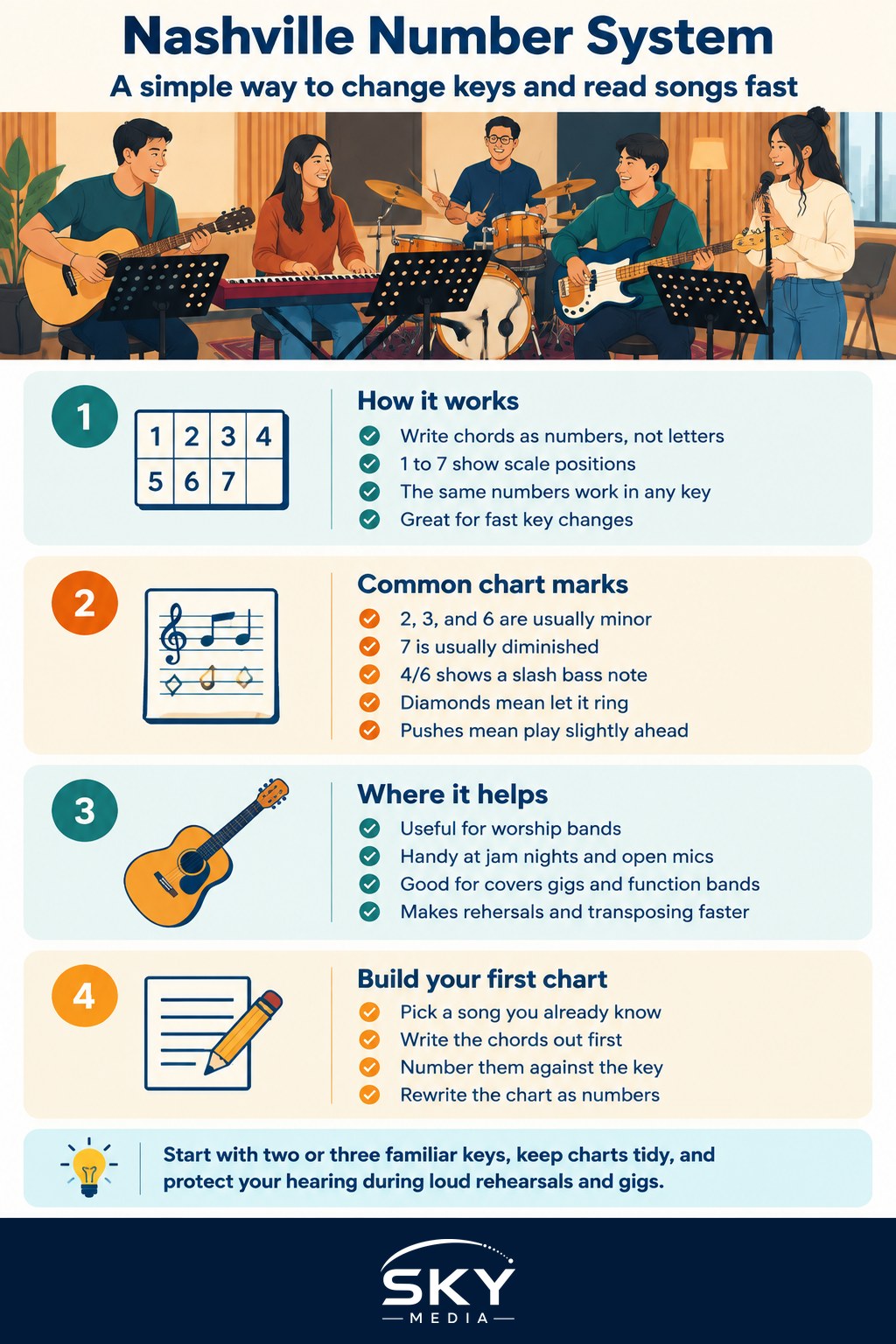
The idea is simple. Take a major scale and give each note a number from 1 to 7. In the key of C, that gives you C (1), D (2), E (3), F (4), G (5), A (6), and B (7). Every chord in that key gets the number of its root note. So a C chord is “1”, an F chord is “4”, and a G chord is “5”. A very common pop progression, C to G to A minor to F, becomes 1, 5, 6, 4.
Now here is the magic. If your singer says the song sits too high and asks you to move it down to the key of A, you do not scribble out new chord names. The numbers stay exactly the same: 1, 5, 6, 4. You just play them in A instead, which gives you A, E, F sharp minor, and D. The chart never changes, only the key does. This is why session players and worship musicians love it, and it pairs naturally with knowing how to transpose music by ear or on paper.
There is one detail worth learning early. Some numbers are naturally minor chords in a major key. The 2, 3, and 6 chords are usually minor, and the 7 is a diminished chord that you rarely use as is. In practice, players often mark minor chords with a small dash or a lowercase “m”, so a 6 minor might be written as “6-” or “6m”. Do not worry about memorising every rule at once. Play through a few songs and the pattern sinks in.
Reading and Writing a Chart
A Nashville chart is usually just a row of numbers grouped to match the song’s sections. You might see a verse written as 1 4 5 1 and a chorus as 6 4 1 5. Bar lines and simple spacing tell you how long to hold each chord. If two chords share one bar, players often underline them or put them close together so you know to split the bar.
A few common markings help you capture more detail:
- A “4/6” or “4 over 6” style slash tells you the chord on top with a different bass note underneath, useful for smooth bass lines and voice leading.
- A diamond drawn around a number means “let it ring”, so you strike the chord once and hold.
- Pushes, shown with a small arrow or a caret before a number, mean you hit the chord slightly ahead of the beat.
To build your first chart, pick a song you already know and write out the chords as names. Then work out the key, number each chord against that key, and rewrite the whole thing as numbers. It feels slow the first few times. After a handful of songs it becomes second nature, and you will start hearing songs in numbers rather than letters. It helps a lot if you already grasp chords and progressions, since the number system is really just a faster way of writing what you already know.
Why It Suits Singapore Musicians
Plenty of local music happens in flexible, fast-moving settings. Church bands rotate vocalists with different ranges, open mic hosts call songs on the fly, and function bands cover requests they may not have rehearsed. In all of these, being able to change key instantly is a genuine superpower. You spend less time rewriting charts and more time actually playing.
It also makes rehearsals kinder on everyone. When a singer struggles with a high chorus, you simply announce a new key, and the whole band follows the same numbers. No one is left squinting at chords they cannot reach. If you play in these settings, it is worth pairing this skill with solid live performance habits so transitions stay smooth on stage.
A Few Practical Tips
Start by getting comfortable in two or three common keys before you try to jump around freely. Practise the same three-song set in different keys until moving between them feels easy. Keep your charts tidy, because a clear number chart is faster to read than a messy one under stage lights.
If you rehearse with amps or in-ear monitors, remember to protect your hearing. Keep stage volume sensible, take breaks during long practices, and use earplugs or proper in-ear monitoring at louder gigs, since prolonged loud exposure can cause permanent hearing damage. Your ears are your most important instrument, so look after them.
The Nashville number system rewards a little patience. Spend a couple of weeks numbering songs you already love, and you will gain a skill that makes you flexible, fast, and genuinely useful in any band. Grab a familiar tune, work out its numbers, and try playing it in a new key today.
Frequently Asked Questions
How do I write minor chords in the Nashville number system? Most players add a small dash or a lowercase m after the number, so a minor sixth chord appears as 6- or 6m. In a major key the 2, 3 and 6 chords are normally minor. Agree on your notation with your band so everyone reads the same chart.
Can the Nashville number system be used for songs in a minor key? Yes. You can number the chords from the minor scale’s home note, or treat the relative major as the key and number from there. Either works as long as the whole band uses the same method. Write the choice at the top of the chart.
Is the Nashville number system better than standard chord names? Neither is better overall. Chord names are clearer when everyone plays one fixed key, while numbers shine when you need to change key quickly. Many musicians use both, keeping letter names for the final version and numbers for rehearsals and band charts.
How do I work out the numbers if I only know the chord names? First identify the key, usually from the first and last chords. Then write out the major scale and number its notes one to seven. Match each chord’s root to that scale. Practising on a few songs you know well makes this quick and natural.
What should I learn before using the Nashville number system? Know your major scales in a few keys and the basic chords built on them. Being able to find the root of a chord quickly matters most. Once chords and scales feel familiar, the numbers are simply a quicker way to write them.