

Most cars leave the factory with an audio system built to a price, not to a standard. The speakers are often paper cones, the amplifier sits inside a basic head unit, and the doors rattle the moment you turn the volume up. A sensible car audio upgrade in Singapore does not need to mean a boot full of subwoofers. Done in the right order, a few targeted changes can make your daily drive along the PIE or your weekend trip to Johor sound far better.
This guide walks through the four main parts of a car audio system, the order in which most people upgrade them, and how to choose an installer you can trust. It also covers how to protect your warranty, insurance and resale value.
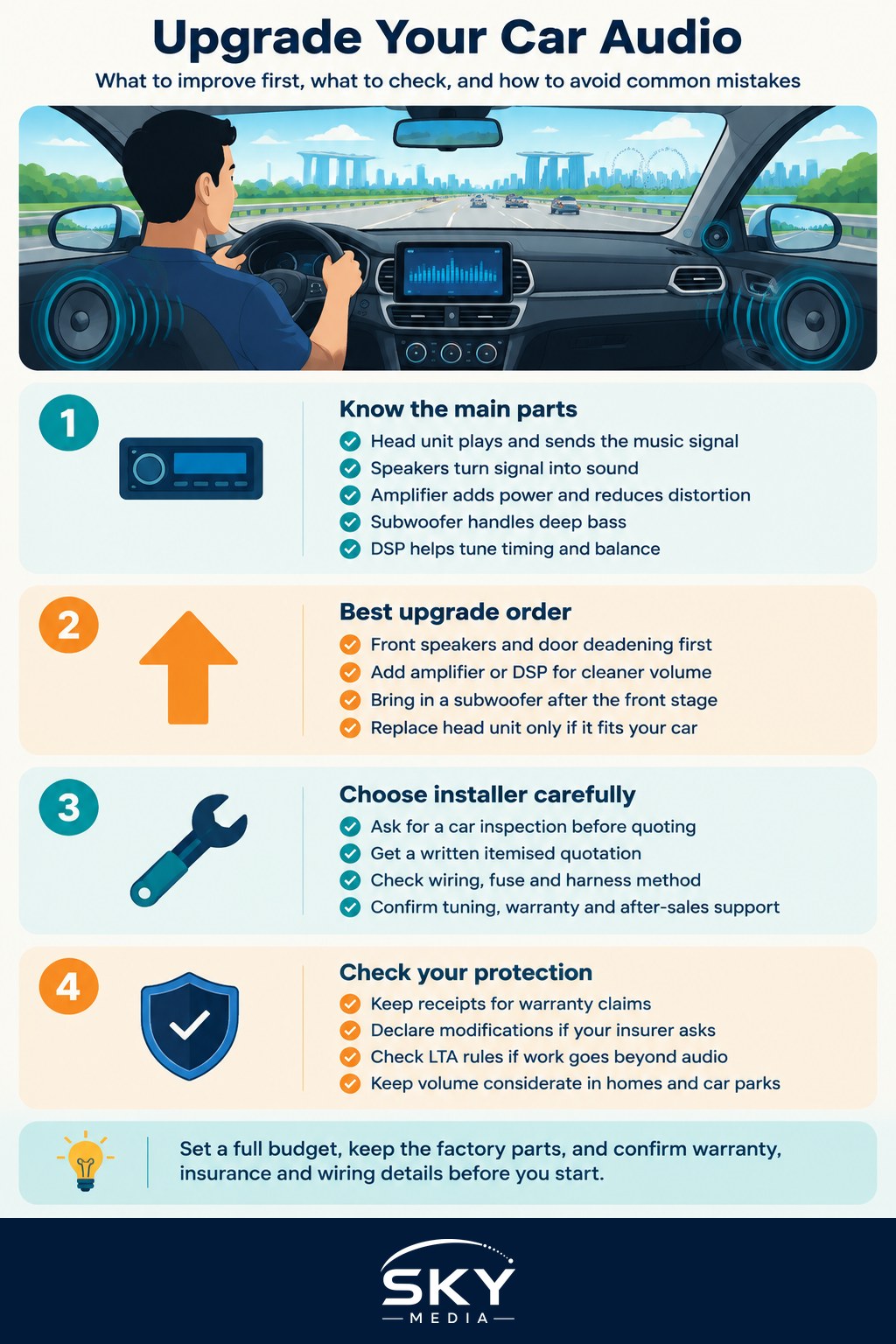
How a Car Audio System Fits Together
Before spending anything, it helps to understand what each part does.
- Head unit. The screen or radio in your dashboard. It plays your music source, handles Bluetooth, Apple CarPlay or Android Auto, and sends a signal to the speakers or an amplifier.
- Speakers. Usually a pair in each front door (a mid-bass driver plus a small tweeter near the mirror or dashboard) and a pair at the rear. They turn the electrical signal into sound, and they are the weakest link in most factory systems.
- Amplifier. Boosts the signal so the speakers can play loudly without distortion. Factory head units have a small built-in amplifier that runs out of power quickly.
- Subwoofer. A large driver dedicated to low bass. It takes the hardest work away from the door speakers.
- Digital signal processor (DSP). A small box that adjusts timing, equalisation and crossovers so sound appears to come from the dashboard in front of you rather than from the door near your knee.
The Upgrade Order That Gives the Best Value
There is no single correct sequence, but the table below reflects the order most enthusiasts and installers suggest, because each step builds on the one before.
| Upgrade step | What it improves | What to watch for |
|---|---|---|
| Front speakers and door sound deadening | Clarity, vocals, less door rattle | Speaker size and mounting depth must suit your doors |
| DSP or amplifier | Volume without distortion, better tuning | Needs proper power wiring and a fuse near the battery |
| Subwoofer | Deeper, tighter bass | Takes boot space; under-seat units save room |
| Head unit replacement | Features, screen, phone integration | May not be possible in cars with integrated screens |
| Rear speakers | Fill for rear passengers | Often the lowest priority for the driver |
Start With the Front Speakers
The front speakers do most of the work you actually hear. A decent component set (a separate woofer and tweeter with a passive crossover) is usually the most noticeable single change. Ask the installer to add sound deadening material to the inner door skin at the same time. Car doors are thin metal shells, and damping them reduces rattles and improves bass from the same speaker.
Add Power and Tuning
If the new speakers sound good at low volume but harsh when pushed, the factory head unit is likely running out of power. A compact amplifier, or an amplifier with a built-in DSP, solves this. A DSP is especially useful in cars, because the driver sits off-centre and the speakers are at different distances from each ear. A good tune corrects for that.
Bring in a Subwoofer
Once the front stage is sorted, a subwoofer lets the door speakers focus on mid-range. You do not need a huge enclosure. Slim under-seat subwoofers and compact boot units suit hatchbacks and sedans, and preserve space for groceries and luggage.
Replace the Head Unit Only if It Makes Sense
An aftermarket head unit can add wireless CarPlay, a bigger screen and better audio controls. In older cars this is a strong upgrade. In newer cars, it may disrupt steering wheel controls, reversing cameras or vehicle settings, so ask your installer to confirm compatibility first. Small plug-in adapters can sometimes add wireless phone mirroring without replacing the screen at all.
Choosing a Car Audio Installer in Singapore
Workmanship matters as much as the equipment. A good installer will listen to what music you play and how loud, then recommend parts to suit. When comparing shops, check:
- Whether they inspect the car first. A reputable workshop looks at your door space, wiring and existing system before quoting.
- A written, itemised quotation. It should list each component, labour, sound deadening and any wiring kits, so you can compare like for like.
- Wiring practice. Ask how they will run power cables, whether they use a fuse close to the battery, and whether they cut factory wiring or use plug-and-play harnesses. Harnesses make it easier to return the car to stock later.
- Tuning. If you buy a DSP, ask whether tuning is included and whether you can come back for a re-tune after a week of listening.
- Warranty on parts and labour. Get the terms in writing, including what happens if a rattle or electrical fault appears later.
Be wary of a hard sell for the most expensive brand, or of quotes that seem far lower than others without explanation. Prices vary a lot depending on the car, the parts and the labour involved, so get two or three quotes before deciding.
Warranty, Insurance and Legal Points to Check
Cars in Singapore are a large investment, so protect it.
- Manufacturer warranty. Some dealers may decline warranty claims on electrical faults they link to aftermarket wiring. Read your warranty booklet or ask the authorised dealer before any work, and keep receipts.
- Insurance. Some insurers ask you to declare modifications. Expensive audio equipment may not be covered for theft or damage unless declared. Check your policy wording and speak to your insurer.
- Vehicle rules. Standard audio upgrades are generally not structural modifications, but rules on vehicle modifications, lighting and anything that affects safety are set by the Land Transport Authority (LTA). If your work goes beyond audio, for example adding lighting or altering the vehicle body, check the LTA website first.
- Noise. Playing music very loudly in residential areas can lead to complaints. Keep volume considerate, especially in car parks and at night.
If you are still deciding whether to keep your car for the long term, our explainer on how COE works in Singapore is useful context, since there is little point investing heavily in a car you plan to deregister soon.
Practical Tips Before You Spend
- Decide on a budget for the whole system, not just the first part. It avoids buying a cheap amplifier that limits better speakers later.
- Keep the factory parts. Store removed speakers and head units so you can refit them before selling the car, if the buyer prefers stock.
- Watch battery load. Large amplifiers draw a lot of current. Ask the installer whether your battery and alternator can cope, especially for cars that sit idle in traffic.
- Listen before you buy. Bring a playlist you know well when you audition demo cars, so you can hear real differences.
If you enjoy tinkering with gear at home too, the same step-by-step thinking applies in our guides on upgrading a gaming PC and choosing an audio interface.
Is a Car Audio Upgrade Worth It?
For drivers who spend a lot of time on the road, a modest upgrade of front speakers, door deadening and some proper tuning often delivers most of the improvement for a fraction of the cost of a full system. Treat the subwoofer and head unit as later stages once you know what you are missing. Choose an installer who explains their wiring and puts everything in writing, check your warranty and insurance, and your car can become one of the most enjoyable places to listen to music.
Frequently Asked Questions
Can I install a car audio upgrade myself? Simple speaker swaps are doable for some, but amplifiers and DSPs need proper power wiring and a fuse near the battery. Mistakes can damage the car’s electronics or create a fire risk. A reputable installer also provides a warranty on workmanship, which DIY work does not.
How long does a car audio installation take? It depends on what is being installed, as speaker swaps are quicker than a full system with amplifier, DSP and sound deadening. Tuning may need a separate visit. Ask the installer for a time estimate and whether you need to leave the car at the workshop.
Is it worth upgrading the audio if my COE is close to expiring? Probably only for modest, removable changes. Heavy spending is hard to recover when the car will be deregistered soon. Choose upgrades you can move to your next car, such as a DSP or speakers, and keep the factory parts for resale.
Does music quality depend on my source, not just the hardware? Yes. Low-bitrate streams or poor Bluetooth connections can limit what even good speakers deliver. Check the quality settings in your music app and consider a wired or high-quality connection if your head unit offers it. Better source files let upgraded gear show its value.
Will a loud subwoofer cause problems with neighbours? It can if played loudly in car parks or at night, as bass travels further than higher tones. Complaints are possible in residential areas. Keep the volume considerate, tune bass for the car’s cabin, and avoid idling with music at high volume.