

If your living room floor disappears under blocks, plush toys and plastic cars by dinner time, you are not alone. Singapore flats are compact, and toys arrive constantly from birthdays, festive seasons, relatives and school events. Toy rotation is a simple system that keeps most toys stored away and puts only a small selection out at any time, then swaps them on a regular schedule.
Done well, toy rotation reduces daily mess, makes tidying faster and often helps children play longer with what they have. This guide sets out a practical rotation system designed for HDB flats and condos where storage space is tight.
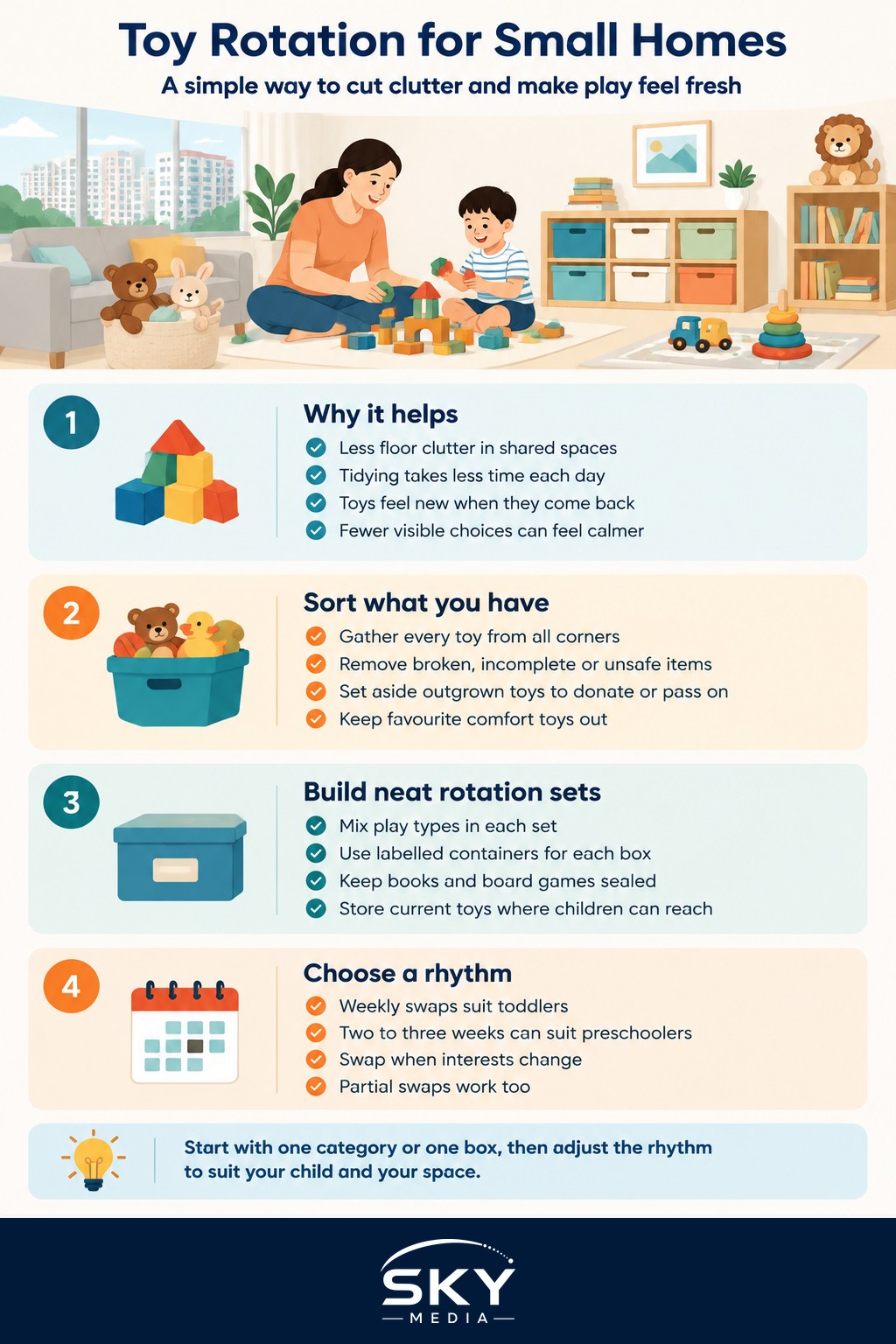
Why Toy Rotation Works in Small Homes
Many parents notice that children with fewer toys in view tend to settle into deeper play. When everything is out, kids often flit from toy to toy, tip out boxes and move on. A smaller, well-chosen selection invites them to explore each item more.
Rotation also helps the adults:
- Less floor clutter, which matters in a living room that also serves as a play area, dining space and work corner.
- Faster clean-ups, because there is simply less to put away.
- Toys feel new again when they return after a few weeks in storage.
- Fewer impulse buys, since you can see what you already own.
- Easier spotting of broken or outgrown items, so they can be repaired, donated or recycled.
Fewer visible choices can also make the day calmer for parents. Our piece on how to reduce decision fatigue explains why a smaller set of options feels easier for adults, and the same idea often applies to children.
Step 1: Gather, Sort and Edit Everything
Before you can rotate, you need to see the full collection. Pick a weekend afternoon, ideally when your child is out or napping if they are very young.
- Collect every toy in one place, including those in bedrooms, the car, grandparents’ homes and the bottom of the stroller basket.
- Remove broken, incomplete or unsafe items. Check for loose small parts, cracked plastic and dead batteries.
- Set aside outgrown toys to donate, pass to relatives or sell second-hand. Ask older children to help choose which to give away.
- Keep true favourites out of rotation. A comfort toy or a beloved soft toy should always be available.
- Group the rest by type of play, not by size or colour.
Useful play categories include:
- Building and construction (blocks, bricks, magnetic tiles)
- Pretend play (kitchen sets, dolls, figurines, dress-up)
- Vehicles and movement (cars, trains, ride-ons)
- Puzzles and games
- Art and craft supplies
- Books
- Sensory and early-learning toys for babies and toddlers
Step 2: Build Rotation Sets That Fit Your Space
Divide each category across several sets so every set has a balance of play types. A common approach is three to five sets, but choose what fits your storage.
Each set might include:
- One building toy
- One or two pretend-play items
- One vehicle or movement toy
- One puzzle or game
- A small selection of books
- Basic art supplies, if your child can use them safely
Keep each set in its own labelled container. Clear boxes with lids make it easy to see contents, while photo labels help younger children recognise what is inside.
Where to Store Rotation Sets in an HDB Flat or Condo
| Storage spot | Works well for | Things to check |
|---|---|---|
| Top of wardrobes | Lightweight boxes of soft toys or vehicles | Use a stable step stool; keep heavy boxes lower |
| Under the bed | Flat, wide boxes of puzzles, blocks or dress-up | Choose boxes with lids to keep out dust |
| Household shelter (bomb shelter) | Larger sets and bulky toys | Keep the space usable and follow any rules on its use |
| Storeroom or service yard cabinet | Sealed containers of off-rotation toys | Avoid damp spots; humidity can damage cardboard and books |
| Closed cabinet in the living room | The current set, within child reach | Leave open shelf space so toys are easy to see and return |
Singapore’s humidity is hard on paper and cardboard. Store books and board games in sealed plastic containers, and consider adding a moisture absorber.
Step 3: Set Up the Play Area for the Current Set
The toys that are out should be easy to see, reach and put back.
- Use low open shelves or a few shallow baskets rather than one deep toy chest.
- Display, do not pile. Give each toy its own spot so children can see the choices.
- Keep it small. For toddlers, a handful of items is plenty. Older children can manage a slightly larger set.
- Create a simple tidy-up routine, such as putting everything back on the shelf before dinner or bath time.
- Leave a little floor space free for play, especially in a living room shared with the family.
Step 4: Choose a Rotation Rhythm
There is no correct schedule. Watch your child and adjust.
- Weekly swaps suit toddlers who lose interest quickly.
- Every two to three weeks often suits preschoolers who return to the same themes.
- Swap on interest, not the calendar, if you notice a toy being ignored or a new interest emerging, such as dinosaurs or trains.
- Partial swaps work too. Keep popular items out and change only two or three things.
Rotate while children are asleep or at school so the new set feels like a small surprise. Some families let older children choose which box comes out next, which builds a sense of ownership.
Keeping the System Going Over Time
A rotation system only works if new toys do not quietly undo it.
- Apply a one-in, one-out habit after birthdays and festive seasons.
- Ask relatives gently for experience gifts, books or consumables like craft supplies.
- Review all sets every few months to remove outgrown toys.
- Write a simple list on your phone of what is in each box so you do not need to open them all.
- Involve children in sorting donations, which teaches them about sharing and caring for belongings.
Toy clutter often mirrors mental clutter for busy parents. If the household to-do list is feeling heavy too, try a brain dump to clear mental clutter before your next sorting session.
Toy rotation is not about owning fewer toys forever. It is about making the toys you have work harder in the space you have, so your home feels calmer and your children enjoy their play more.
Frequently Asked Questions
What age should I start rotating my child’s toys? You can start once there are more toys than your child plays with, often from the toddler stage. For babies, a simple small basket changed occasionally works. There is no required age. Start whenever clutter or loss of interest becomes the issue.
What if my child protests when a favourite toy disappears? Keep the true favourites out of the rotation, as the article suggests, and let your child help choose which box comes out. If they ask for something stored, bring it back. Rotation should reduce clutter, not become a source of upset.
Does toy rotation work with siblings of very different ages? Yes, with separate sets. Keep small-part toys for the older child in a place the younger one cannot reach, and make one shared set for toys both can use safely. Label boxes by child or age so choking hazards stay out of reach.
Where can I donate toys my children have outgrown? Charities, community drives, schools and preschools often accept toys in good condition, but each has its own rules, so ask before you drop them off. Clean the toys and check for missing pieces. Passing them to friends or relatives also works well.
Should I clean toys before putting them into storage? Yes. Wipe or wash toys according to their material and let them dry completely, since stored damp items can grow mould in Singapore’s humidity. Take out batteries to prevent leaks, and use sealed boxes. This also keeps them fresh when they come back out.
Further reading: How to Help Siblings Share Toys Without Constant Fights