

When your mind feels like a dozen browser tabs open at once, you cannot think clearly or rest properly. Learning how to do a brain dump gives you a simple release valve: you move every task, worry and half-formed idea out of your head and onto paper, where you can actually see it. This guide shows you the method and, just as importantly, what to do afterwards.
What a Brain Dump Actually Is
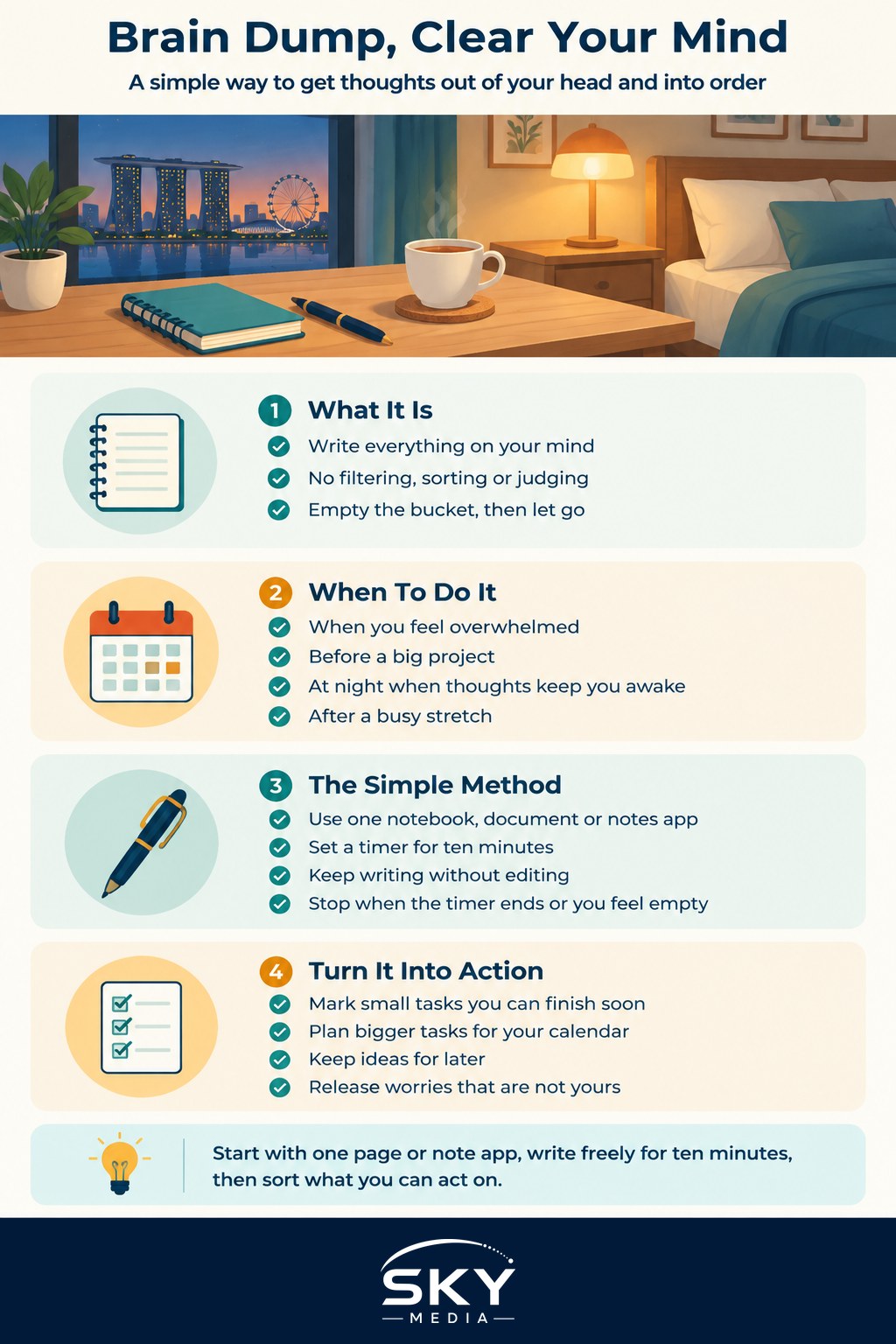
A brain dump is the practice of writing down everything on your mind without filtering, sorting or judging. There is no structure at this stage. You are simply emptying the bucket so it stops overflowing.
The relief is real. Your brain is good at having ideas and terrible at storing them. Every unfinished task you try to remember takes up quiet background effort. Once it is written down, your mind can let go, because it trusts the note to hold it.
When to Do One
There is no wrong time, but certain moments call for it especially:
- When you feel overwhelmed and cannot decide where to start.
- On a Sunday evening before the week begins.
- Before a big project, to surface everything it involves.
- At night, when racing thoughts keep you awake.
- After a busy stretch, to catch what fell through the cracks.
The Step-by-Step Method
The process is deliberately simple. Complexity defeats the purpose.
- Grab one tool. A notebook, a blank document or a notes app. One place, so nothing scatters.
- Set a timer for ten minutes. A limit stops you overthinking and keeps the energy up.
- Write everything. Tasks, worries, ideas, reminders, things you keep meaning to do. Do not organise. Do not judge whether something is silly or small.
- Keep the pen moving. If you stall, write “what else is bothering me” and let the next thought surface.
- Stop when the timer ends or when your mind feels genuinely empty.
The rule that matters most: no editing while you dump. Sorting too early jams the flow. Get it all out first.
From Chaos to Order
An unsorted list brings relief but not action. Once everything is out, spend a few minutes turning the pile into something useful. Read through and mark each item.
- Do: small tasks you can finish in a few minutes.
- Plan: bigger tasks that need a slot on your calendar.
- Someday: ideas worth keeping but not now.
- Let go: things that, seen in daylight, do not matter.
- Not mine: worries or tasks that belong to someone else.
That last two categories are quietly powerful. A brain dump often reveals how much you carry that you could simply release.
Brain Dump Versus a To-Do List
People sometimes confuse the two, but they serve different purposes and work best in sequence.
| Feature | Brain Dump | To-Do List |
|---|---|---|
| Goal | Empty the mind | Direct the day |
| Structure | None, freeform | Ordered and prioritised |
| Content | Tasks, worries, ideas | Actionable tasks only |
| Frequency | As needed, when full | Daily or weekly |
| Feeling | Relief and release | Focus and control |
Think of the brain dump as the raw material and the to-do list as the finished product. You dump first, then refine.
Make It a Habit
A one-off brain dump helps in a crisis, but a regular rhythm keeps the clutter from building up again. Try a short weekly dump and a longer monthly one.
A Weekly Reset
Every Sunday, spend ten minutes emptying your mind of everything the coming week holds. Then sort the list and slot the important items into your week. You will begin Monday with a clear head rather than a vague dread.
A Night-Time Version
If your thoughts spin when you lie down, keep a notebook by the bed. When something surfaces, write it and let it go. You are telling your mind it is safe to switch off because the note will remember for you.
Try Different Formats
There is no single right way to dump your thoughts. Experiment until you find what suits you, and feel free to switch depending on the day.
- The plain list. Fast and simple. Just write line after line as things come.
- The categories page. Draw a few boxes first, such as work, home and personal, then drop items into whichever fits. Useful when you already sense the main areas weighing on you.
- The mind map. Put a central worry in the middle and branch outwards. Good for untangling one big, tangled issue.
- The spoken dump. If writing feels slow, talk it out into a voice note, then jot down what surfaced. Handy on a commute.
The tool matters less than the honesty. What counts is getting everything out without holding back.
What to Do With Worries, Not Just Tasks
A brain dump often surfaces anxieties as well as chores, and these deserve different handling. A task asks “what is my next action”. A worry asks “is this mine to solve, and can I do anything about it right now”.
For each worry you write down, ask two questions. Can I act on this today? If yes, turn it into a task. If no, can I schedule a time to deal with it, or must I simply accept it for now? Naming a worry and deciding you cannot act on it yet is itself a release. It stops circling because you have looked at it squarely.
Common Mistakes to Avoid
A few habits blunt the benefit:
- Sorting while writing. It stops the flow and defeats the point.
- Judging your items. Nothing is too small or too silly for the page.
- Never revisiting the list. A dump you never sort just becomes another source of stress.
- Using it as your permanent system. The dump is a first step, not a home for tasks.
Closing Thoughts
Knowing how to do a brain dump is a small skill with an outsized effect on how calm and clear you feel. Empty the bucket, sort what spills out, and act on what matters. The rest you can plan for later or release entirely.
Try it once this week when your mind feels crowded. Ten minutes and a blank page may be all it takes to feel like yourself again.
Explore more: How to Prioritise Your Tasks · Planning Your Week for Less Stress · How to Rest Properly
Frequently Asked Questions
Is it better to do a brain dump on paper or on my phone? Paper tends to feel slower and calmer, with fewer distractions, while a phone is always on hand and easy to search. Choose what you will actually use, and keep it to one place. A voice note is handy if writing feels slow.
How is a brain dump different from journaling? A brain dump is quick and practical, aimed at emptying tasks, worries and ideas so you can sort them. Journaling is usually more reflective, exploring feelings and meaning at greater length. You can use both, and a dump often leads naturally into a journal entry.
What if a brain dump brings up feelings that overwhelm me? Pause, breathe and put the pen down if you need to. You do not have to deal with everything at once. Pick one item to act on and leave the rest. If distress is persistent or heavy, talk to a doctor or counsellor.
Can students use a brain dump before exams? Yes. Listing worries, topics and tasks can calm a crowded head and show what needs revising. Sort the list into what to study this week and what can wait. Take breaks, and speak to a teacher or school counsellor if stress feels unmanageable.
How can I share the mental load at home with a brain dump? Each person can dump their own tasks, then sort together into who handles what. Seeing everything written down makes hidden work visible and the split fairer. Review it regularly rather than leaving one person to remember it all.