

Price tags only tell you what a garment costs to buy, not what it costs you to own. Understanding cost per wear flips the question from “how much is this?” to “how much will this cost me each time I wear it?”, and that small shift can quietly change how you shop. A cheap top worn twice can work out more expensive than a well-made one worn weekly for years. This guide explains the simple idea, the maths behind it, where it can mislead you, and how to use it to build a wardrobe that feels good value in Singapore.
What Cost Per Wear Actually Means
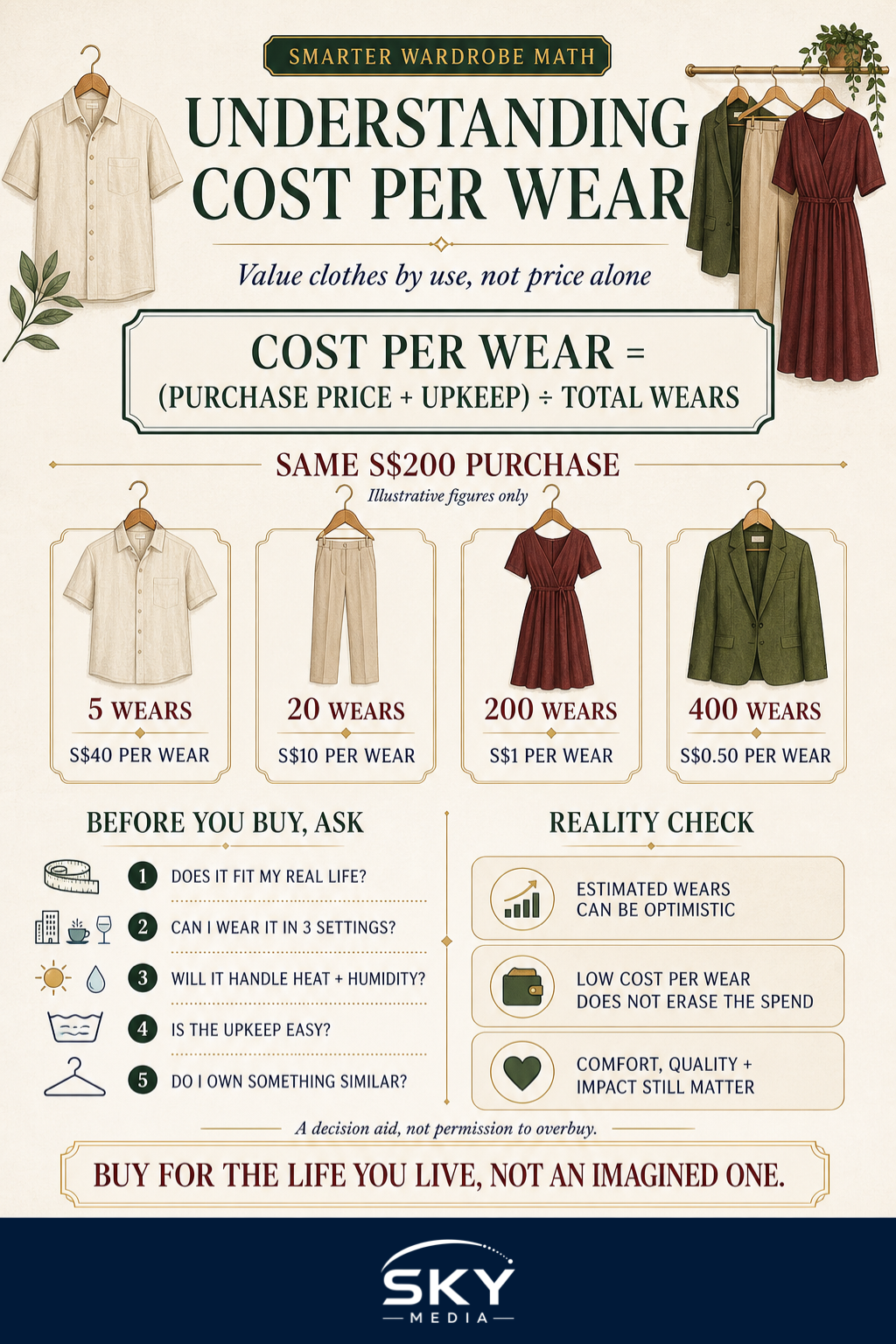
Cost per wear is the total cost of a garment divided by the number of times you wear it. It reframes value around use rather than the sticker price, so a piece you reach for constantly earns its keep, while a bargain you never touch stays expensive no matter how little it cost.
The idea is useful because it matches how clothes actually behave in your life. Two people can buy the same item and get wildly different value from it depending on how often it suits their days. Rather than a rule, treat cost per wear as a lens: a way to sense-check a purchase before you make it and to understand your existing wardrobe better. It rewards versatility, comfort and durability, the qualities that make you actually wear something, over novelty that stays on the hanger.
The Simple Maths
The formula is refreshingly plain. Take what you paid, add any ongoing costs such as dry-cleaning or repairs, and divide by the realistic number of times you will wear the piece over its life.
Cost per wear = (purchase price + upkeep) / total wears
The figures below are illustrative only, chosen to show the maths rather than to quote real prices, which vary by brand and change over time. Imagine a piece that cost 200 dollars in these examples.
| Scenario | Illustrative cost | Wears over its life | Cost per wear |
|---|---|---|---|
| Trend piece worn a few times | 200 | 5 | 40.00 |
| Occasion piece for events | 200 | 20 | 10.00 |
| Versatile staple worn weekly | 200 | 200 | 1.00 |
| Everyday basic worn often | 200 | 400 | 0.50 |
Same outlay, very different value. The lesson is not that expensive is always better, it is that how often you wear something matters as much as what you pay. A modestly priced piece you wear constantly can have a lower cost per wear than a pricier one that suits your life less often.
Where Cost Per Wear Can Mislead
For all its usefulness, cost per wear is easy to twist into a justification for buying things you do not need. It is worth knowing its blind spots so it stays a helpful tool rather than an excuse.
- The wear count is a guess. It is tempting to imagine wearing something far more than you realistically will, which flatters the maths. Be honest about your actual routine.
- It ignores the money you spent. A very low cost per wear on a piece you rarely reach for still means cash tied up in your wardrobe that could have gone elsewhere.
- It says nothing about quality or comfort. A piece only racks up wears if it holds up and feels good, so pair the sums with checks on how well something is made.
- It can excuse overbuying. “It is such good value per wear” is not a reason to own five similar coats. Value per wear only counts if the item genuinely earns its place.
- It leaves out non-money costs. Fast, throwaway clothing carries real environmental and labour costs that never appear in a simple division.
Used with these caveats in mind, cost per wear guides you toward pieces you will love and use, rather than talking you into more than you need.
Making It Work in Singapore
Cost per wear takes on a local flavour in our climate and lifestyle. The pieces that rack up the most wears here are usually breathable, comfortable in heat and humidity, and easy to care for. A lightweight cotton or linen shirt you can wear to work, weekends and errands will quietly earn a very low cost per wear, while a heavy wool coat, however well made, may sit unused for years and stay expensive by this measure.
A few habits help you buy for genuine wear rather than wishful thinking:
- Favour versatile pieces that suit multiple settings, from the office to dinner, since flexibility drives up wears.
- Choose fabrics that survive frequent washing in a humid climate without losing shape or fading fast.
- Factor in upkeep. Something that needs constant dry-cleaning or delicate handling adds to its real cost and may get worn less because it is a hassle.
- Buy for the life you actually lead, not an imagined one, so the occasion pieces you rarely need do not crowd out the staples you wear daily.
Secondhand shopping, through a marketplace like Carousell, a thrift store or a swap with friends, can push cost per wear even lower, since you often pay a fraction of the original price for a piece with plenty of life left. Bought thoughtfully, a pre-loved staple can be some of the best value in your wardrobe.
A Calmer Way to Value Clothes
At its heart, understanding cost per wear encourages you to buy less and choose better, which tends to be kinder to both your budget and the planet. When you weigh a purchase by how much you will genuinely wear it, you naturally drift toward well-made, versatile pieces you love and away from impulse buys that fade to the back of the wardrobe.
There is no need to run the numbers on every single purchase. The point is the mindset: pausing before you buy to ask whether this piece truly fits your life and will be worn often. Do that regularly and your wardrobe becomes smaller, more useful and better value, without any strict rules or spreadsheets.
Explore more
Cost per wear only rewards pieces that actually last, so pair it with how to spot quality clothing to judge durability before you buy. To sidestep the impulse purchases that wreck your averages, read how to avoid fast fashion traps, and get more mileage from what you own with how to elevate basic outfits.