

If you have ever watched a competitive match and wondered why some teams get a second chance while others go home after one loss, you are already asking the right question. Learning about esports tournament formats in Singapore helps you follow the drama, understand what is at stake in each game, and even plan a small event of your own at a local LAN shop or community centre. This guide explains the common formats in plain English, without jargon, so both curious beginners and seasoned fans can keep up.
Why formats matter
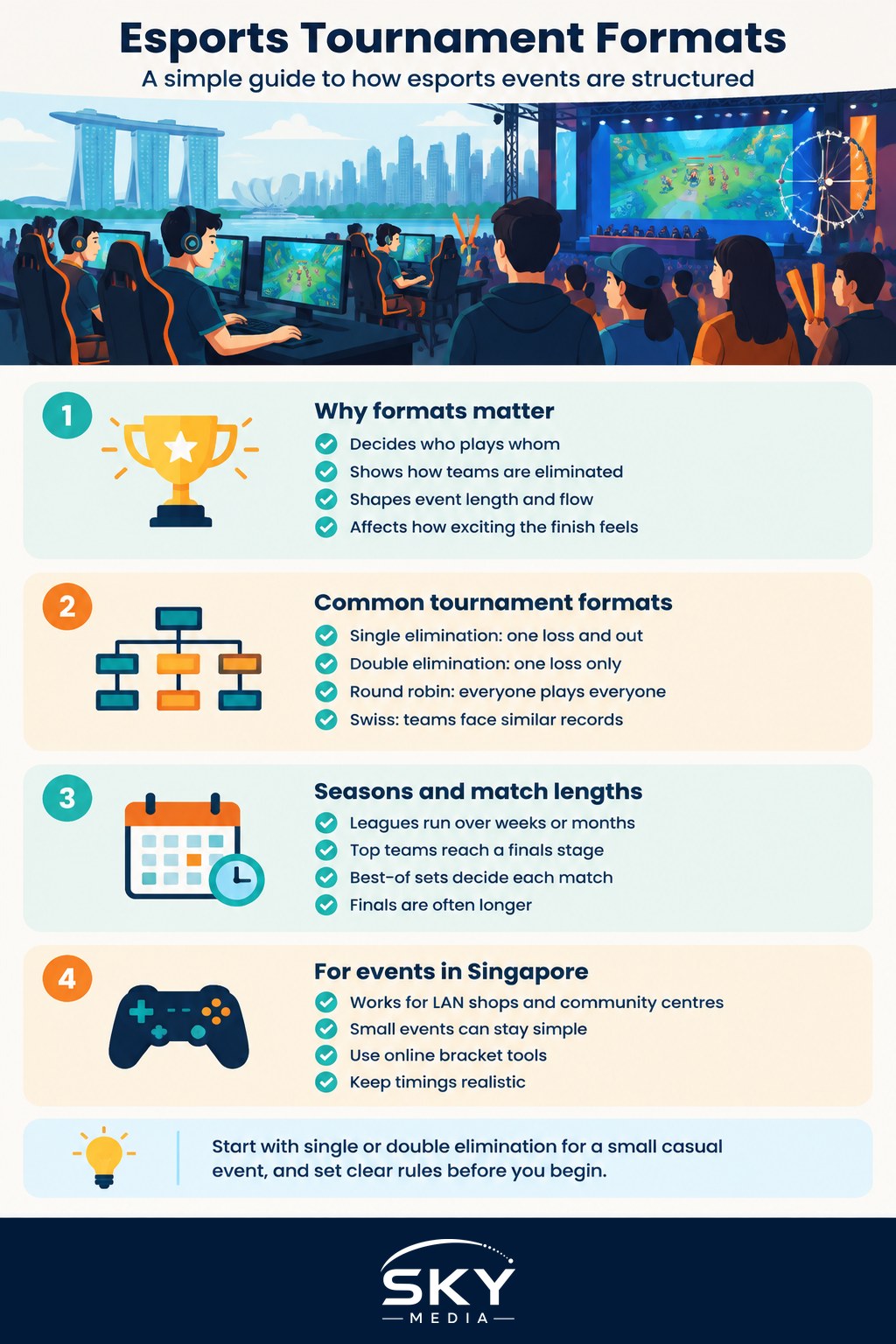
A tournament format is simply the set of rules that decides who plays whom, how many losses knock a team out, and how a champion is crowned. The format shapes everything. It affects how long an event runs, how forgiving it is to a team that has one bad day, and how exciting the finish feels for viewers. Organisers pick a format based on how many teams are taking part, how much time and venue space they have, and what kind of experience they want to create. A quick weekend cup at a gaming cafe in Singapore needs a fast, simple format, while a season-long league can afford something longer and more thorough.
Understanding formats also makes you a smarter viewer. When you know a team is in a “lower bracket” and one more loss ends their run, every round carries more weight. If you are new to watching competitive play, our guide on how to watch esports pairs nicely with this one.
The common formats
Here are the formats you will run into most often.
Single elimination
This is the classic knockout bracket. Lose once and you are out. It is quick, easy to follow, and full of tension because every match is do or die. The downside is that a strong team can be eliminated early by an off day or a tough draw, so it can feel harsh. Single elimination suits short events with limited time, which is why many local one-day tournaments use it.
Double elimination
Here every team can lose once and still continue. Teams start in an upper bracket, and a loss drops them to a lower bracket rather than out of the event. A second loss ends their run. This format is more forgiving and often seen as fairer, since one mistake does not end everything. It takes longer to run, but it rewards consistency and gives fans more matches to enjoy.
Round robin and group stages
In a round robin, every team plays every other team, and standings are decided by wins and losses over many games. This is thorough because the results reflect overall performance rather than a single match. Large tournaments often use a group stage, splitting teams into smaller round robin groups, then sending the top finishers into a knockout bracket called the playoffs. This mix gives everyone several games while still building toward an exciting finale.
Swiss format
The Swiss system pairs teams with similar records against each other over several rounds without knocking anyone out early. Win and you face tougher opponents, lose and you face easier ones, until clear standings emerge. It handles a large number of teams in fewer games than a full round robin, which is why big open events like it.
Leagues and seasons
A league runs over weeks or months, with teams playing a full schedule before the top ones reach a finals stage. Leagues reward long-term consistency and give fans a story to follow across a season. Many established scenes use this structure, and you can read more about it in our look at how esports teams work.
Best-of formats within a match
Separate from the bracket, each meeting is played as a “best of” set. A best of three means the first team to win two games takes the match, and a best of five needs three wins. Longer sets reduce the role of luck and reward the better prepared team, while a single game is faster but swingier. Finals are usually longer sets to make the climax feel earned.
Running or joining an event in Singapore
If you fancy organising a small competition, start simple. A single or double elimination bracket works well for a casual gathering at a LAN shop, and free bracket tools online handle the pairings for you. Set clear rules on maps, timings, and conduct before you begin, and keep the schedule realistic so nobody waits around for hours. To find events to watch or enter, our overview of local gaming tournaments in Singapore is a good starting point.
The practical takeaway is this. There is no single best format, only the right one for the number of teams, the time available, and the experience you want. Once you can name what you are watching, the whole event becomes easier to follow and a lot more fun.
Frequently Asked Questions
Which tournament format is fairest for the teams? Double elimination and round robin are usually seen as fairer, since one bad match does not end a run. Single elimination is quickest but harsher. The fairest choice also depends on how many teams there are and how much time the organiser has.
How many teams do I need to run a small tournament? You can start with as few as four teams, using a simple bracket. More teams means more matches and time, so match the format to your venue hours. A group stage followed by playoffs helps once the number grows.
What is a seeded bracket and why does it matter? Seeding ranks teams or players before the bracket is drawn so the strongest do not meet too early. It makes results more meaningful and keeps the later rounds exciting. Organisers may seed by past results or rankings, or draw randomly for casual events.
What happens if two teams finish with the same record in a group? Organisers use tiebreakers, which should be announced before the event. Common ones include head-to-head results or game differences. Always read the tournament rules, because each event can set its own tiebreak order.
What free tools can I use to manage brackets for a local event? Many online bracket generators handle pairings, scores and updates for free, and some let spectators follow along on their phones. Pick one that supports your chosen format, and test it with a practice bracket before the event day.
Further reading: How to Host a Small Gaming Tournament in Singapore · Where to Watch Esports Tournaments in Singapore Live · How to Build a School Esports Tournament Bracket