

If you have ever felt that Social Studies is just a lot of reading with no clear right answer, you are not alone. Many students find it hard to know exactly what to memorise and how to score. The good news is that learning how to study social studies singapore schools teach becomes much easier once you understand what the subject is really testing: your ability to think, weigh evidence, and explain your reasoning clearly. This guide walks you through practical, doable steps, without any promises of magic grades.
A quick and honest note first. Syllabuses and exam formats are set by MOE and SEAB, and they can change over time. So always check your current syllabus, your school, or the SEAB website for the exact components, question types, and how the paper is structured. Treat the advice below as sound general study technique, not a fixed description of the paper.
Understand what the subject is asking of you
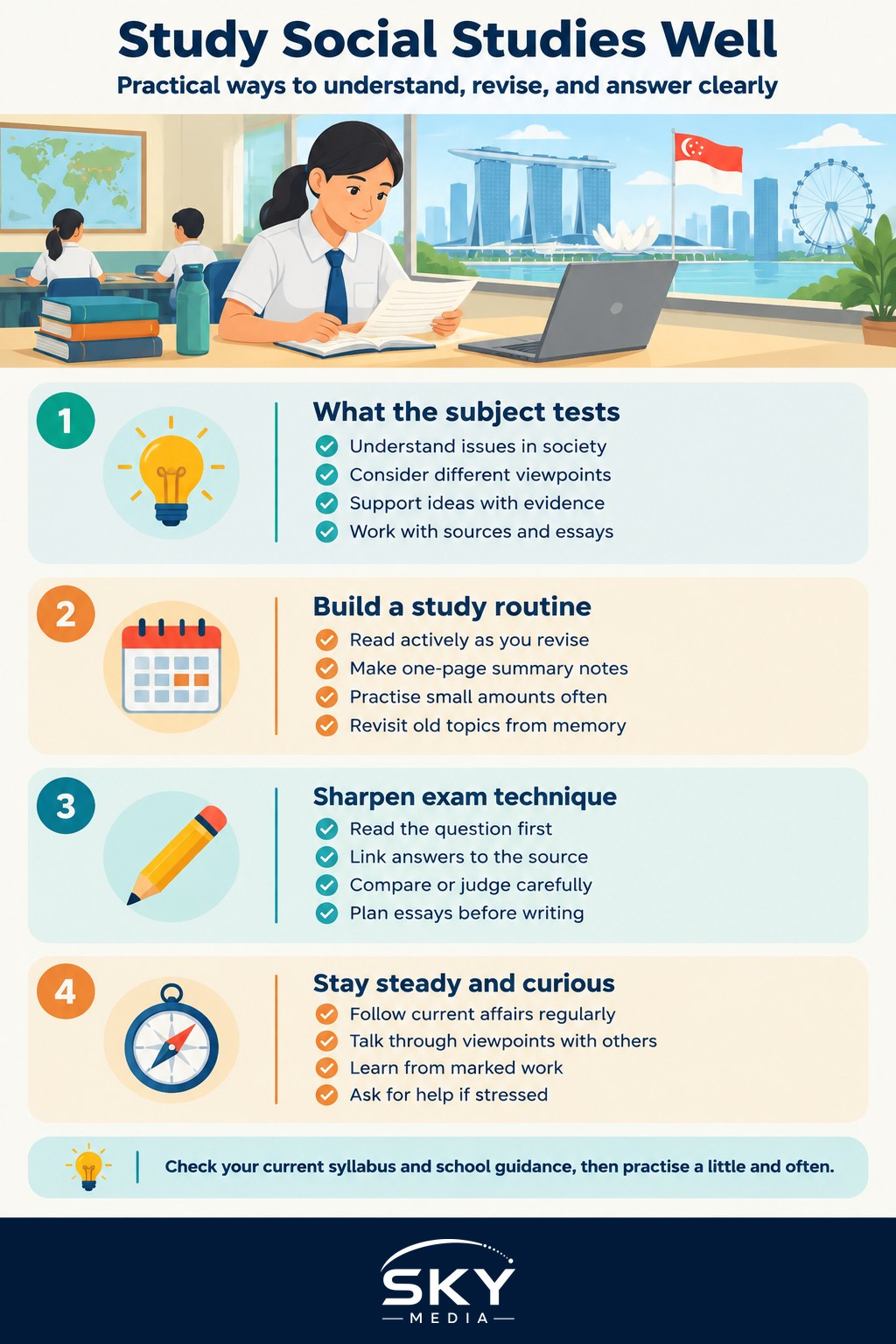
Social Studies is less about recalling facts and more about using them. Broadly, the subject asks you to understand issues in society, consider different points of view, and support your ideas with evidence. Two skills sit at the heart of it: working with sources, and building a reasoned response to an essay-style question.
For source work, you are usually asked to read text, cartoons, photographs, tables, or statements and then do something with them, such as infer a message, compare two sources, explain a purpose, or judge how useful or reliable a source is. The trick is to always link back to the source itself. Quote a short phrase, point to a detail, then explain what it shows. A common slip is writing what you already think instead of what the source actually says.
For the essay or structured response, examiners want a clear stand, developed points, and a balanced view. Learn the command words closely, because “explain”, “assess”, and “to what extent” all ask for different things. Building this habit early pays off, and our guide on understanding exam command words breaks down what each word is really asking.
Build a study routine that sticks
Cramming rarely works for a thinking subject. Short, regular sessions beat one long panic. Try these steps.
- Read actively. As you go through a topic, jot the main issue, the different views, and one or two strong examples. Do not copy whole paragraphs.
- Make your own summary notes. Turn each topic into a one-page map of the key debate and the evidence on each side. This forces you to process, not just highlight.
- Practise little and often. Do one source question or one paragraph a few times a week rather than a huge batch the night before.
- Revisit older topics. Come back to a topic a week later and test yourself from memory before checking your notes.
If you want a fuller system for spacing out revision, the ideas in using active recall to study and spaced repetition for better memory work very well for Social Studies content and case examples.
Sharpen your source and essay technique
Technique is where many marks are won or lost, so practise it deliberately.
For source-based questions, use a simple loop: read the question first, then read the source with that question in mind, then answer with evidence plus explanation. When comparing sources, name the point of agreement or difference before you explain it. When judging reliability, think about who produced the source, why, and when, rather than only whether you agree with it.
For essays, plan for two minutes before writing. A quick outline of your stand and your main points keeps your answer focused. Aim for clear paragraphs where each one makes a point, supports it with evidence, and explains how it answers the question. End with a short, reasoned conclusion that actually takes a position.
Marking your own work honestly is powerful. Compare your answer against the question requirements and ask what a stronger response would have added. Our piece on how to use model answers and mark schemes shows how to learn from marked work without simply copying it.
Keep perspective and stay steady
Social Studies rewards curiosity. Reading the news, talking about current issues with your family, and noticing different viewpoints all feed the subject naturally, so it does not have to feel like extra work. When practice questions feel discouraging, remember that this is a skill you build over months, not overnight.
If the workload ever feels heavy or you feel persistently stressed, talk to your teacher or a school counsellor. Progress in a thinking subject is uneven, and that is normal. Focus on understanding one topic well, practise your technique regularly, and check the current syllabus so you are preparing for the real thing. Do those steadily, and you give yourself the best honest chance of doing well.
Official sources: SEAB