

Understanding modes is one of those skills that suddenly makes a lot of songs click into place. A mode is simply a scale with its own flavour, built by starting a familiar set of notes from a different point. Once you hear how each mode feels, you can pick the exact mood you want for a melody.
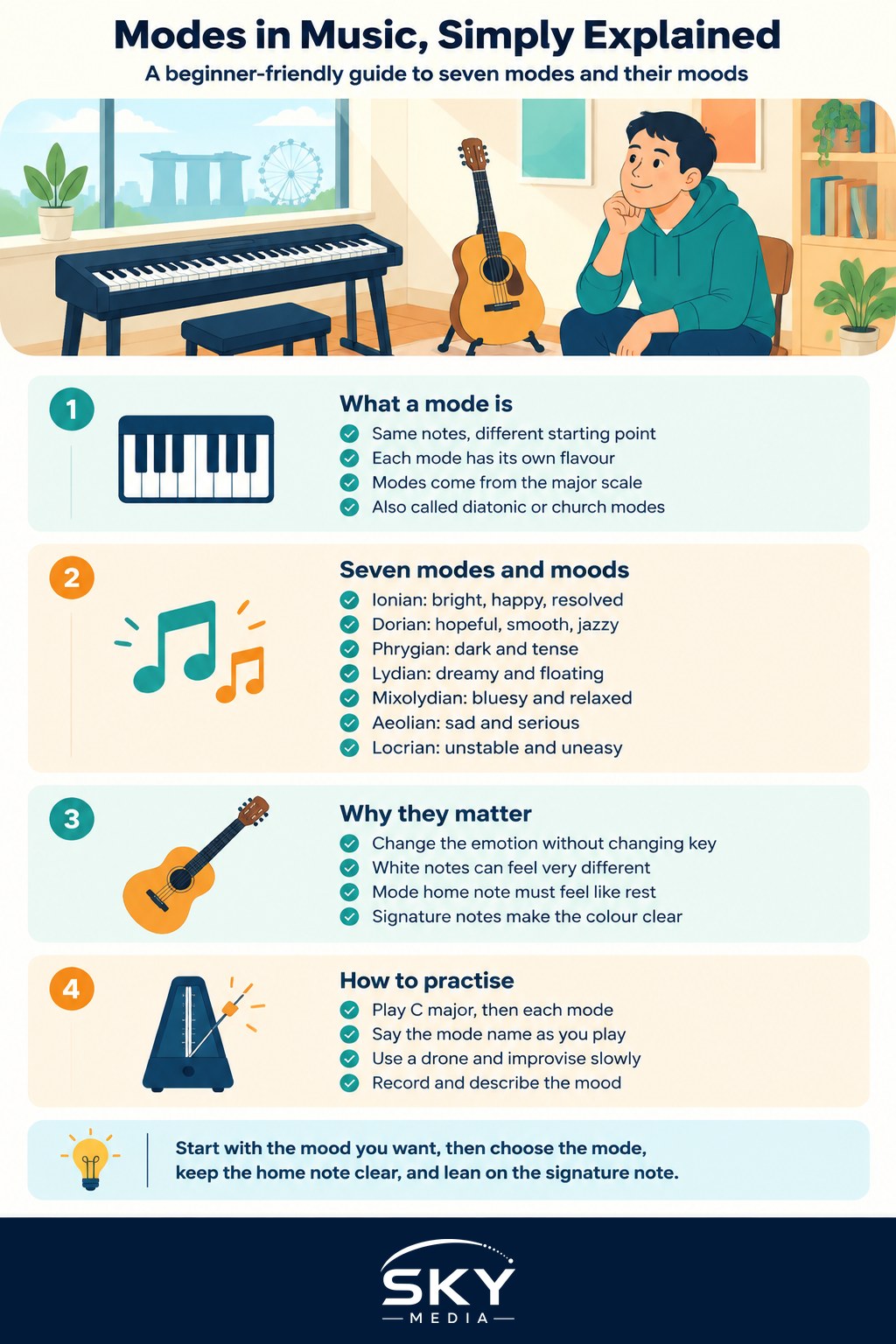
What a Mode Actually Is
Think of the seven white keys on a piano, from C to C. Play them in order and you get the C major scale. That happy, settled sound is the first and most famous mode, called Ionian.
Now play those same seven white keys, but start and end on D instead of C. You have not changed a single note, yet the scale feels different. It sounds a little sad, a little cool and jazzy. That is the Dorian mode. This is the whole idea behind modes: keep the same pool of notes, but shift the starting point, and the pattern of steps between the notes changes. That new pattern gives each mode its personality.
Because the seven modes here all come from the major scale, they are called the diatonic modes. Long ago they were used in church music, so you will sometimes hear them called the church modes.
The Seven Diatonic Modes and Their Moods
Here are all seven, shown on the white keys so you can try them at a keyboard right away. The mood words are a guide, not a rule, but they are a helpful starting point.
- Ionian (start on C): bright, happy, resolved. This is the plain major scale.
- Dorian (start on D): minor but hopeful, smooth and jazzy. Common in folk and funk.
- Phrygian (start on E): dark and tense, with a Spanish or flamenco feel.
- Lydian (start on F): dreamy, floating, magical. Popular in film scores.
- Mixolydian (start on G): major but bluesy and relaxed, great for rock and blues.
- Aeolian (start on A): sad and serious. This is the natural minor scale.
- Locrian (start on B): unstable and uneasy, rarely used for whole songs.
Why Modes Matter
Understanding modes gives you a fast way to change the emotion of a piece without leaving your key. Say you are writing a tune using only white notes. If you centre it on A, it feels melancholy. Centre the same notes on G and it turns warm and bluesy. Nothing else changes, only where the music feels at home.
Modes also explain why some songs feel major yet slightly off in a good way. A guitar riff that keeps landing on a bright chord but uses a flattened seventh note is usually Mixolydian. Recognising that helps you play along and write your own parts that fit.
A Worked Example You Can Hear
Let us compare two modes built on the same starting note, D, so the difference is easy to feel.
D Dorian uses the notes D, E, F, G, A, B, C. The important feature is the sixth note, B, which is a natural rather than a flat. That raised sixth is what gives Dorian its hopeful lift compared to a plain minor scale.
D Aeolian (natural minor) uses D, E, F, G, A, B flat, C. Here the sixth note is B flat. That single lowered note makes the scale sound noticeably sadder.
Play a slow melody in D Dorian, then play the same melody after flattening every B to B flat. You have just moved from Dorian to Aeolian, and you will hear the mood sink. This one note difference is the clearest way to understand what modes really do.
The Modes Compared at a Glance
The table below lines up each mode with its home note on the white keys, its overall feel and the single feature that makes it stand out. The “signature note” is the note that most defines the mood.
| Mode | Start note (white keys) | Overall mood | Signature note |
|---|---|---|---|
| Ionian | C | Bright, happy | Natural everything |
| Dorian | D | Hopeful minor | Raised sixth |
| Phrygian | E | Dark, tense | Lowered second |
| Lydian | F | Dreamy, floating | Raised fourth |
| Mixolydian | G | Bluesy major | Lowered seventh |
| Aeolian | A | Sad, serious | Lowered sixth |
| Locrian | B | Unstable | Lowered second and fifth |
How to Use Modes in Your Own Music
Start by choosing the mood you want, then pick the matching mode from the table. If you want something bright but slightly mysterious, try Lydian. If you want a groove that feels cool rather than sad, reach for Dorian.
Next, make sure your music actually points at the mode’s home note. A mode only sounds like itself when that note feels like the resting place. You can do this by ending phrases on it, by holding a drone on it in the bass, or by building your main chord around it. Without that anchor, the ear simply hears the parent major scale again.
Finally, lean on the signature note. Let your melody touch the raised fourth in Lydian or the flattened seventh in Mixolydian. Those notes are the fingerprints of each mode, so featuring them makes the character obvious.
A Simple Practice Routine
Try this short routine a few times a week to build your ear.
- Play C major up and down, then play each mode from its white key start, saying the name aloud.
- Hold a single bass note as a drone and improvise a slow melody above it in the matching mode.
- Record yourself, then listen back and describe the mood in your own words.
Keep Exploring
Understanding modes is really about hearing how the same notes can wear different costumes. Take it slowly, trust your ears, and treat each mode as a mood you can call on whenever a song needs a fresh colour. With a little practice, choosing a mode will feel as natural as choosing a chord.
Explore more: Understanding Scales and Keys · Music Theory Basics for Beginners · Ear Training for Musicians