
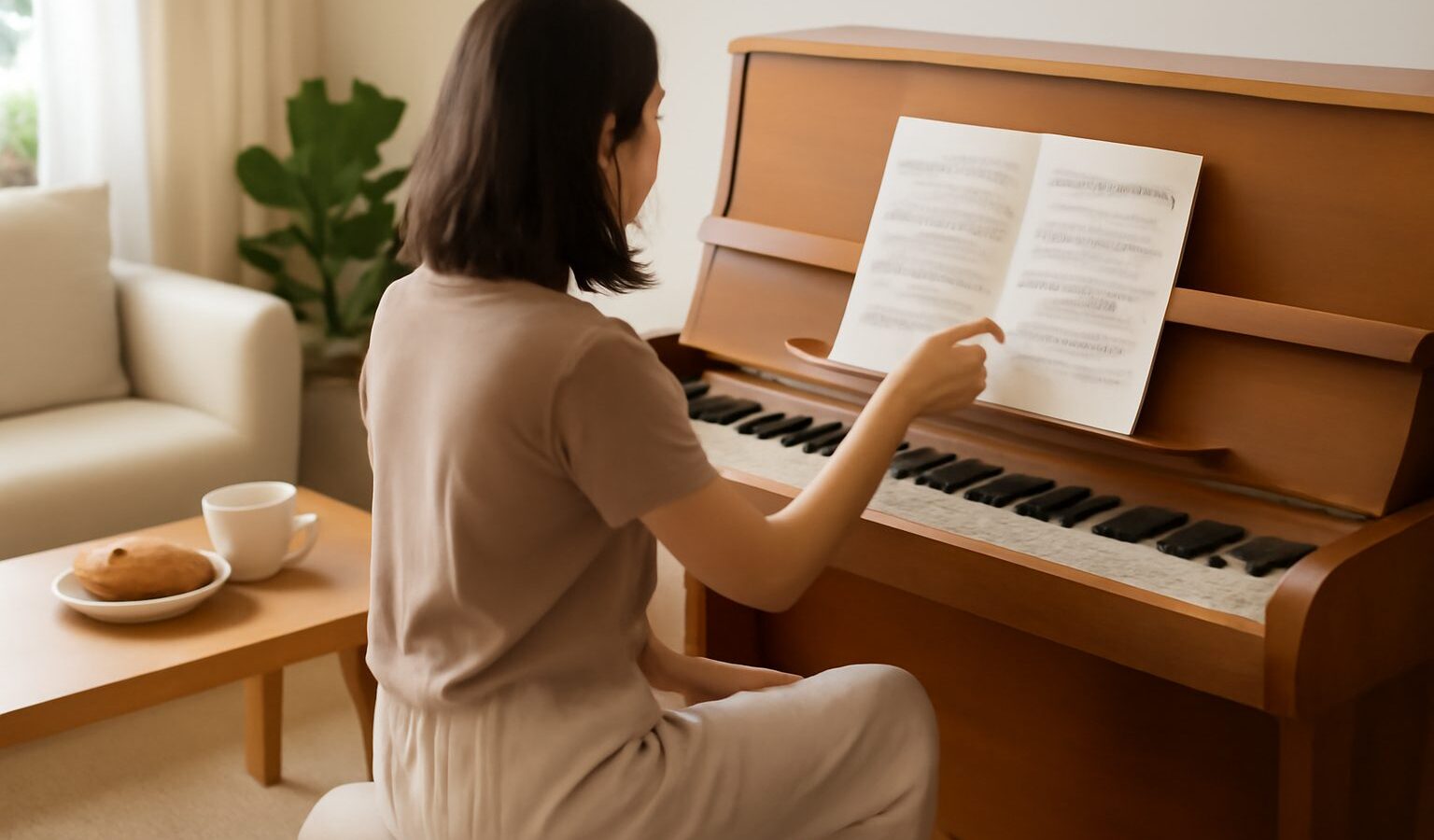
If you have ever looked at a page covered in dots, lines and squiggles and felt completely lost, you are in good company. Reading sheet music can seem like a secret code, but it is really just a clear picture of two things: which notes to play, and how long to hold them. Once those two ideas click, the rest falls into place quickly. This guide walks you through the basics in plain language, with small steps you can practise at home in Singapore, whether you are learning piano in an HDB flat, picking up the guitar, or joining a choir at your community centre.
You do not need any musical background to start. Give it a few short sessions, keep a pencil handy, and be patient with yourself. Reading sheet music is a skill, not a talent, and it grows with steady practice.
Why Bother Learning to Read Music
Plenty of people play by ear or follow tutorials online, and that is a perfectly good way to make music. So why learn notation at all? A few honest reasons stand out.
Reading music lets you play songs you have never heard, which opens up a huge world of pieces beyond what happens to be on video. It also helps you talk to other musicians clearly, so when you join a band, a church music team or a school ensemble, everyone is literally on the same page. If you plan to take graded exams with boards like the ABRSM or Trinity, which many Singapore students do, sight-reading is part of the assessment. Finally, seeing the shape of the music on paper helps you understand how songs are built, which makes learning faster over time.
You do not have to choose between playing by ear and reading. The strongest musicians usually do both.
The Staff, Clefs and Where Notes Live
Everything sits on the staff (sometimes called the stave): five horizontal lines with four spaces between them. Where a note sits, higher or lower on the staff, tells you its pitch. Higher on the page means a higher sound; lower means a lower sound.
At the start of the staff you will see a clef, a symbol that fixes which notes the lines and spaces stand for.
- The treble clef (it curls around the second line) is used for higher instruments and the right hand on piano: think flute, violin, most singing parts and guitar.
- The bass clef is used for lower sounds, such as the left hand on piano, the bass guitar and the cello.
For the treble clef, a classic memory trick helps. The notes sitting on the lines, from bottom to top, spell E, G, B, D, F, which many people remember as “Every Good Boy Deserves Fruit”. The notes in the spaces, from bottom to top, spell F, A, C, E, which is simply the word “FACE”. When a note goes above or below the five lines, we add short extra lines called ledger lines to carry it further.
Do not try to memorise everything at once. Learn a handful of notes around the middle of the staff first, then add more as you go.
Rhythm: How Long Each Note Lasts
Pitch tells you which note; rhythm tells you how long to hold it. This is where beginners often stumble, so take it slowly.
Music is measured in beats, a steady pulse like a ticking clock or your foot tapping. The notes are drawn differently depending on how many beats they last. At the start of the piece you will see a time signature, two numbers stacked like a fraction. The most common is 4/4, which means four beats in each bar. A bar (or measure) is a small chunk of music marked off by vertical bar lines, a bit like words grouped into sentences.
Here is a simple comparison of the most common note values in 4/4 time.
| Note | What it looks like | How many beats | Quick way to feel it |
|---|---|---|---|
| Whole note (semibreve) | Hollow oval, no stem | 4 beats | Hold for a full bar |
| Half note (minim) | Hollow oval with a stem | 2 beats | Two per bar |
| Quarter note (crotchet) | Filled oval with a stem | 1 beat | One tap of the foot |
| Eighth note (quaver) | Filled note with one flag or beam | Half a beat | Two per tap, say “1-and” |
Rests work the same way but tell you to stay silent for a set number of beats. Counting out loud, “1, 2, 3, 4”, while you clap the rhythm is the single best habit you can build early on. Master the rhythm away from your instrument first, then add the notes.
Sharps, Flats and Key Signatures
You will soon meet two small symbols: the sharp, which raises a note slightly, and the flat, which lowers it. On a piano these are usually the black keys. When a sharp or flat appears right next to a single note, it affects only that note for the rest of the bar.
More often, sharps or flats are gathered at the very start of each line, just after the clef. This group is the key signature, and it tells you which notes to raise or lower throughout the whole piece. It saves the composer from writing the same symbol over and over. For now, all you need to do is glance at the key signature before you start and remember to apply it as you play. Understanding why certain keys use certain sharps and flats comes later, and pairs well with a little music theory.
One more symbol worth knowing is the natural sign, which cancels a sharp or flat and returns the note to its normal pitch.
A Simple Practice Plan That Works
Reading music improves fastest with short, frequent practice rather than the occasional marathon. Try this gentle routine.
- Spend five minutes naming notes on flashcards or a free app, just the treble clef to begin with.
- Clap and count a short rhythm out loud before you touch your instrument.
- Play a very easy piece slowly, keeping a steady beat even if it means playing at a snail’s pace. Accuracy beats speed every time.
- Use a pencil to mark tricky notes or count beats above the bar. There is no shame in it, and you can rub it out later.
- Learn one new note or symbol per session, no more.
A metronome, whether a physical one from a local music shop or a free phone app, keeps your timing honest and is well worth using once you are comfortable. Keep your books and any printed scores away from damp windows too, as Singapore’s humidity can warp paper and swell instrument cases over time.
Common Beginner Mistakes to Avoid
A few habits slow people down without their realising it. Skipping the counting and rushing to play the notes is the most common one, and it makes rhythm sloppy. Trying to read fast pieces too early is another; start with music marked easy or grade one. Ignoring the rests, which are just as important as the notes, will throw off your timing. And comparing yourself to others, especially children who seem to soak it up quickly, only saps your confidence. Everyone learns at their own pace.
Above all, keep it enjoyable. Choose songs you actually like, celebrate small wins, and remember that even seasoned musicians were once staring at those five lines feeling exactly as puzzled as you might feel now.
Explore more
- /music-theory-basics-for-beginners
- /learning-to-sing
- /writing-your-first-song