
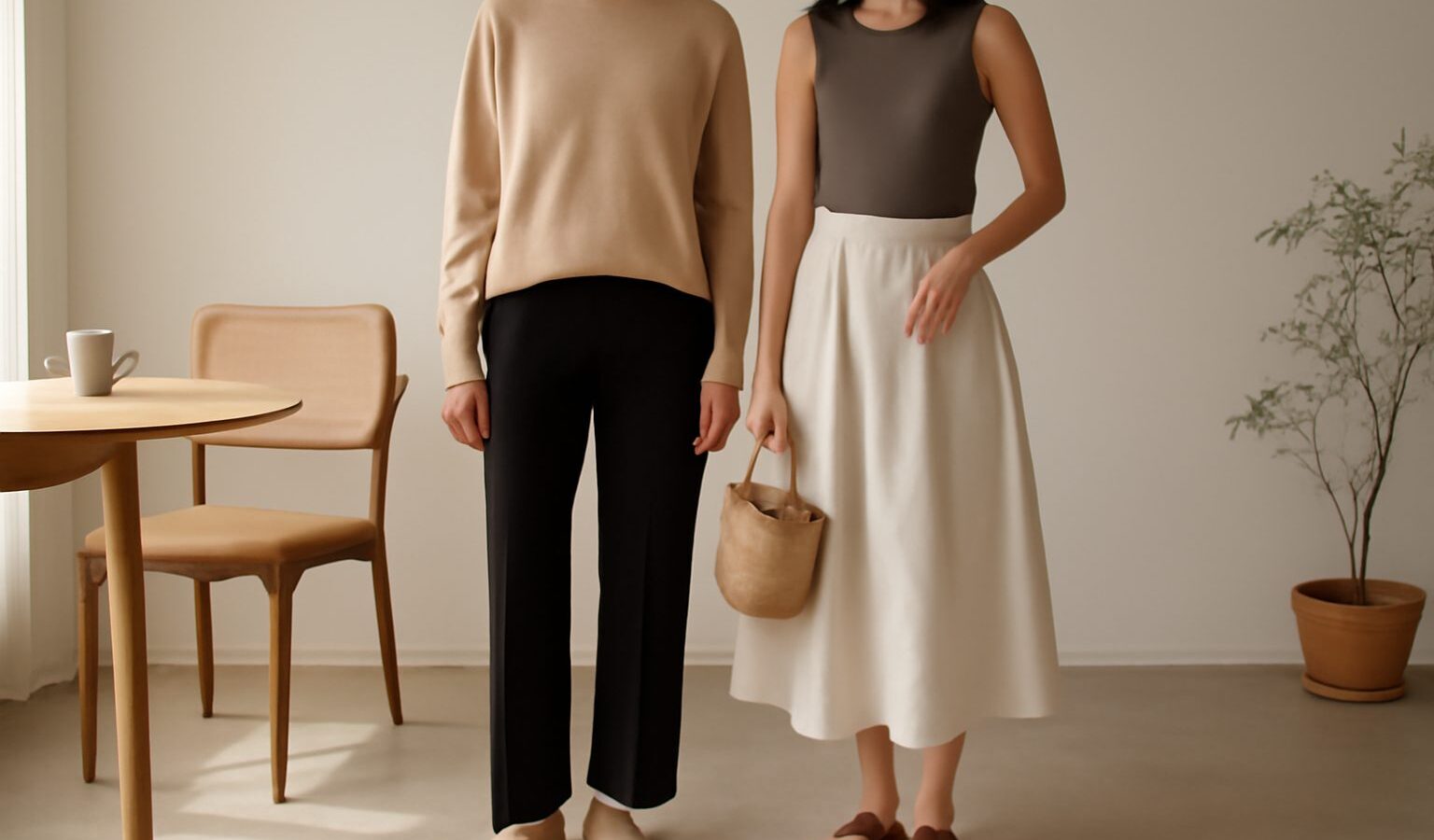
Have you ever put on clothes you love, one piece at a time, only to find the whole outfit feels slightly off? Nine times out of ten the culprit is proportion. Proportion and balance dressing is the quiet skill behind outfits that look intentional, and it explains why the same wide trousers can feel chic with one top and awkward with another. The encouraging part is that this has nothing to do with having a particular body. It is simply about how the shapes and lengths of your clothes relate to each other, and once you can see those relationships, you can arrange them to help you feel exactly how you want to feel.
Let us be clear from the start. This is not about hiding, fixing or shrinking anything. Your body is not a problem to solve. Proportion is just a set of tools for framing an outfit so it flatters the mood you are going for, whether that is relaxed, sharp, playful or elegant.
What Proportion and Balance Actually Mean
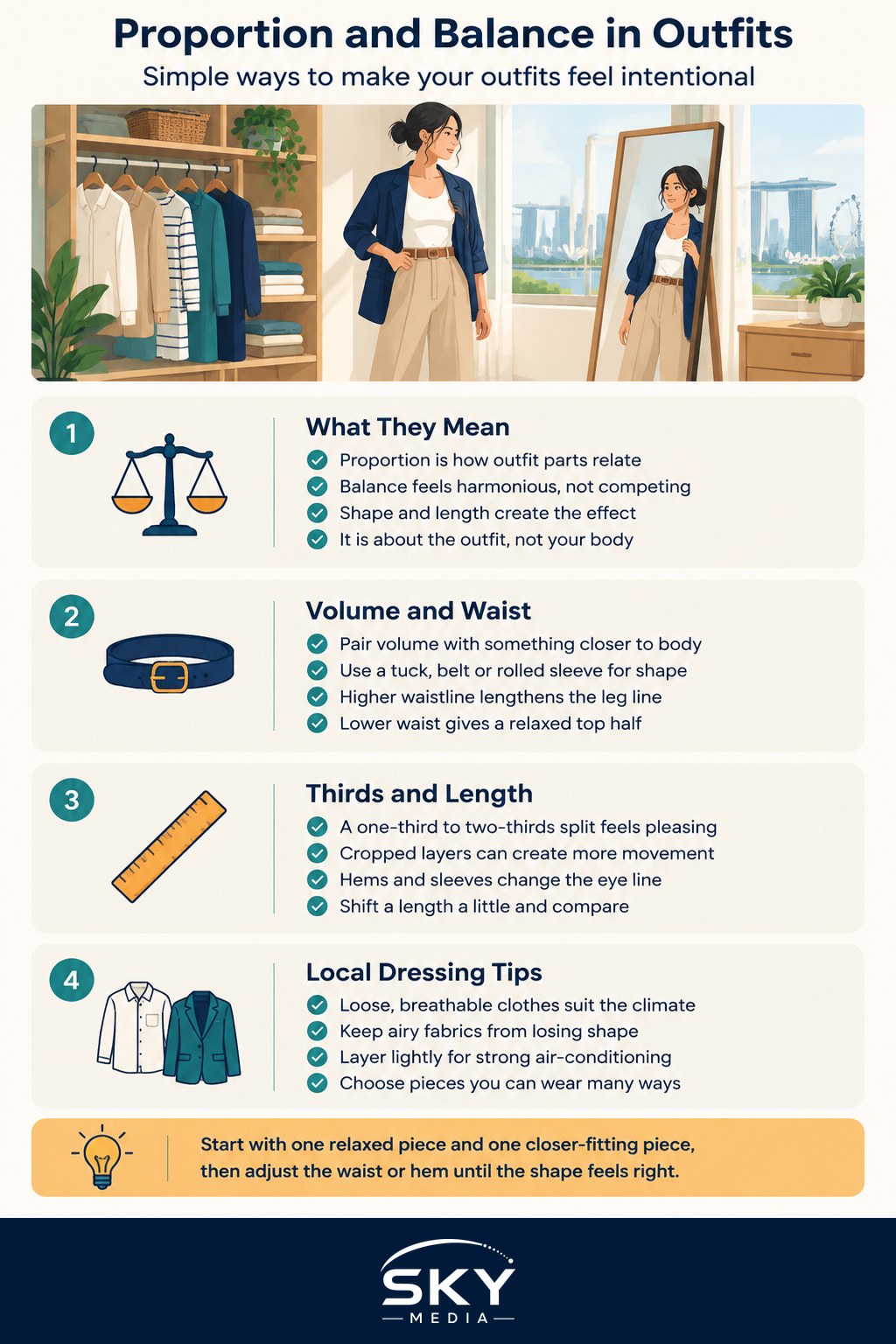
Proportion is the relationship between the sizes of the different parts of your outfit, chiefly the volume on top versus the volume on the bottom, and where the outfit divides your body. Balance is the pleasing result when those parts feel in harmony rather than in competition. When both halves of an outfit are very loose, the look can feel like it is swallowing you; when both are very tight, it can feel like there is nowhere for the eye to rest. Balance usually comes from contrast.
The most reliable principle is to pair volume with something closer to the body. A loose, flowing top sits well over slim trousers. Wide leg trousers feel balanced with a fitted or tucked top. An oversized shirt looks considered with a narrow bottom, and a voluminous skirt is grounded by a neat top half. You do not have to follow this every day, but it is the fastest way to make an outfit feel deliberate rather than accidental.
Volume, Waist and the Line You Create
Two levers do most of the work: volume and the waistline. Volume is how much fabric and space a garment takes up. Balancing volume means offsetting fullness in one area with restraint in another, so the outfit has both interest and structure. If you want to wear a big top and a big bottom, which can look wonderfully relaxed, add definition somewhere, such as a tuck, a belt or a rolled sleeve, so the shape still reads clearly.
Waist placement is the second lever, and it quietly controls how the whole outfit divides your body. A higher waistline lengthens the leg line and creates a longer lower half, while a lower or dropped waist gives a more relaxed, elongated top half. Neither is better; they simply create different lines. This is why high waisted trousers feel so different from low rise ones even in the same colour. Deciding where your waist sits, and whether to mark it at all, is one of the most powerful choices you can make.
- Mark the waist with a tuck or belt when you want a defined, structured shape.
- Skip the waist with a straight or column line when you want ease and flow.
- Raise the waist to lengthen the leg line and elongate the silhouette.
- Balance a full skirt or wide trouser with a top that follows the body more closely.
The Rule of Thirds and Length
Designers often lean on the rule of thirds, the idea that dividing an outfit roughly one third to two thirds is more pleasing than cutting it exactly in half. An outfit split evenly at the waist can look static, whereas a shorter top over longer bottoms, or a longer layer over a shorter hem, creates a more dynamic and elegant line. This is the logic behind a cropped jacket over a long dress, or a tucked top that shows more leg than torso.
Length works alongside this. Where a hem, sleeve or jacket ends draws a line across you, and those lines guide the eye. A hem that ends at the narrowest part of your leg tends to look neat, while sleeve length can lengthen or shorten the arm. None of this is a rule you must obey, but noticing where your clothes end helps you understand why one combination sings and another feels stuck. Try shifting a hemline or sleeve by a few centimetres and watch how much the whole balance changes.
| If you are wearing | Balance it with | Why it works |
|---|---|---|
| Wide leg trousers | Fitted or tucked top | Contrast keeps the shape clear |
| Oversized top | Slim bottoms, defined waist | Volume needs a counterpoint |
| Full, flowing skirt | Neat, closer top half | Grounds the fullness |
| Body skimming dress | A structured layer or belt | Adds shape and interest |
| Big top and big bottom | A tuck, belt or rolled cuff | Restores a readable line |
Proportion in the Singapore Wardrobe
Our climate rewards clever proportion because so much of what we wear here is loose and breathable. Flowing linen, airy cotton and relaxed silhouettes keep us cool, and the trick is to keep that comfort without losing shape. A billowy top stays elegant when paired with a slimmer bottom or lightly defined at the waist, so you get airflow and structure at once. Layering for fierce office and mall air conditioning is another proportion exercise: a light jacket or cardigan adds a top layer, so balance it by keeping the layer underneath and the bottom half streamlined.
Practical, honest shopping helps too. Rather than chasing trends, buy pieces whose proportions you can actually balance with what you own, since a well fitted basic earns its keep over many outfits. You will find flattering shapes across budget, mid range and premium bands at fast fashion chains, local boutiques, department stores and online marketplaces like Carousell, and a small alteration at a tailor can fix a length or waist that is almost right. Check the current price with the retailer, because value lies in cost per wear rather than a single price tag.
Above all, hold these ideas lightly. Proportion and balance dressing is meant to expand your choices, not police them. If an outfit makes you stand a little taller and feel like yourself, it is balanced enough, whatever the ratios say. Use these tools on the days you want them, and enjoy breaking them on the days you do not.
Explore more
Proportion sets the frame that everything else fits into. See how waist placement plays out in practice with our guide to shirt tucking techniques, and learn how to finish a balanced silhouette in how to accessorise an outfit. For a streamlined look that shows proportion clearly, our monochrome and tonal dressing guide is a great companion.