
Some people wake at 6am feeling sharp and ready. Others do their best thinking near midnight, long after the neighbours have gone quiet. If you have ever wondered why you feel wide awake at odd hours or foggy at times when everyone else seems fine, learning about your chronotype singapore style can help. Your chronotype is simply your body’s natural preference for when to sleep, wake, and feel most alert. It is not a flaw or a discipline problem. It is a rhythm, and understanding it can make ordinary days feel far less of a fight.
What A Chronotype Actually Is
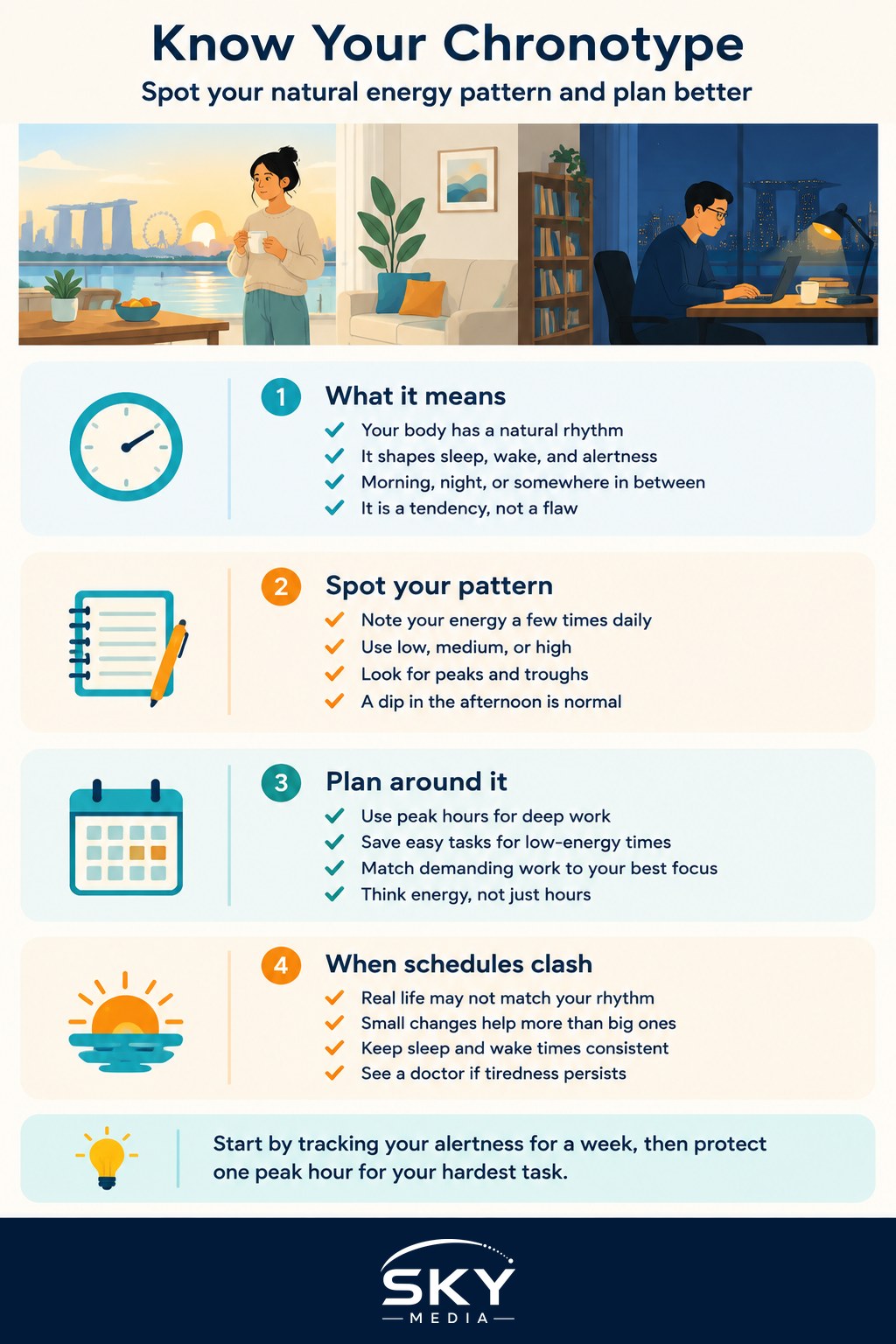
A chronotype describes your internal clock: the pattern that tells you when you naturally feel sleepy and when you feel switched on. Most people fall somewhere on a spectrum. Some lean towards the morning, waking early and fading in the evening. Some lean towards the night, coming alive later in the day. Many of us sit comfortably in the middle.
It helps to treat these as gentle tendencies rather than fixed labels. A chronotype is a self-reflection tool, not a science-grade test, and no simple quiz can hand you a definitive type or score. The honest way to learn yours is to observe your own patterns over a week or two, ideally when your schedule is fairly relaxed. Notice when you wake naturally, when you feel a slump, and when your mind feels clearest.
Life in Singapore does not always make this easy. Long commutes, early school runs, shift work, and an always-on work culture can push everyone into the same early start regardless of what their body prefers. That is worth keeping in mind. Your natural rhythm may be quietly at odds with your calendar, and simply naming that can be a relief.
How To Notice Your Own Energy Pattern
You do not need any device to start. For a week, jot down a quick note a few times a day about how alert you feel, on a scale of low, medium, or high. Over time a shape appears. You might find you have a strong morning peak, a mid-afternoon dip, and a small second wind in the evening. That afternoon dip, by the way, is normal for almost everyone and not a sign that something is wrong.
Look for your peaks and your troughs. Your peaks are the hours when focus comes easily and you feel most like yourself. Your troughs are the hours when even simple tasks feel heavy. The goal is not to judge these but to work with them. Keeping a short daily note can help here, and if you enjoy that kind of reflection you may like the benefits of journaling for spotting patterns you would otherwise miss.
Common patterns to watch for
- A clear morning peak with an early evening fade.
- A slow start with energy building through the afternoon and evening.
- Two smaller peaks with a noticeable dip in between.
- A pattern that shifts with sleep, food, stress, or the weekend.
None of these is better than another. The value is in knowing which one is roughly yours.
Planning Your Day Around Your Rhythm
Once you have a sense of your peaks, you can start matching tasks to them. This is where a chronotype becomes genuinely useful rather than just interesting. The idea is to protect your best hours for the work that needs the most thought, and to save routine, low-focus tasks for your dip.
If your mornings are sharp, try to guard that window for demanding work before meetings and messages pile up. If your energy builds later, resist the guilt of a slow start and plan your hardest task for when your mind is actually ready. Admin, tidying, and easy errands fit nicely into low-energy stretches, when they ask little of you.
This is really about managing energy rather than squeezing more hours from the day. If that idea appeals, it is worth reading more on how to manage your energy, not just time, because two hours at your peak can be worth far more than four at your trough. Building this awareness into your daily plan takes a little practice, and how to plan your day offers gentle structure without turning your schedule into a cage.
When Your Rhythm And Your Schedule Clash
Sometimes your natural chronotype and real life simply do not line up, and there is only so much you can shift. If you are a night owl with a 7am start, you cannot rewrite your whole calendar overnight, and pretending otherwise only leads to frustration. Be kind to yourself here. Small adjustments help more than sweeping ones: a consistent sleep and wake time, some daylight early in the day, a wind-down routine, and honest limits on late-night screens all nudge your rhythm gently in a workable direction.
If you find you are constantly exhausted no matter what you try, or your sleep is badly disrupted for weeks on end, that is worth taking seriously rather than pushing through. Persistent tiredness can have many causes, and a quiet chat with a doctor is a sensible step, not an overreaction.
A Gentle Way Forward
Understanding your chronotype is not about becoming a different person or forcing yourself into someone else’s ideal morning. It is about noticing your own rhythm and treating it with a bit of respect. Start small. Watch your energy for a week, protect one peak hour for something that matters to you, and move one draining task into a dip. Over time these tiny shifts add up to days that feel more like they fit you. Work with your rhythm, not against it, and let that be enough.
Frequently Asked Questions
Can I change my chronotype from night owl to morning person? You can shift your schedule a little, but your natural tendency is hard to rewrite. Move bedtime and wake time in small steps, get daylight early and limit late screens. Expect a gradual adjustment rather than a complete change.
Is the afternoon slump normal and how can I handle it? Yes, a dip in the early afternoon is common. Schedule lighter tasks then, take a short walk, drink water and step into daylight. A heavy lunch can deepen it. If you feel exhausted every day, mention it to a doctor.
How does shift work affect my body clock? Irregular hours can disrupt sleep and alertness because your body clock still follows daylight. Keep a steady routine on workdays, use a dark, cool bedroom for daytime sleep and plan meals sensibly. If you struggle persistently, speak to a doctor.
Does caffeine fit into a chronotype plan? It can help, but timing matters. Taking it too late can delay sleep, especially for night-leaning people. Notice how long it affects you and have your last cup earlier in the day. Sensitivity varies from person to person.
Do teenagers have a different body clock? Many teenagers naturally drift towards later sleep and waking, which can clash with early school starts. Encourage steady sleep times, morning light and limited late-night screens. If sleep problems affect school or mood, check with a doctor.