

If your alarm feels like an assault and your brain only switches on after lunch, you are not lazy. Your body clock may simply run later than your schedule needs. The good news is that most people can become a morning person, or at least a more comfortable early riser, by shifting their sleep timing step by step. The trick is not willpower at 6am. It is working with the signals your body clock already responds to: light, timing and routine.
This guide focuses on how to move your sleep window earlier. It is not about what to do once you are awake. It is about getting there without feeling wrecked.
This is general information, not medical advice. If you have ongoing trouble sleeping, see a doctor.
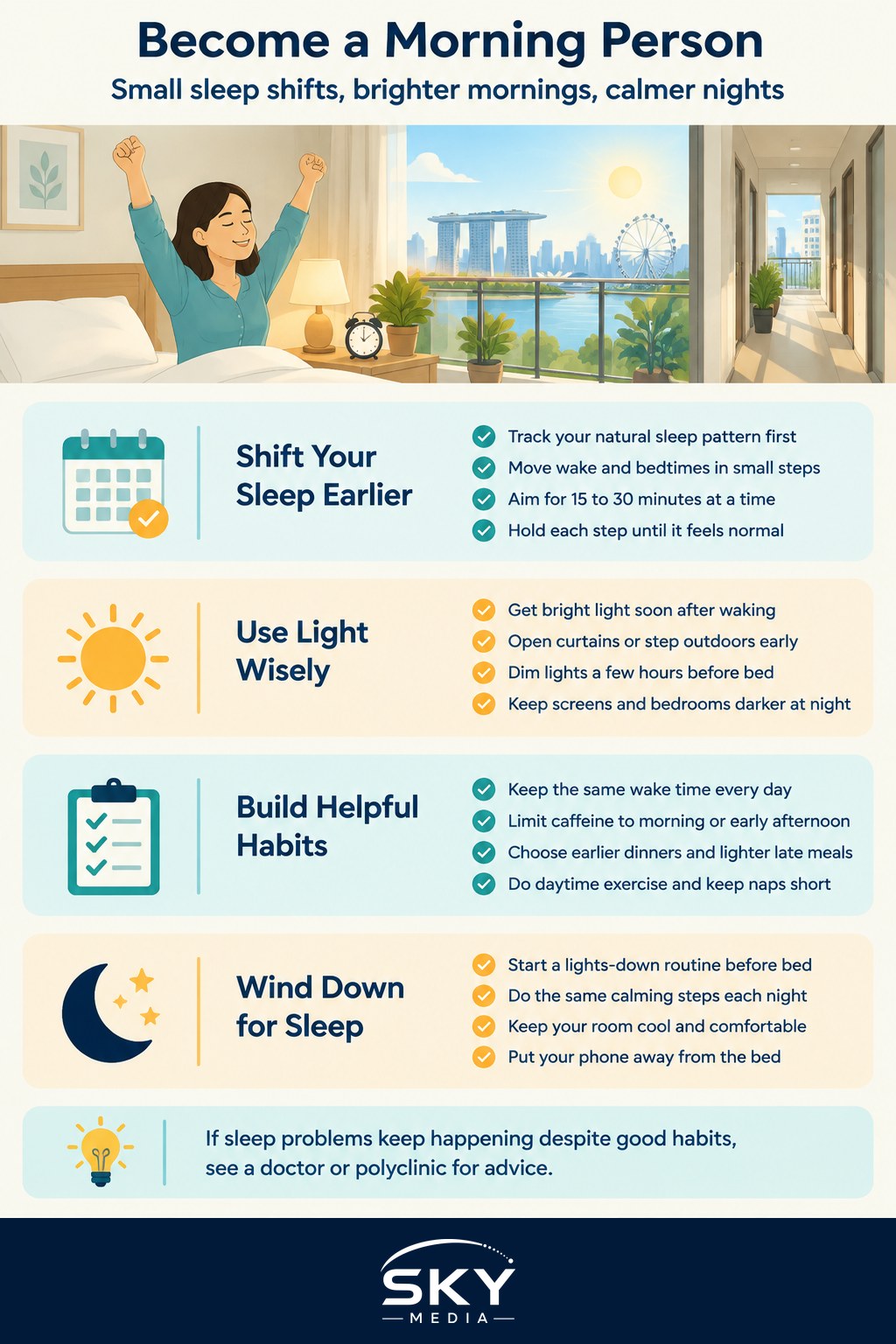
Why Your Body Clock Resists Early Mornings
Your sleep and wake times are governed by your circadian rhythm, an internal clock of roughly 24 hours. It controls when you feel sleepy, when you feel alert, body temperature and the release of melatonin, a hormone that helps signal night-time.
The strongest signal that sets this clock is light. Bright light in the morning nudges your clock earlier. Bright light late at night, including from screens and strong indoor lighting, nudges it later.
Many young adults naturally lean later, and modern life pushes them further: late classes or shifts, evening gym sessions, supper with friends, and phones in bed. Weekends often make it worse, with late nights and sleep-ins that act like a mini jet lag every Monday.
Some people are genuine night owls by biology and will never love 5am. But most can still shift their natural rhythm earlier by an hour or more with consistent habits.
Shift Gradually, Not Overnight
The most common mistake is setting your alarm two hours earlier and hoping for the best. Your body cannot fall asleep two hours earlier on command, so you end up short of sleep, exhausted, and back to old habits within a week.
A gentler approach:
- Track your current pattern for a week. Note when you fall asleep and wake naturally on free days. That is your starting point.
- Pick a realistic target. Decide on a wake-up time that suits your life and still allows enough sleep for you.
- Move in small steps. Bring your wake time and bedtime earlier by around 15 to 30 minutes every few days.
- Hold each step until it feels normal. If you feel rough, stay at the current time a bit longer before moving again.
- Keep going until you reach your target. Depending on how far you are moving, this can take a few weeks.
Fixing your wake time first is usually more effective than forcing an early bedtime. If you wake at the same time every day, sleep pressure builds and you naturally start feeling sleepy earlier at night.
Use Light as Your Main Tool
Light is your best lever for moving your clock. Our guide to the benefits of morning sunlight goes deeper into why.
In the morning:
- Get bright light soon after waking. Open curtains, step onto the corridor or balcony, or walk part of your commute outdoors.
- In Singapore, sunrise is roughly around 7am all year. If your target wake time is earlier, switch on bright indoor lights straight away, then get outdoor light once the sun is up.
- Even overcast daylight is much brighter than indoor lighting.
In the evening:
- Dim your home lighting a couple of hours before bed. Warm, lower lamps are better than bright ceiling lights.
- Reduce screen time near bedtime, or at least turn down brightness and use night mode.
- Keep your bedroom dark. Blackout curtains help if street or corridor lights shine in.
If you are choosing a new home, your room’s orientation matters too. Our guide to checking whether a property gets morning or afternoon sun explains how to tell.
Habits That Support an Earlier Schedule
| Habit | What helps | What works against you |
|---|---|---|
| Wake time | Same time every day, including weekends | Long weekend sleep-ins |
| Light | Bright light in the morning, dim light at night | Bright screens and lights late at night |
| Caffeine | Morning or early afternoon only | Kopi or tea late in the day |
| Meals | Regular breakfast, earlier dinner | Heavy late suppers |
| Exercise | Morning or daytime workouts | Intense training close to bedtime |
| Naps | Short and early, if needed | Long or late-afternoon naps |
A few details worth knowing:
- Caffeine lingers. It can affect sleep for several hours, so consider an earlier cut-off if you struggle to fall asleep.
- Late suppers matter. Singapore’s 24-hour food culture makes late meals easy, but heavy food near bedtime can make sleep harder.
- Weekends are the real test. A small weekend sleep-in of under an hour is usually fine. Sleeping in for several hours undoes your progress.
Building an Evening Wind-Down
Becoming a morning person starts the night before. A predictable wind-down tells your body that sleep is coming.
- Set a “lights down” reminder about an hour before your target bedtime.
- Do the same few things in the same order: shower, prepare tomorrow’s bag and clothes, a few pages of a book.
- Keep your room cool. A fan or air-conditioning set to a comfortable temperature helps in Singapore’s humid nights.
- Put your phone to charge away from your bed, so scrolling does not drag on.
- If neighbourhood noise from renovations, traffic or late conversations keeps you awake, try earplugs or a white-noise app.
Making Early Mornings Worth It
Motivation helps the habit stick. Give yourself a reason to get up that feels good, not just a duty. It might be a quiet coffee before the household wakes, a run before the heat, a study session with no notifications, or simply a calmer commute before the crowds.
Put your alarm across the room so you have to get up to switch it off, and avoid hitting snooze repeatedly, which tends to leave you groggier.
When to Get Help
Habits can only go so far. See a doctor if:
- You regularly struggle to fall asleep or stay asleep despite good habits
- You snore loudly, gasp at night, or wake unrefreshed even after a full night
- You feel very sleepy during the day, especially while driving or working
- Low mood or anxiety is affecting your sleep
Your GP or polyclinic can assess you and refer you to a sleep specialist if needed. Shift workers may also need tailored advice rather than a standard early schedule.
The Bottom Line
To become a morning person, move slowly, fix your wake time, flood your mornings with light, dim your evenings, and protect your weekends. Give it a few weeks of consistency, and early starts can go from painful to almost normal.