

If you have ever been offered a fund at your bank or seen options inside a robo-advisor app, you have almost certainly come across unit trusts. Unit trusts in Singapore, known elsewhere as mutual funds, are one of the most common ways for ordinary investors to put money into a professionally managed, diversified pool. They can be a sensible tool, but they carry costs and risks that are easy to overlook when the sales material focuses on past returns. This guide explains what unit trusts are, how they are run, and why their fees matter so much over time, all in plain and general terms. It is general information, not financial advice, and it quotes no specific fees or returns because these vary by fund and change. All investing carries risk, including the loss of capital, so consider your own circumstances and, where relevant, consult a licensed financial adviser or the MAS-regulated provider before deciding.
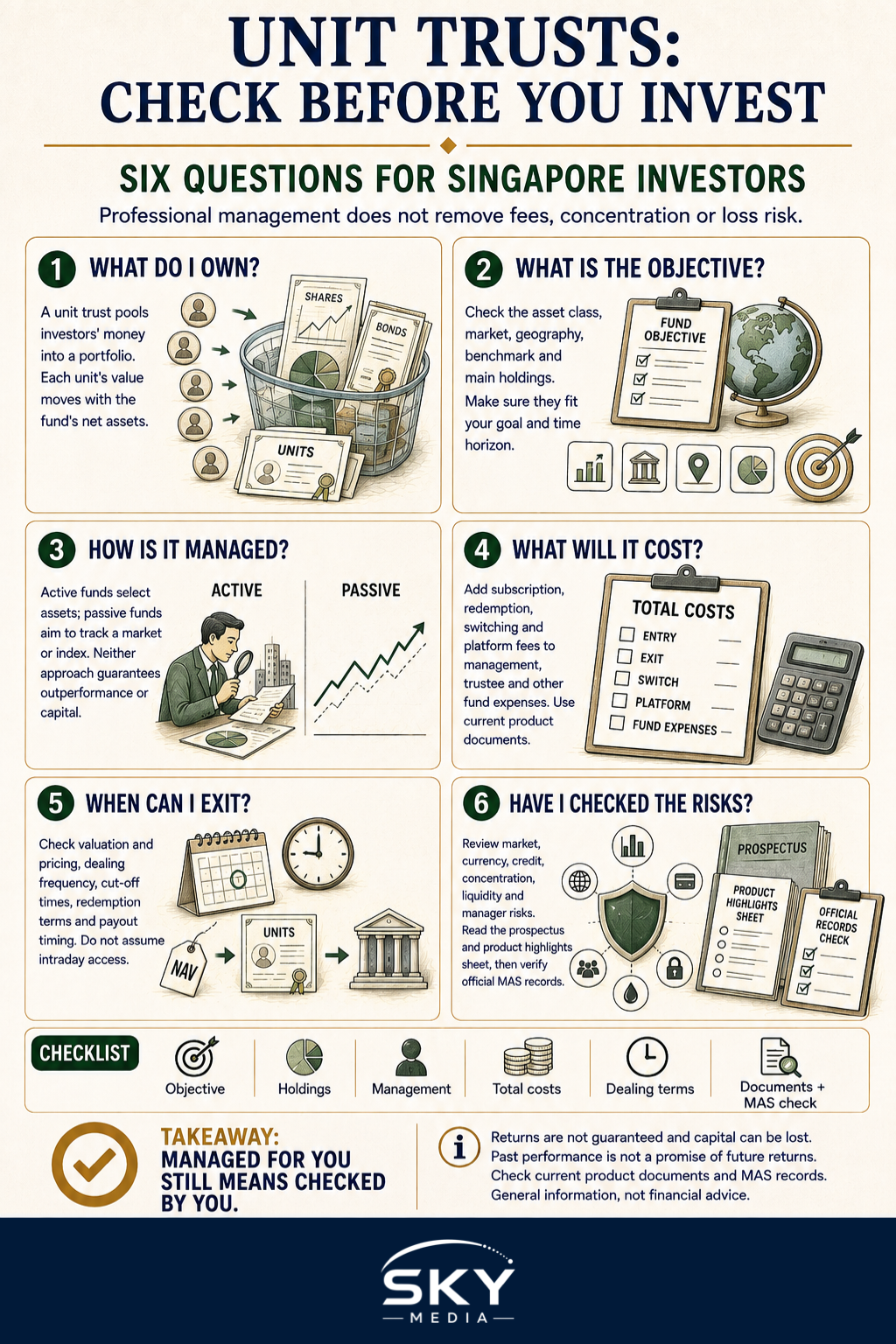
What a Unit Trust Is
A unit trust pools money from many investors and uses it to buy a portfolio of investments, such as shares, bonds or a mix of both, according to a stated objective. When you invest, your money buys units in the fund, and the value of each unit rises and falls with the value of everything the fund holds. Instead of picking individual shares yourself, you own a small share of a large, diversified basket that a professional fund manager runs on behalf of all the investors.
This pooling is the main attraction. With a single modest investment you gain exposure to far more holdings than you could easily buy on your own, which spreads your risk across many companies or bonds. A manager handles the day-to-day decisions and trading. In Singapore, funds offered to retail investors are regulated under the MAS framework, and each comes with a prospectus and a product highlights sheet that set out its objective, holdings, risks and costs. Reading those documents is the single best habit you can form.
Active Versus Passive Funds
Unit trusts broadly fall into two camps, and knowing the difference helps you understand what you are paying for. Active funds employ a manager and a team who research investments and make decisions with the aim of doing better than the market. You are paying for that expertise and effort, whether or not it succeeds in any given period. Passive funds instead aim to track an index, simply holding what the index holds so that the fund moves roughly in line with the market it follows.
Neither approach is automatically better. Active management offers the possibility of beating the market but charges more for the attempt and does not guarantee success, and many active funds do not outperform over long stretches. Passive funds usually cost less and remove the risk of a manager underperforming the market, but by design they will not beat it either. The right choice depends on your goals and your tolerance for cost, and higher fees must be earned back before you are ahead.
How Fees Work and Why They Matter
Fees are where many investors quietly lose out, because they are easy to skim over yet they compound against you year after year. Unit trusts can carry several kinds of charges, and understanding each one lets you compare funds fairly.
- Sales charge, sometimes called a front-end or subscription fee, is a one-off percentage taken when you buy in. Platforms increasingly reduce or waive this, so it is worth checking.
- Management fee is charged every year by the fund manager for running the fund, taken out of the fund’s assets rather than billed to you separately.
- Expense ratio, or total expense ratio, bundles the management fee together with the fund’s other running costs into a single annual percentage. It is the clearest number for comparing the ongoing cost of one fund against another.
- Other costs, such as platform fees or switching charges, may apply depending on where and how you invest.
The reason fees matter so much is compounding. A seemingly small annual percentage is deducted every year, and because it is charged on your whole balance, the drag grows as your investment grows and accumulates over decades. As a purely hypothetical illustration, if two similar funds returned the same amount before costs but one charged noticeably more each year, the cheaper fund could leave you meaningfully better off after many years; the actual gap depends entirely on the real fees and returns, which differ. The lesson is not that the cheapest fund is always best, but that cost is one of the few things you can see clearly in advance, so it deserves attention.
Where and How to Buy Them
There are several routes to buying unit trusts in Singapore, and they differ in choice, cost and convenience rather than in what a fund fundamentally is. Common channels include:
- Banks, where relationship managers can offer funds, though the range and charges vary and you should compare rather than accept the first option.
- Fund platforms and brokerages, which often list a wide selection and may offer lower or waived sales charges.
- Robo-advisors, which build and manage a portfolio of funds for you based on your risk profile, for a fee.
- CPFIS and SRS, which let you invest eligible CPF savings or your Supplementary Retirement Scheme monies into approved funds, each under its own rules and list of permitted investments.
If you are considering investing through CPFIS or SRS, check the current rules, eligibility and approved-product lists with the CPF Board and MoneySense, because these schemes have specific conditions and are not the same as investing with ordinary cash. Whichever channel you use, make sure the fund and provider are MAS-regulated.
Comparing Funds Beyond Past Performance
The most prominent number in any fund’s marketing is usually its past return, yet that is one of the least reliable guides to the future. Past performance is not indicative of future returns, and a fund that led its category recently can lag badly later. Rather than being drawn in by a headline figure, look at the whole picture: the fund’s stated objective and whether it matches your goal, what it actually invests in, its total expense ratio, its risk level, and how consistently it has behaved rather than a single standout year.
The comparison below sets out, in general terms, how a unit trust and an ETF tend to differ, since investors often weigh the two. Both are pooled, diversified products, and both can lose value; the differences are mostly in structure and how they are bought and priced.
| Feature | Unit trust | ETF |
|---|---|---|
| How you buy | Through banks, platforms or advisors, in dollar amounts | On a stock exchange, like a share, through a brokerage |
| Pricing | Priced once a day based on the fund’s value | Priced continuously while the market is open |
| Management style | Often actively managed, though passive options exist | Commonly passive index-tracking, though active ones exist |
| Typical costs | May include a sales charge plus an annual expense ratio | Usually a low expense ratio plus brokerage and spread costs |
| Minimum to start | Often a modest fixed amount or regular contribution | The price of at least one unit plus fees |
Treat this as a map of the differences, not a verdict; the right choice depends on your goals, costs in your specific case and how hands-on you want to be.
Understanding the Risks
Unit trusts spread your money across many holdings, but diversification reduces risk without removing it. The value of your units can fall as well as rise, and you can get back less than you invested, so capital loss is a real possibility. Share funds can be volatile, bond funds carry their own risks including sensitivity to interest rates, and funds holding overseas assets add currency risk. Fees drag on returns every year regardless of how the fund performs, and no manager, however skilled, can promise a result.
None of this makes unit trusts unsuitable; they remain a practical way for many people to invest in a diversified, managed portfolio. The point is to go in with clear eyes, matching the fund to your goal and time horizon, watching the costs, and reading the prospectus and product highlights sheet before committing. This guide is general information, not a recommendation of any fund or product; for guidance suited to your own situation, consult a licensed financial adviser and rely on the official documents of any MAS-regulated product you are considering.
Explore more
Unit trusts are one of several ways to invest, so it is worth seeing how they compare with the listed alternative in our guide to ETFs explained for Singapore investors. And if you are still weighing up where to begin, our overview of how to start investing in Singapore puts unit trusts in the wider context of building a plan that fits you.