

Co-curricular activities, or CCAs, are a familiar part of growing up in Singapore, and understanding the role of CCA in school in Singapore helps families support their children well. Far more than a break from lessons, CCAs develop character, friendships and skills that classroom learning alone cannot provide. They also carry some weight in later admissions and posting decisions. This guide explains, in general terms, why CCAs matter, how they are recognised, and how they fit into pathways such as the Direct School Admission (DSA) exercise.
As with all such arrangements, the Ministry of Education (MOE) and individual schools set and may update the details. This guide gives an overview, and you should confirm current specifics with MOE and the schools.
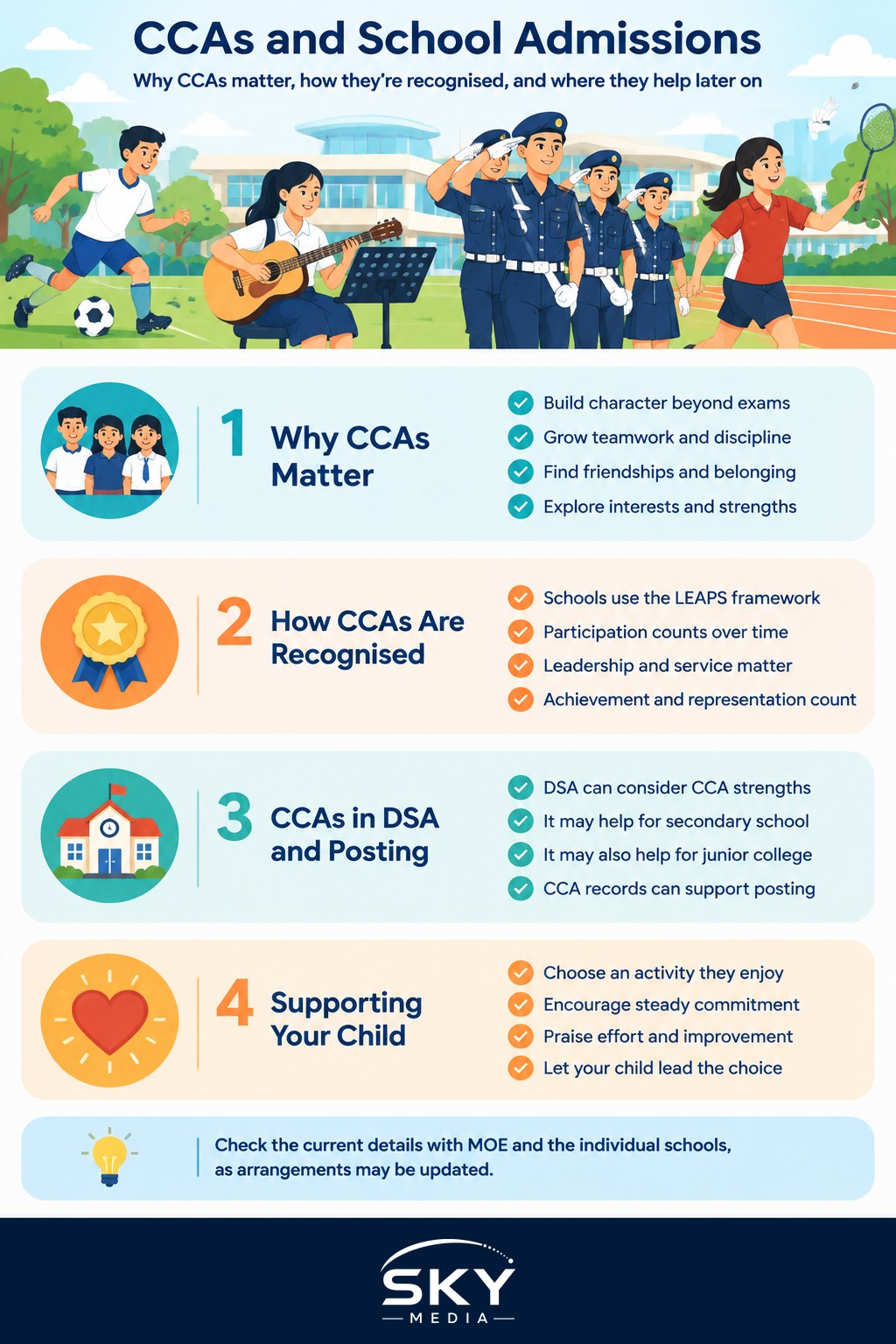
Why CCAs Matter
At their heart, CCAs are about growing the whole child. A student who joins a sport, a uniformed group, a performing arts group or a club or society learns things that examinations rarely measure. Teamwork, discipline, resilience, leadership and time management all develop naturally when a child commits to an activity over months and years.
CCAs also give students a place to belong. For many children, their CCA becomes one of the most memorable parts of school, the source of close friendships and a sense of identity. A shy child may find confidence on stage or on the field, and a restless child may find focus and purpose. These benefits are real and lasting, quite apart from any role CCAs play in admissions.
There is a broad range of CCAs, and schools generally group them into areas such as physical sports, uniformed groups, visual and performing arts, and clubs and societies. Trying different activities in the early years can help a child discover where their interests and strengths lie.
Parents sometimes worry about whether a child has chosen the right CCA, or whether a particular activity carries more weight than another. In truth, no single type of CCA is inherently better than the rest. A uniformed group, a sport and a performing arts group each offer their own lessons in commitment, teamwork and growth. What counts is that a child engages sincerely and develops through the experience. A child who loves their activity will naturally put in the effort that leads to both enjoyment and a strong record.
How CCAs Are Recognised: LEAPS and CCA Points
To recognise students’ involvement and growth in CCAs, secondary schools use a framework often referred to as LEAPS. The framework acknowledges different dimensions of a student’s co-curricular life, including participation over time, leadership roles, achievements and representation, and service or enrichment beyond the school.
Through this framework, students can earn what are commonly called CCA points, which reflect their engagement and development across these dimensions. In broad terms, sustained participation, taking on responsibility such as a leadership role, representing the school or achieving in an activity, and contributing through service all count toward a student’s record.
The underlying message is encouraging. The framework rewards commitment and personal growth over time, not a single trophy. A student who stays with an activity, grows into a leadership role and serves others is recognised for that steady journey. This is why teachers often encourage children to choose a CCA they genuinely enjoy and to stick with it, rather than chasing points for their own sake.
| LEAPS dimension (general) | What it broadly recognises |
|---|---|
| Participation | Ongoing, committed involvement over time |
| Leadership | Taking on responsibility and leading others |
| Achievement | Representation and accomplishment in the activity |
| Service | Contributing to the school and wider community |
Because the exact structure and any point arrangements are set by MOE and may be updated, treat the table above as a general picture and check MOE for the current framework.
CCAs in DSA and Posting
CCAs also connect to admissions in a few ways. The most direct is the Direct School Admission (DSA) exercise, which allows students to seek a place in a secondary school or, at a later stage, a junior college based on talents and strengths, including in sports, the arts and other CCA-related areas. A student with a genuine talent and track record in a CCA may apply through DSA to a school that offers a strong programme in that area, ahead of receiving their examination results.
DSA is a wonderful route for children with a clear passion or ability, but it is worth keeping in perspective. It is one pathway among several, it is selective, and it works best when a child’s interest is authentic rather than manufactured for an application. Schools look for real commitment and potential, so the best preparation is simply to pursue an activity your child loves and to grow within it.
Beyond DSA, a student’s CCA record can play a supporting role in certain posting or admission considerations, and CCA involvement contributes to a student’s overall development in ways that later count when they apply for post-secondary options. Because the specifics vary and are set by MOE and the institutions, this guide keeps to the general principle rather than exact rules.
Supporting Your Child With CCAs
The most helpful thing you can do is encourage your child to choose an activity they enjoy and to commit to it. Genuine interest fuels the perseverance that makes CCAs so rewarding, and it is that perseverance, rather than any calculation about points, that produces both personal growth and a strong record.
Support your child through the ups and downs. There will be tiring training sessions, disappointing results and moments of doubt, and your steady encouragement helps them stay the course. Celebrate effort and improvement, not only medals, and let your child lead in choosing where their interests take them.
Kept in this healthy perspective, CCAs enrich your child’s school years enormously. They build character and friendships now, and they open doors later, whether through DSA or simply through the confidence and skills your child carries forward. For the current details of frameworks and admission routes, always refer to MOE and to the individual schools.
Explore more
Singapore School System Explained
Direct School Admission (DSA) Guide
Choosing a Secondary School in Singapore
Frequently Asked Questions
How many CCAs should my child join? There is no set answer, so check your school’s current requirements with MOE and the school. Focus on one activity your child enjoys and can commit to. Doing a single CCA well and consistently often matters more than spreading too thin.
Can my child change CCAs partway through secondary school? Schools set their own rules for switching, and a change can affect the record of sustained participation. Talk to the CCA teacher or school before deciding. If a child is unhappy, a conversation about why is a good first step.
Do sports CCAs count for more than other CCAs? No single type of CCA is inherently better than the rest. Sports, uniformed groups, performing arts and clubs each offer their own lessons in commitment and teamwork. What counts is sincere engagement and growth, so let your child choose what they enjoy.
What if my child’s school does not offer the CCA they love? Ask the school about similar options, and explore activities outside school that build the same interest. For DSA, schools look at genuine talent and commitment, which can be shown through a track record outside school. Check MOE and the school’s DSA information.
How can a CCA help a shy or restless child? A shy child may gain confidence on stage or on the field, while a restless one can find focus and purpose through regular training. Choose an activity that suits their interests, and encourage them through the ups and downs.
Official sources: Ministry of Education (MOE)
Further reading: Debate Classes and Debating CCA for Students in Singapore