

There is a simple, satisfying rhythm at the heart of one of gaming’s oldest genres. You descend into a dangerous place, fight through its dangers, grab better gear, and go deeper still. Dungeon crawler games in Singapore appeal to players who love that steady loop of exploration, combat, and reward, whether they want a quick mobile session on the MRT or a long evening on the couch. The genre is broad and welcoming, and once you understand its core rhythm it opens up a huge library of games to enjoy.
The Core Loop Explained
As the name suggests, a dungeon crawler is built around exploring a dungeon, meaning any confined, hostile environment full of enemies, traps, and treasure. This could be a literal stone dungeon, but it might just as easily be a spooky mansion, a tower, a spaceship, or a sprawling underground cavern.
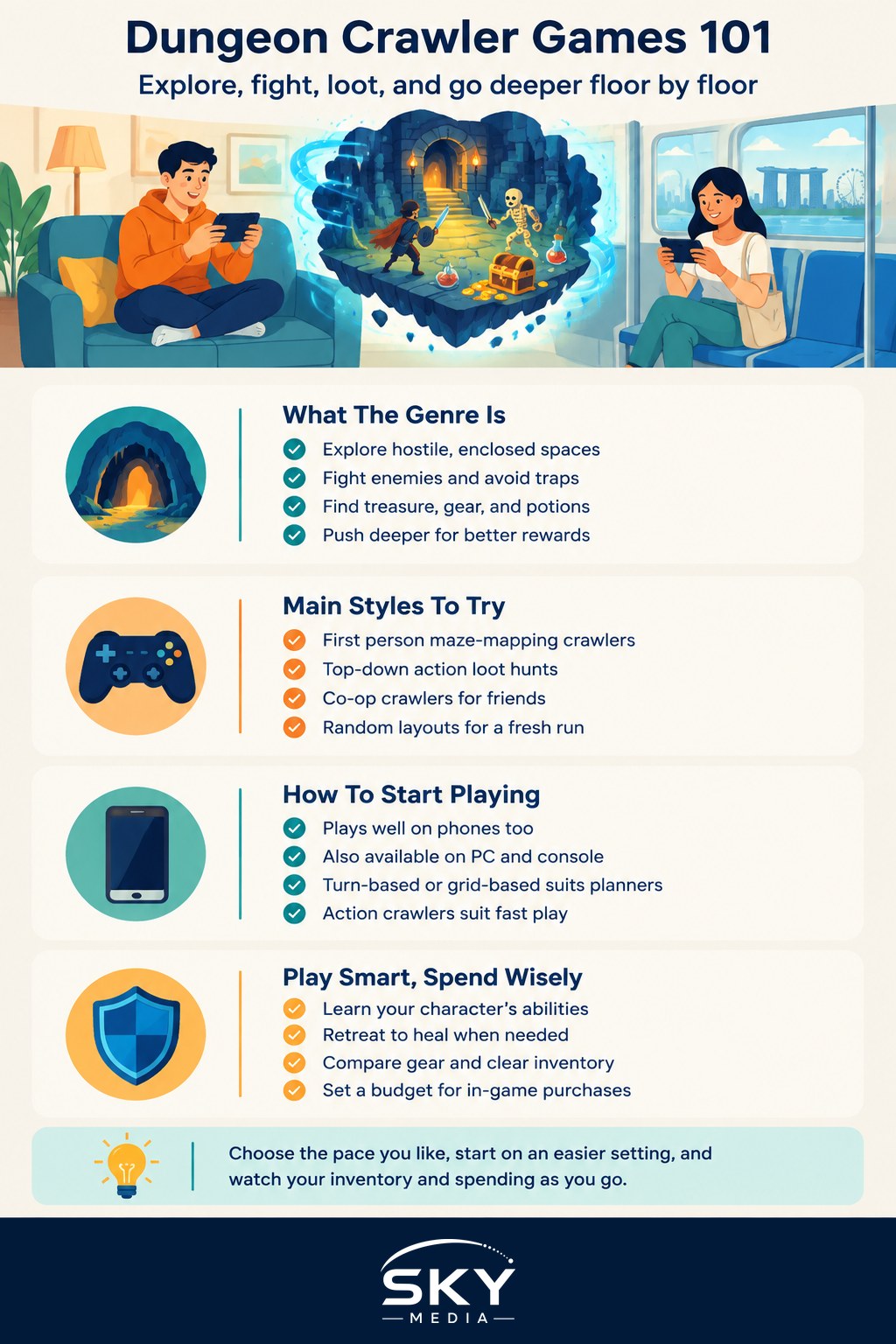
The core loop is where the magic lives. You explore a space room by room, fighting the monsters you encounter, collecting loot such as weapons, armour, gold, and potions, and using that loot to grow stronger. As you get stronger you push deeper, facing tougher enemies that in turn drop better rewards. That satisfying cycle of risk and reward is the beating heart of the genre. Do you press on to the next floor with low health for a chance at greater treasure, or retreat to safety and lose your momentum? This constant push and pull keeps you engaged, and it explains why “just one more floor” is the genre’s version of the strategy fan’s “just one more turn”. Because it leans so heavily on gear, levelling, and character growth, the dungeon crawler sits close to the role playing game family, and many crawlers are essentially focused, combat heavy RPGs.
The Many Flavours Of Dungeon Crawler
The genre has splintered into several styles over the years, which is part of its charm. Classic first person crawlers like the Etrian Odyssey series have you mapping a maze from a first person view, moving grid square by grid square. Action focused crawlers such as the Diablo series play from a top down angle and revolve around real time combat and a torrent of loot to sift through. There are also cooperative crawlers designed for a group of friends to tackle a dungeon together.
One of the most popular modern strands blends the dungeon crawl with randomly generated layouts, so the dungeon is different every single time you play. This overlaps heavily with the roguelike genre, where death often sends you back to the start but with lessons learned and, in many games, some permanent progress carried over. There is also a growing family of deckbuilding crawlers, where your “attacks” are cards you draw and play, blending dungeon exploration with the tactics of card and deckbuilding games. This variety means the genre spans everything from slow, methodical map makers to fast, frantic loot hunts. If you are still sorting out how these labels relate, our overview of video game genres can help you place them.
How To Get Started
The great news for newcomers is that the genre is enormously accessible and spans every platform and budget. Plenty of excellent dungeon crawlers run well on a phone, making them ideal for short bursts during a commute, while others are full sized experiences for PC and console. Because the core loop is so simple to grasp, you can pick up most of them without a steep learning curve.
A sensible way in is to decide what pace suits you. If you enjoy careful planning and do not mind slower combat, a turn based or grid based crawler will reward your patience. If you want immediate action and the thrill of loot raining down, an action crawler will scratch that itch. Start on a normal or easy difficulty, learn how your character’s abilities work, and do not be shy about retreating to heal and regroup. Managing your inventory is a real skill in this genre, so get into the habit of comparing gear and selling or discarding what you no longer need.
A few honest words of caution. Some dungeon crawlers, particularly free mobile ones, lean on in game purchases to speed up progress or grab better gear. There is nothing wrong with spending if you enjoy a game, but set yourself a firm budget beforehand, never chase a loss by buying “just one more” pack, and keep your account secure with a strong password. Random reward mechanics can be moreish, so treat any spending as entertainment rather than investment. Stick to those simple habits, pick a style that matches your mood, and the dungeon crawler will give you one of gaming’s most reliably satisfying loops, floor after floor after floor.