
Some games are relaxing. These are not. Soulslike games are famous for being hard on purpose, for making you fight the same boss a dozen times, and for the enormous satisfaction when you finally win. They have grown from a niche curiosity into a much-loved genre, and plenty of players who “hate hard games” end up adoring them. This guide explains what soulslike games are, why the difficulty is a feature rather than a flaw, and how a newcomer can get past the intimidating first hours.
Where The Name Comes From
The term “soulslike” describes a family of games inspired by a hugely influential series whose titles included the word “Souls”. Rather than naming that series, the community simply borrowed the style and called anything similar a soulslike. It is a genre defined by feel rather than by any single publisher, so the label now covers many games from many makers that share the same demanding, deliberate design.
At its core, a soulslike is a third-person action game where combat is slow, weighty and punishing. You cannot mash buttons and win. Instead you watch enemies, learn their patterns, and strike in the gaps. The genre assumes you will fail often, and it builds that assumption into everything, from how you lose progress to how the world is laid out.
The Ideas That Define The Genre
A few shared mechanics turn a merely hard game into a true soulslike, and each one is worth understanding before you start.
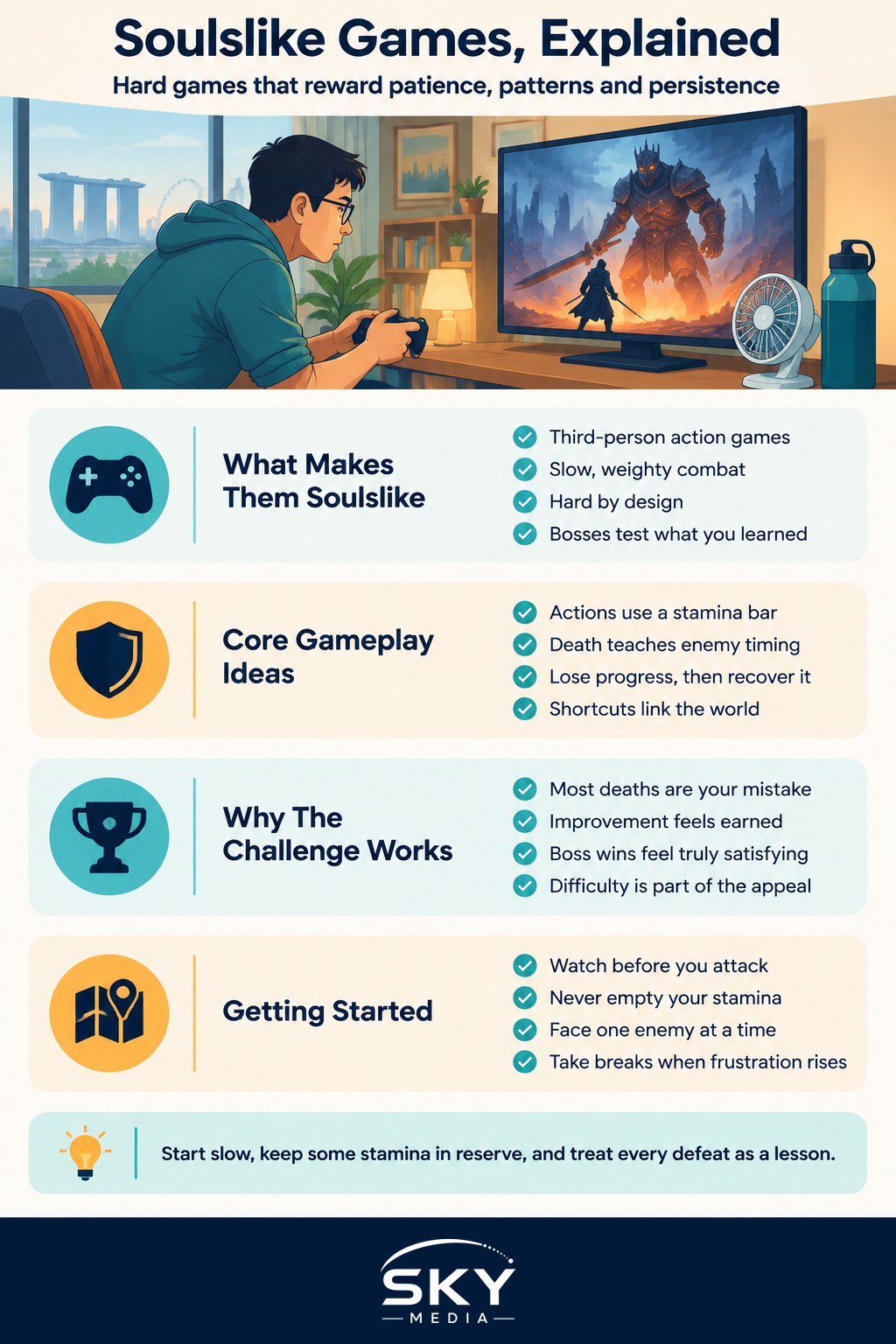
- Deliberate, stamina-based combat. Most actions, such as attacking, dodging or blocking, drain a “stamina” bar that refills over a second or two. Emptying it leaves you helpless, so fights become a rhythm of careful strikes and patient recovery rather than constant swinging.
- Learning through death. You are expected to die, often. Death is not a game-over screen but a lesson. Each attempt teaches you an enemy’s timing until the fight becomes readable.
- A risk-and-recovery loop. In many soulslikes, dying drops the experience or currency you were carrying at the spot where you fell. You can retrieve it, but if you die again on the way, it is gone. This makes every journey back tense and meaningful.
- Interconnected worlds and shortcuts. Levels often loop back on themselves, rewarding exploration with shortcuts that make the next attempt faster.
- Boss fights as milestones. Progress is marked by large, memorable boss battles that test everything the area has taught you.
Why “Too Hard” Is The Point
Newcomers often bounce off soulslike games in the first hour, deciding they are simply unfair. They are not. The difficulty is carefully tuned so that almost every death is your mistake, not the game cheating. That fairness is what makes improvement feel earned. When you finally beat a boss that crushed you twenty times, the victory is yours in a way an easy win never could be.
It helps to reframe failure. In most games, dying is a punishment. In a soulslike, dying is how you gather information. A boss that felt impossible on your first try becomes predictable by your tenth, not because the game got easier, but because you got better. That shift, from frustration to curiosity, is the mindset the whole genre rewards.
Soulslike Compared To Other Action Games
If you are used to fast or forgiving action games, it helps to see how a soulslike differs in approach.
| Aspect | Typical action game | Soulslike game |
|---|---|---|
| Combat pace | Fast, forgiving, combo-heavy | Slow, deliberate, punishing |
| Role of death | Minor setback, quick retry | Central lesson, real cost |
| Difficulty | Often adjustable, eased for you | Fixed and demanding by design |
| Guidance | Clear objectives and hints | Sparse; you piece the world together |
| Reward | Steady, frequent progress | Rare, hard-earned and memorable |
Neither approach is better. They simply offer different pleasures. If a fixed, demanding challenge sounds exhausting rather than exciting, that is completely fine, and there are gentler genres to enjoy instead.
Starting Without Rage-Quitting
The genre’s reputation scares off players who would actually love it. A few practical habits make the first hours far kinder:
- Slow down. Patience is your best weapon. Watch an enemy attack before you commit, and dodge or block rather than trading blows.
- Manage your stamina. Never empty the bar completely. Leaving a little in reserve means you can always dodge the counterattack.
- Learn one enemy at a time. Fight carefully rather than rushing into a crowd. Pulling foes one by one is far safer than facing several at once.
- Treat each death as a note. Ask what killed you and what you will do differently. That reflection is the whole skill.
- Take breaks when you tilt. Frustration makes you sloppy. Stepping away for ten minutes often beats twenty more angry attempts.
The patience and pattern-reading that soulslike games teach carry over widely. Our guide on understanding game sense explores reading a situation and predicting what comes next, a skill these games sharpen relentlessly. If you enjoy the tension of losing progress, roguelike games build entire experiences around starting over, and readers who like steady, self-directed challenges may also enjoy survival games.
Comfort, Balance And Playing In Singapore
Soulslike games are demanding on your attention, so comfort matters more than usual. In a small HDB or condo room, set up a supportive chair, a screen at a sensible height, and good ventilation, since long, focused sessions in our warm climate can get sweaty. Repeated boss attempts can also raise your stress, so treat breaks as part of the strategy rather than a weakness. Stand, stretch, rest your eyes and wrists, drink water, and protect your sleep, especially before school or work. For most people this intensity is a healthy, rewarding hobby, but if gaming starts crowding out sleep, studies, relationships or self-care, or feels hard to control, that is worth taking seriously, and you can speak to a GP, a school counsellor, a trusted adult or a service like TOUCH Cyber Wellness. This is general information, not medical advice.
Most soulslike games are bought once and complete, with no pressure to spend more, which is a refreshing change from free-to-play systems. Where any extra content or cosmetics do appear, set a budget and, for younger players, respect age ratings, since these games are often mature in tone and violence. Check a game’s rating and content before buying it for a child. This is general information, not financial advice.
The Bottom Line
Soulslike games turn difficulty into a reward. They are slow, deliberate and unforgiving, and they ask you to learn from every death rather than rage against it. Manage your stamina, take enemies one at a time, treat failure as information, and take breaks when you tilt. Beat that first great boss and you will understand why so many players fall in love with the challenge.
Frequently Asked Questions
Can I make a soulslike easier if I am struggling? Many soulslikes have no difficulty setting, but you can ease things by levelling up, using stronger equipment, summoning help if the game offers it, or fighting from range. Some games include assist options. Check reviews to find which titles are most accessible.
Which soulslike game is best to start with? Look for one with a clear tutorial, readable combat and good reviews for fairness, rather than the hardest title on offer. Watching a short playthrough before buying shows whether the pace suits you. Avoid choosing purely on difficulty reputation.
Do I need quick reflexes to beat soulslike bosses? Less than you might think. Success depends more on patience, learning attack patterns and managing stamina than on raw speed. Players of many ages and skill levels beat these games by studying bosses and striking only when it is safe.
Should I use a controller or keyboard for soulslike games? A controller is generally more comfortable for dodging, blocking and camera control, though keyboard and mouse can work if you are used to it. Try both if the game allows. Pick whichever lets you dodge reliably without hand strain.
How long does a typical soulslike take to complete? It varies widely by game and by how quickly you learn the bosses, and most take many hours. Exploring and repeating tough fights add to the time. Store pages and reviews give a rough idea, so check before you buy.
Further reading: What Are Dungeon Crawler Games?