

Insurers in Singapore market a range of products aimed specifically at women: female cancer plans, riders for pregnancy complications, and policies that bundle conditions such as lupus or osteoporosis. They are often priced low and sold with reassuring messages. But is a women insurance plan in Singapore a smart addition, or does a regular critical illness (CI) policy already do the job?
This guide compares female-specific covers with standard CI so you can see where each fits. It is general information, not financial advice. Policy terms differ, so read the product summary and policy wording, and consider speaking to a licensed financial adviser. MoneySense, the national financial literacy programme, and the compareFIRST portal are useful neutral starting points.
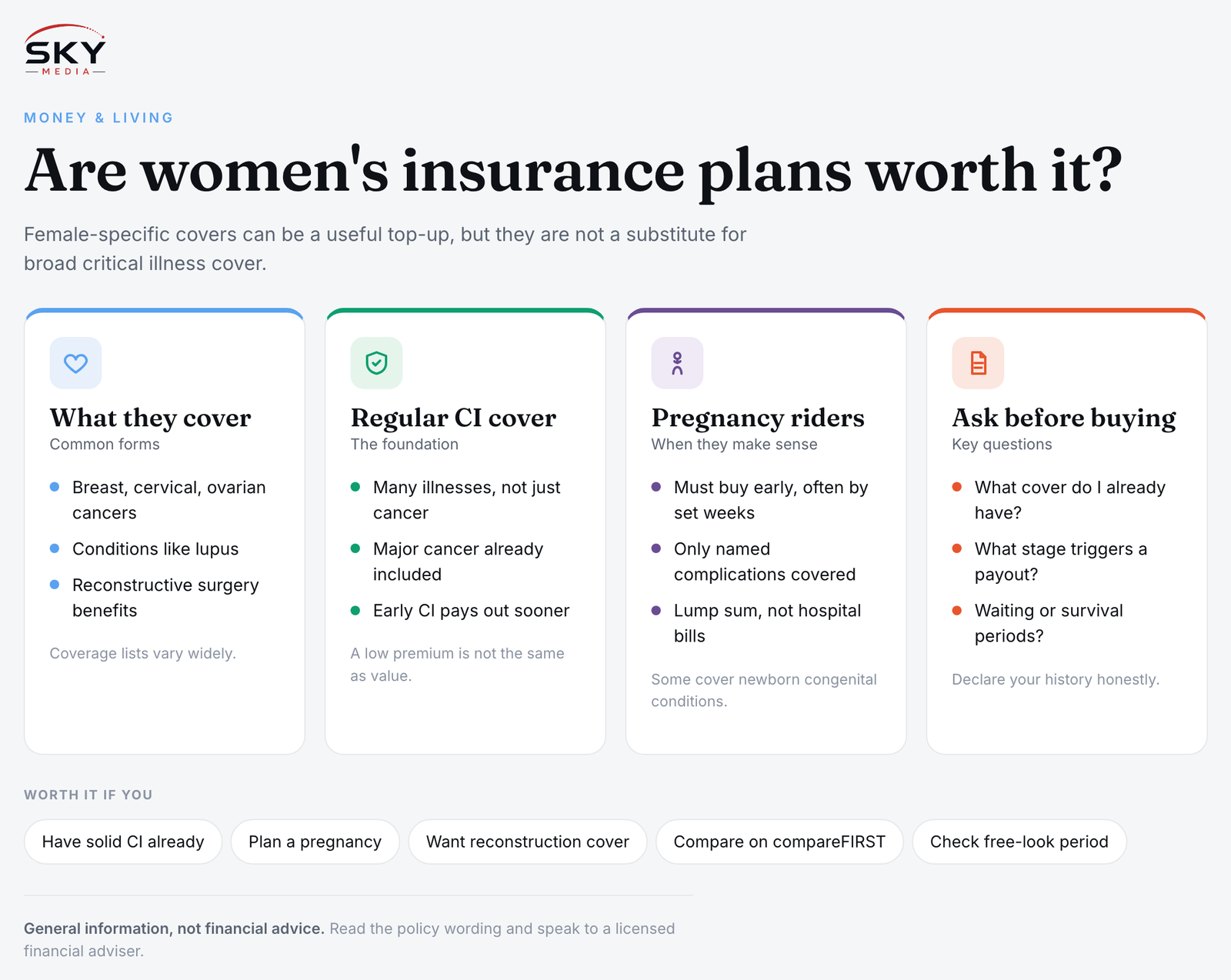
What Female-Specific Insurance Usually Covers
Women’s plans come in a few common forms:
- Female cancer plans that pay out on diagnosis of cancers such as breast, cervical, ovarian or uterine cancer. Some also pay for earlier stages, such as carcinoma-in-situ, at a lower percentage.
- Female condition benefits for illnesses more common in women, such as systemic lupus erythematosus, or for events like fractures linked to osteoporosis. Coverage lists vary widely.
- Reconstructive surgery benefits that pay a lump sum if you undergo breast reconstruction after mastectomy, or similar procedures.
- Pregnancy complication riders that pay a benefit if specified complications occur, such as certain serious conditions in pregnancy or delivery. Some also cover specified congenital conditions in the newborn.
These products are usually sold as standalone plans, add-on riders to a life or CI policy, or as part of a “women’s” bundle.
How Regular Critical Illness Cover Compares
A standard CI policy pays a lump sum if you are diagnosed with one of a list of covered illnesses. In Singapore, many insurers follow standard definitions for major critical illnesses set by the Life Insurance Association Singapore (LIA), which makes it easier to compare policies. Major cancer is on that list, and it covers cancers including breast, cervical and ovarian cancer that meet the definition of major cancer.
So if you already have adequate CI cover, a female cancer plan duplicates part of it. The question is whether the extra is worth the premium.
Early or multi-stage CI policies go further. They can pay out at earlier stages of illness, including some early-stage cancers. If you want protection that starts sooner, an early CI policy may cover more ground than a narrow female plan.
For a deeper look at a related trade-off, read our comparison of cancer-only insurance plans vs critical illness cover.
Female Plans vs Regular CI: A Comparison
| Factor | Female cancer or condition plan | Regular or early CI cover |
|---|---|---|
| Scope | Narrow: specific female cancers and conditions | Broad: many illnesses including heart attack, stroke and major cancer |
| Premium | Usually lower for the same sum assured | Usually higher, reflecting wider cover |
| Payout trigger | Diagnosis of a listed female condition, sometimes early stage | Diagnosis meeting the defined severity for listed illnesses |
| Overlap | Often overlaps with existing CI for major cancers | Core protection on its own |
| Best used as | A top-up for specific concerns | The foundation of illness protection |
The key point: a low premium is not the same as good value. A cheap plan that only covers a few conditions can leave you exposed to more common risks, such as heart disease and stroke, which affect women as well as men.
Pregnancy Complication Riders: When They Make Sense
Pregnancy complication cover is the most distinctive part of many women’s plans. Some things to know:
- Timing matters. Many maternity or pregnancy riders must be bought early in pregnancy, often within a set number of weeks of gestation, or before conception. After that window, you may not qualify.
- Lists are specific. Only the named complications are covered, and each has a definition. Read them carefully.
- Newborn benefits vary. Some cover specified congenital conditions in the baby. Check which ones and for how long.
- It is not hospitalisation cover. These riders usually pay a lump sum, not your hospital bill. Your hospitalisation plan, MediShield Life (for citizens and permanent residents) and any Integrated Shield Plan work separately, and they have their own rules on pregnancy-related claims.
If you are planning a family, read our detailed guide to maternity insurance in Singapore, which covers when to buy and what it typically includes.
Questions to Ask Before You Buy
- What do I already have? List your existing CI, life, hospitalisation and employer group cover. Our guide to employer group insurance and cover gaps explains why work cover should not be your only protection.
- Which exact conditions are covered? Ask for the list and the definitions, not just the brochure headline.
- What stage triggers a payout? Early stage, major stage, or both? What percentage of the sum assured is paid at each stage?
- Are there waiting or survival periods? Many policies do not pay for conditions diagnosed within an initial waiting period, and some require you to survive a set number of days after diagnosis.
- Is the premium guaranteed? Some plans have premiums that can be revised or that rise with age.
- Does a claim end the policy? Some plans terminate after one payout; others allow multiple claims.
- Does family history matter? Underwriting may exclude conditions linked to your medical or family history. Declare everything honestly to avoid a rejected claim later.
Who Might Benefit From a Female-Specific Plan
A women’s plan may be worth considering if:
- You already have solid CI and life cover and want a modest top-up for female cancers.
- You are planning a pregnancy and want lump-sum protection for specified complications.
- You want a benefit for reconstructive surgery, which a standard CI plan may not pay separately.
It is probably less useful if:
- You have little or no CI cover. Start with broad protection first.
- The plan’s list of conditions duplicates what you already have.
- You are buying mainly because the premium looks low.
Looking at Your Whole Financial Picture
Insurance is one part of protecting yourself. Women in Singapore often take career breaks for caregiving and tend to live longer, which affects both protection needs and retirement savings. Our guide on why women should plan retirement differently in Singapore covers the savings side.
Review your cover whenever your life changes: marriage, a new baby, a job switch or a major health diagnosis in the family. Use compareFIRST to compare premiums and features, and check the free-look period in your policy, which gives you time to cancel after you receive the policy documents.
The Bottom Line
Female-specific insurance can be a useful top-up, especially for pregnancy complications and reconstructive surgery benefits, but it is not a substitute for broad critical illness cover. Build the foundation first, then decide whether a women insurance plan adds real value to your situation. Read the definitions, compare policies on neutral platforms, and ask a licensed adviser if you are unsure.
Frequently Asked Questions
Is it better to buy early-stage critical illness cover than a female cancer plan? For most people, broad early or multi-stage critical illness cover is a stronger foundation because it covers more illnesses, including heart attack and stroke. A female cancer plan works best as a modest top-up. Compare the definitions and payout stages with a licensed adviser.
When should I buy pregnancy complication cover? Usually before or very early in pregnancy, because many riders must be bought within a set number of weeks of gestation. After that window you may not qualify. If you are planning a family, read the policy wording and ask the insurer about the exact cut-off.
Does MediShield Life cover pregnancy complications? MediShield Life is a basic hospitalisation scheme for citizens and permanent residents and has its own rules on pregnancy-related claims. It is separate from lump-sum riders. Check the MediShield Life details on the CPF Board website or ask your insurer.
Do women pay more than men for critical illness insurance? It depends on the insurer and product, since premiums reflect age, health, smoking status and the sum assured. A lower-priced female plan covers fewer conditions, so compare like with like. Use compareFIRST to see premiums and features side by side.
Can I cancel a women’s insurance plan after buying it? Yes, within the free-look period stated in your policy, you can cancel after receiving the documents. Check the length of that period and any conditions in the policy. After it ends, cancelling may mean losing some premiums paid.