

International Women’s Day is usually about celebration and progress, but it is also a useful prompt for a less glamorous topic: money in later life. Women retirement planning in Singapore deserves its own conversation because women, on average, face a different set of numbers. They tend to live longer, are more likely to take time out of paid work for caregiving, and often end up with smaller retirement savings as a result.
None of this means women are doomed to a poorer retirement. It means the standard advice, “save consistently for 40 years and you will be fine”, does not fit many real lives. This guide explains the main reasons the gap appears and the practical levers available. It is general information, not financial advice. For your own situation, check the CPF Board’s website and planning tools, and consider speaking to a qualified, licensed adviser.
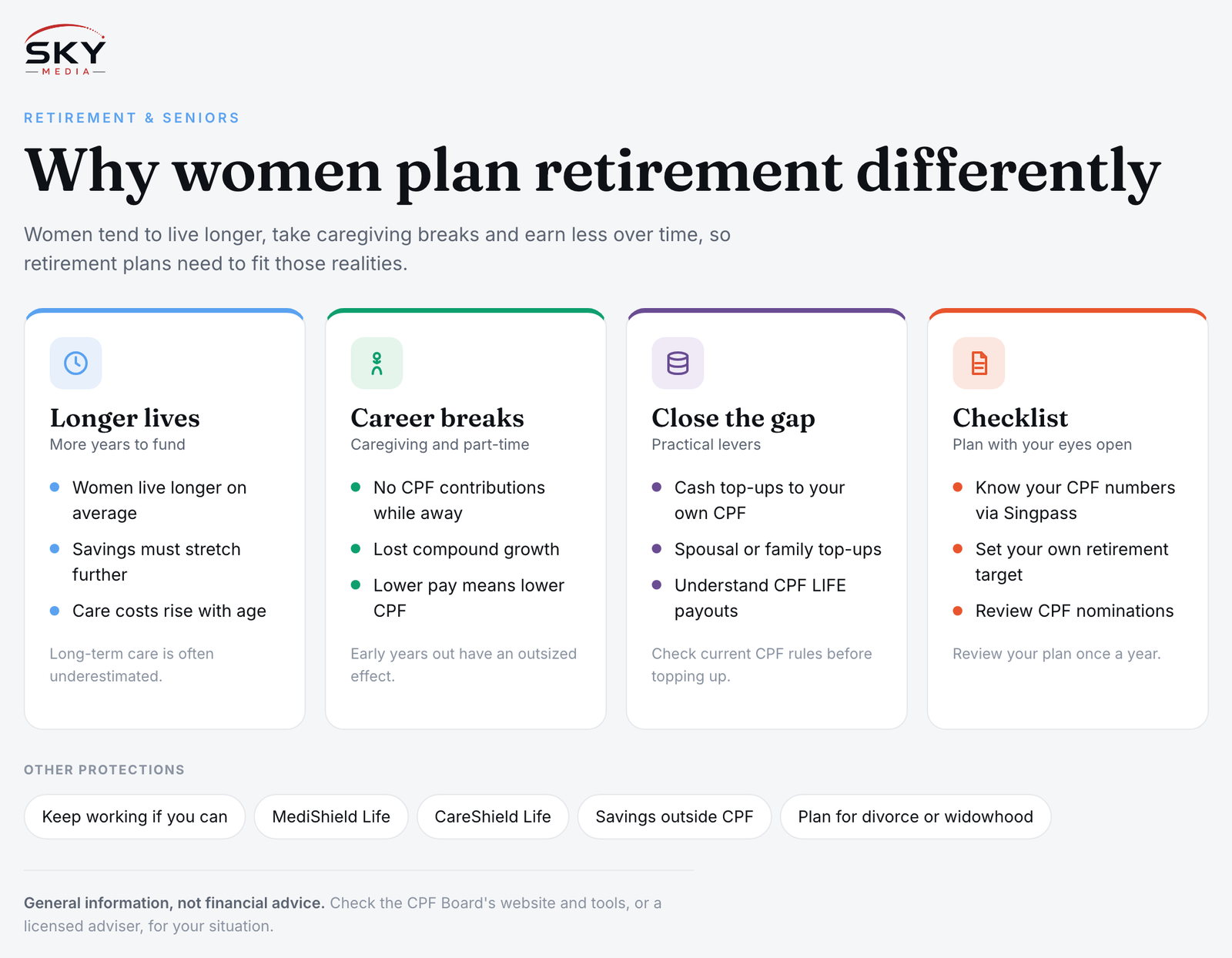
Why the Retirement Picture Looks Different for Women
Longer lifespans mean a longer retirement to fund
In Singapore, as in most countries, women have a longer life expectancy than men on average. A longer life is good news, but it also means your savings need to stretch over more years. Healthcare and long-term care costs tend to rise with age, so the final years of a long retirement can be among the most expensive. You can see current life expectancy figures on the Department of Statistics Singapore website.
Caregiving career breaks interrupt saving
Many women step back from paid work to care for young children, ageing parents or a family member with health needs. Each year out of work is a year without CPF contributions from salary and a year without compound growth on those contributions. Even a few years away during your thirties can have an outsized effect decades later, because money saved early has the longest time to grow.
Part-time and lower-paid work
Women are more likely to work part-time or to move into roles with more flexibility but less pay, especially after having children. Since CPF contributions are tied to wages, lower earnings mean lower contributions.
Divorce and widowhood
Life events can change your finances sharply. After a divorce, CPF savings may be divided under a court order, and household costs that were once shared now fall on one person. Women who outlive a spouse may lose a second income in retirement. Planning for your own security, rather than relying solely on a household’s combined resources, gives you more resilience.
Comparing Common Situations and What They Mean
| Situation | Effect on retirement savings | Possible response |
|---|---|---|
| Career break of several years for caregiving | Missed CPF contributions and lost compound growth | Cash top-ups or spousal top-ups during the break, where eligible |
| Long-term part-time work | Lower monthly CPF contributions | Voluntary contributions and a written budget for retirement savings |
| Divorce | Division of assets, single-income household | Review CPF nominations, insurance and your own retirement target |
| Outliving a spouse | Loss of a second income, longer retirement | Ensure your own CPF LIFE payouts and savings, not just joint assets |
| Self-employment or gig work | No employer CPF contributions | Regular MediSave contributions and voluntary CPF top-ups |
Practical Ways to Close the Gap
Use CPF top-ups strategically
The CPF system allows cash top-ups to your own Retirement Account (or Special Account, depending on your age and the scheme rules at the time) and, in many cases, to the accounts of loved ones. Topping up early lets the money earn CPF interest over a longer period. There may be tax relief for some top-ups, subject to caps and conditions set by IRAS and the CPF Board. Rules on which accounts can receive top-ups, how much, and what tax relief applies have changed over the years, so check the current details on the CPF website before you transfer anything.
Ask about spousal or family top-ups
If you are taking a career break while your spouse continues working, a top-up from your spouse to your CPF account can help keep your retirement savings growing. Family members can also top up for each other in some circumstances. This is a practical way for a household to share the cost of a caregiving break more fairly, rather than leaving one person’s retirement to absorb it. Have the conversation openly and early.
Understand CPF LIFE
CPF LIFE is the national annuity scheme that provides monthly payouts for as long as you live, starting from your payout eligibility age. For women, who tend to live longer, a lifelong income stream is especially valuable because it addresses the risk of outliving your savings. CPF LIFE offers different plans with different payout patterns. Use the CPF Board’s planning tools to estimate your payouts and compare plan options.
Keep working, if you can and want to
Even a few years of part-time work during a caregiving period can keep contributions flowing and your skills current. Re-entering the workforce later is often easier if you have not been away entirely. Check government schemes for returners and mid-career workers through the Skills and Workforce Development Agency (SWDA, formed in 2026 from Workforce Singapore and SkillsFuture Singapore) and SkillsFuture.
Protect against health and care costs
Longer lives often mean more years managing health conditions. MediShield Life and CareShield Life provide basic national coverage; private integrated plans and other insurance can add more. Review your coverage with your insurer and read the policy wording carefully. For many women, long-term care is the expense they underestimate most.
Build savings outside CPF
CPF is the foundation, but many people also keep cash savings and other investments for flexibility. Whatever you choose, make sure it suits your risk tolerance and time horizon, and be wary of any product that promises high guaranteed returns.
A Simple Planning Checklist
- Know your numbers. Log in to the CPF website with Singpass to see your current balances and projected payouts.
- Set your own target. Base it on the retirement lifestyle you want, not just what your partner expects to have. Our guide on planning your retirement lifestyle in Singapore helps you picture this.
- Plan for breaks in advance. If a caregiving break is likely, agree with your family how retirement savings will be protected during it.
- Review nominations. Make a CPF nomination and update it after marriage, divorce or other life changes.
- Check annually. Review your plan each year, perhaps around International Women’s Day, and adjust as your life changes.
Starting Where You Are
Whether you are in your twenties or already approaching retirement age, the best time to plan is now. Younger women benefit most from compound growth, while women closer to retirement can still make meaningful decisions about CPF LIFE plans, top-ups and working longer. If you are single, our article on retirement planning for singles covers additional points, and Retirement Planning in Singapore: A Roadmap lays out the overall structure step by step.
The aim is not to frighten anyone but to plan with your eyes open. Women’s lives often include more interruptions and a longer finish line, and a retirement plan built for that reality will serve you far better than one built for an average that does not match your life.
Frequently Asked Questions
Can a stay-at-home mum build CPF savings without a salary? CPF contributions from wages stop when there is no salary, but cash top-ups to your own account may be possible, and a spouse may be able to top up too. Rules on which accounts qualify and any tax relief change, so check the CPF Board’s website before transferring money.
What happens to my CPF savings after a divorce? CPF savings may be divided under a court order as part of the division of matrimonial assets. Get legal advice on your case, and review your CPF nomination, insurance and retirement target once the divorce is finalised, since your household is now a single-income one.
Why does CPF LIFE matter more for women? Women tend to live longer on average, and CPF LIFE pays out monthly for as long as you live, which covers the risk of outliving your savings. Use the CPF Board’s planning tools to estimate payouts and compare the plan options before choosing.
Do freelancers and gig workers need to save for retirement differently? Yes, because there are no employer CPF contributions. Freelancers should make regular MediSave contributions and consider voluntary CPF top-ups, and set a written budget for retirement savings. Check the CPF Board’s website for what applies to self-employed persons.
Should I rely on my husband’s retirement savings? It is safer to plan your own, since divorce or widowhood can change a household’s resources sharply. Set your own retirement target, check your own CPF balances and projected payouts after logging in with Singpass, and agree with your family how savings will be protected during breaks.
Official sources: CPF Board