

Most directors know that a private limited company protects its owners from the company’s debts. What fewer realise is that this protection has limits. If a company keeps taking on debts when it cannot pay them, the people running it can be made personally responsible. In Singapore, this is called wrongful trading, and it is one of the most important director risks to understand before a business runs into trouble.
This guide explains the wrongful trading Singapore rules in plain terms: what the law is aiming at, how it differs from fraud, the warning signs that should make a director stop and think, and the practical steps that reduce personal exposure. It is general information, not legal advice. If your company is already struggling, speak to a lawyer or a licensed insolvency practitioner early.
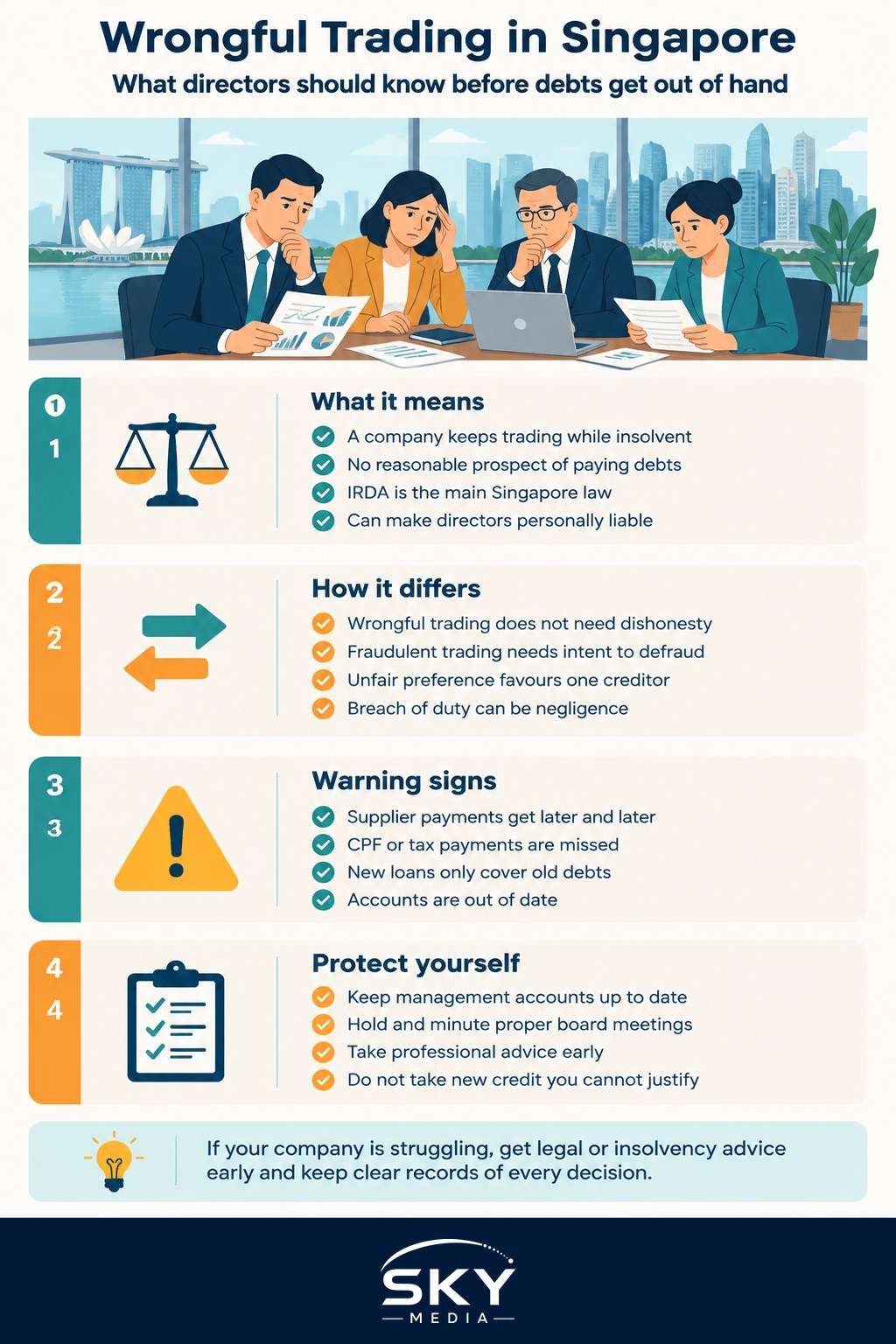
What Wrongful Trading Means Under Singapore Law
Wrongful trading is set out in the Insolvency, Restructuring and Dissolution Act 2018, usually shortened to the IRDA. It is the main Singapore law on insolvency and winding up.
In broad terms, a company trades wrongfully when it carries on business and incurs debts or other liabilities while it is insolvent, or becomes insolvent because of those debts, and there is no reasonable prospect that it will be able to pay them in full. Insolvent here generally means the company cannot pay its debts as they fall due.
The key point for directors is that the court can declare that a person who was knowingly a party to the wrongful trading is personally responsible for some or all of the company’s debts. For company officers, the test is not only what they actually knew. It also covers what they ought to have known, given their role and the information reasonably available to them. A director cannot escape simply by not looking at the accounts.
Applications are usually brought once the company is in a formal insolvency process, such as when a liquidator or judicial manager has been appointed and is looking at how the company got into its position. In some situations creditors can also be involved. The exact rules on who can apply and what the court can order are detailed, so check the current wording of the IRDA or ask a lawyer.
Wrongful Trading Compared With Related Director Risks
Wrongful trading is often confused with other insolvency claims. The table below shows the main differences in general terms.
| Concept | What it is about | Does it need dishonesty? | Typical example |
|---|---|---|---|
| Wrongful trading | Taking on debts while insolvent with no reasonable prospect of repayment | No, it can arise from careless or unrealistic decisions | Continuing to order stock on credit for months after cash has run out |
| Fraudulent trading | Carrying on business with intent to defraud creditors or for a fraudulent purpose | Yes, intent to defraud must be shown | Taking deposits from customers knowing the goods will never be delivered |
| Unfair preference | Paying one creditor ahead of others shortly before insolvency | Not necessarily, the focus is on the effect and the intention to prefer | Repaying a director’s own loan while suppliers go unpaid |
| Breach of directors’ duties | Failing to act honestly, with care, or in the company’s interests | No, negligence can be enough | Approving large transactions without reading the numbers |
The practical lesson is that you do not need to be a fraudster to be caught.
Warning Signs That Should Make a Director Pause
No single sign proves a company is insolvent, but several together should trigger a serious review. Watch for:
- Paying suppliers later and later, or stretching some creditors to keep others happy.
- Missing statutory payments, such as CPF contributions for staff or tax owed to IRAS (the Inland Revenue Authority of Singapore).
- Relying on new orders or new loans simply to pay old debts.
- Regular use of personal funds to plug monthly gaps with no clear end point.
- Letters of demand or statutory demands from creditors, or threats of legal action.
- Management accounts that are months out of date, so nobody actually knows the position.
- A key customer or contract lost with no realistic replacement in sight.
When these appear, the question every director should ask is simple: if we take on this next debt, is there a reasonable prospect we can pay it in full when it falls due? If the honest answer is no, carrying on as normal is exactly the risk the law is aimed at.
Practical Steps to Protect Yourself as a Director
Directors are allowed to try to rescue a business. The law does not expect a company to shut the moment it hits a rough patch. What matters is that decisions are reasonable, informed and recorded. These habits help:
- Keep financial information current. Insist on regular management accounts and a rolling cash flow forecast. You cannot judge solvency without numbers.
- Hold proper board meetings and minute them. Record what was considered, what advice was taken and why the board believed there was a reasonable prospect of paying debts.
- Take professional advice early. A lawyer or licensed insolvency practitioner can explain options such as restructuring, a scheme of arrangement or judicial management while they are still available.
- Stop taking on new credit you cannot justify. Avoid new supplier credit, customer deposits or loans unless you can show how they will be repaid.
- Treat creditors fairly. Avoid repaying connected parties, including yourself, ahead of ordinary creditors when the company is in difficulty.
- Do not simply resign and walk away. Resignation does not erase decisions you were part of, and leaving without raising concerns may look worse later.
- Consider a formal process. If rescue is not realistic, an orderly winding up is usually better for creditors and directors than drifting on.
Directors who take these steps are in a much stronger position if a liquidator later reviews their conduct.
Nominee, Non-Executive and Foreign Directors Are Not Exempt
A common misunderstanding is that only the “real” decision-maker is at risk. Under Singapore law, every director carries duties, including nominee directors who are appointed to meet the local resident director requirement and non-executive directors who attend only a few meetings a year.
If you hold a nominee role, read up on nominee director duties and risks and make sure you receive regular financial information. Foreign founders weighing whether to appoint someone locally should also understand how liability is shared, which is covered in our guide on whether you need a local nominee director as a foreign founder.
The court can take account of a director’s actual role, but “I was only a nominee” is not a shield on its own. Anyone who agrees to sit on a board should expect to ask questions and to see the numbers.
Consequences and What Happens Next
If wrongful trading is established, the possible outcomes can include personal liability for company debts, and in some circumstances wrongful trading can also lead to criminal consequences or disqualification from acting as a director. The precise penalties and how courts apply them can change, so check the current IRDA provisions and official guidance from the Ministry of Law and the Accounting and Corporate Regulatory Authority (ACRA), which oversees company registration and director obligations.
For a solvent company that simply wants to stop trading, the route is very different. Our guide to closing a company in Singapore explains striking off and voluntary winding up, which are designed for businesses that can settle their debts.
Key Takeaways for Directors
- Wrongful trading is about incurring debts while insolvent with no reasonable prospect of paying them, and it does not require dishonesty.
- Directors can be judged on what they ought to have known, not just what they knew.
- Up to date accounts, minuted decisions and early professional advice are your best protection.
- Nominee and non-executive directors carry real responsibility too.
Treat this as a starting point for a conversation with your own advisers, and check the latest position with the relevant official bodies before relying on it.
Frequently Asked Questions
Can I be personally liable for company debts as a director in Singapore? Yes, in some situations. A limited company normally shields owners, but a court can make a person who was knowingly party to wrongful trading personally responsible for some or all debts. Take advice from a lawyer or licensed insolvency practitioner.
What should I do first if I think my company is insolvent? Stop and get current financial numbers, then speak to a lawyer or licensed insolvency practitioner early. Avoid taking on new credit you cannot justify, and keep a written record of the board’s decisions and the advice received.
Does resigning as a director remove my wrongful trading risk? Not automatically. Resigning does not erase decisions you were part of while on the board, and walking away without raising concerns can look worse later. If you are unsure, take legal advice before you act.
Is a nominee director also at risk for wrongful trading? Yes, a nominee carries the same legal duties as any other director. Being appointed to meet the local resident director requirement is not a shield on its own, so a nominee should insist on regular financial information and ask questions.
What is the difference between closing a healthy company and an insolvent one? A solvent company that can pay its debts can usually be struck off or voluntarily wound up in an orderly way. An insolvent one follows formal insolvency processes. ACRA and the Ministry of Law publish the current procedures.
Official sources: ACRA
Further reading: Company Directors’ Duties in Singapore: What You Are Legally Responsible For · Judicial Management and Schemes of Arrangement for Struggling Singapore Companies