

When you incorporate a business, Bizfile (ACRA’s online portal, ACRA being the Accounting and Corporate Regulatory Authority) asks you for a financial year end, or FYE. Yet the financial year end of a Singapore company quietly decides when your first accounts close, when your first tax filings fall due, how much benefit you squeeze out of start-up tax relief and how crowded your accountant’s diary will be when your books need closing.
This guide explains what the FYE actually controls, the trade-offs behind the common choices and the questions to settle before you lock it in. It is general information, not tax or legal advice. Rules on filing periods and tax exemptions can change, so confirm the current position with ACRA, IRAS (the Inland Revenue Authority of Singapore) or a qualified accountant before deciding.
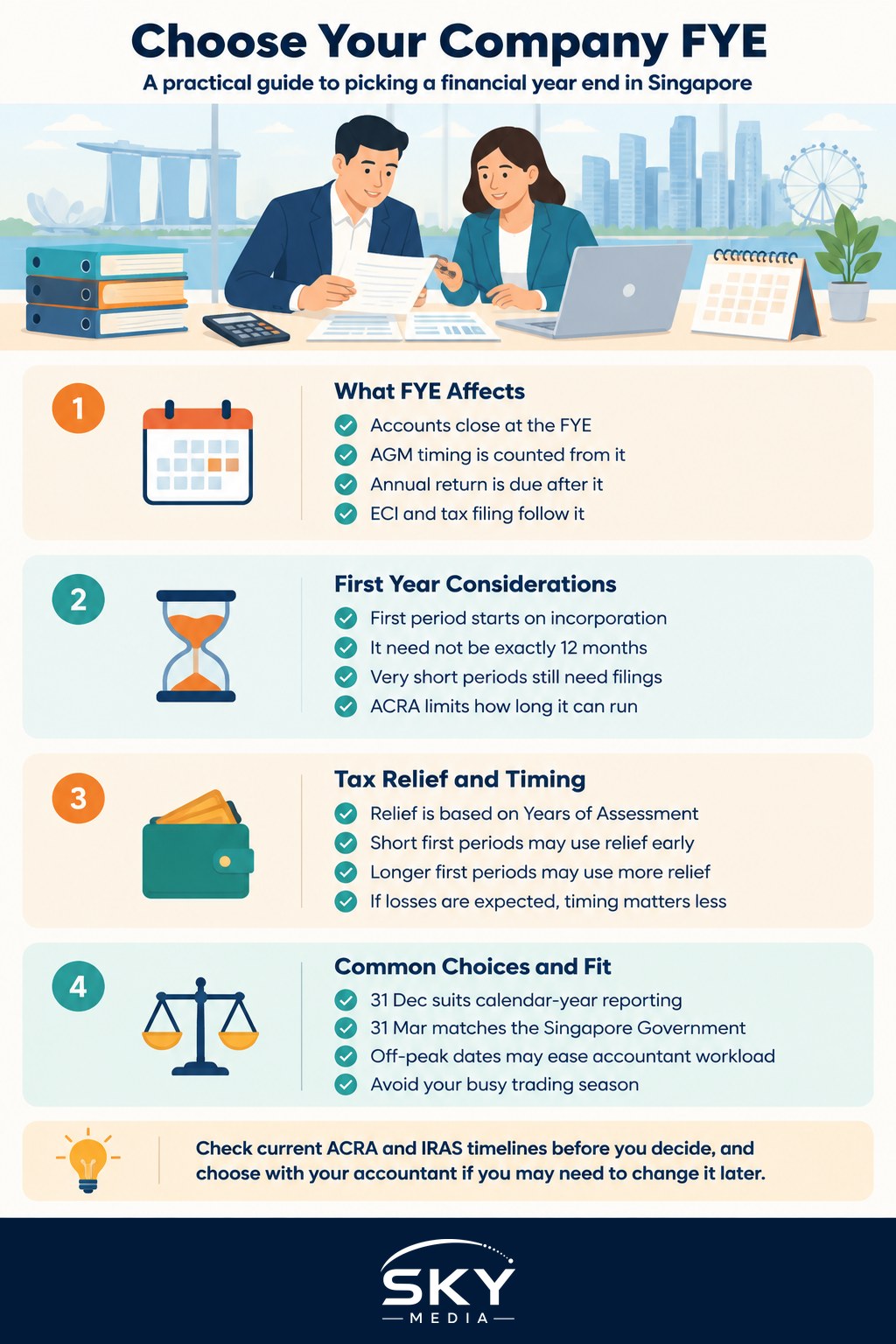
What Your Financial Year End Actually Controls
Your FYE is the last day of each accounting period. Every 12 months your company closes its books on that date and prepares financial statements covering the year. Almost every recurring compliance deadline is then counted from it:
- Financial statements. Your accounts must be prepared for the period ending on the FYE.
- Annual General Meeting (AGM). For most private companies, ACRA sets a deadline for holding the AGM (or dispensing with it, where permitted) counted from the FYE.
- Annual return. The annual return filed on Bizfile is also due within a set period after the FYE.
- Estimated Chargeable Income (ECI). IRAS expects companies to file an ECI, an early estimate of taxable profit, within a few months of the FYE unless the company qualifies for a waiver.
- Corporate income tax return. The Form C-S, Form C-S (Lite) or Form C is filed once a year for the Year of Assessment (YA), which is based on the financial year that ended in the previous calendar year.
Because these deadlines all move with your FYE, choosing it is really choosing your compliance calendar. Check the exact current timelines on the ACRA and IRAS websites rather than relying on memory, as they have been revised before.
How the First Financial Period Works
Your first financial period runs from the date of incorporation to your first FYE. It does not have to be exactly 12 months. A company incorporated in April that picks 31 December will have a first period of about nine months, while one that picks 31 March of the following year will have a first period of about a year.
ACRA places a limit on how long a first financial period can run, so you cannot defer your first accounts indefinitely. Note that a very short first period may hold little activity, yet still triggers a full round of statements, filings and accounting fees. Check the current maximum on the ACRA website or with your corporate secretary before choosing a date far in the future.
Financial Year End and the Start-Up Tax Exemption
Qualifying new companies in Singapore have historically been able to claim a start-up tax exemption on part of their chargeable income for their first three Years of Assessment. The exact amounts, conditions and exclusions are set by IRAS and have changed over time, so check the current scheme on the IRAS website.
The key idea is that the relief is counted in Years of Assessment, not in months of trading. That means your FYE affects how much profit falls inside those first three YAs:
- A short first period (for example, two or three months) still uses up a whole YA, often when the company has barely started earning. One of your relief years may cover very little income.
- A longer first period, within ACRA’s limit, can let more of your early trading fall into the first YA, which may make better use of the relief if you expect profits early.
- If you expect losses in the first year or two, the timing matters less for the exemption, though loss carry-forward rules then come into play.
How this works out for your business depends on your expected revenue and costs, so model it with an accountant or tax agent before you commit. For a refresher on how IRAS calculates tax in general, our guide to estimating next year’s income tax with the IRAS calculator explains the YA concept from the individual side.
Common Financial Year End Choices Compared
There is no single right answer. The table below compares the options founders most often weigh up.
| FYE option | Why people choose it | Watch out for |
|---|---|---|
| 31 December | Matches the calendar year, easy to remember, aligns with many overseas parent groups | Accountants and auditors are busiest in the months after December, so fees and turnaround can suffer |
| 31 March | Matches the Singapore Government’s financial year and some group structures | Year-end closing lands alongside Chinese New Year preparations and Q1 workload |
| 30 June or 30 September | Spreads workload away from the December peak, often quicker service from accountants | Calendar-year reporting to banks or investors may need extra management accounts |
| Last day of the month before your incorporation anniversary | Gives a first period close to 12 months, can make fuller use of the first YA | Odd month-ends can be confusing if you later join a group with a different FYE |
Workload, Seasonality and Group Alignment
Beyond tax, think about the human side of closing your books.
Avoid your own peak season. A retailer that does most of its business in the November to January festive period may not want to count stock and close accounts on 31 December. A tuition centre may prefer a quieter month away from exam season. Pick a date when your team has room to reconcile accounts.
Think about your accountant’s calendar. Many Singapore companies close on 31 December, so accounting and audit firms tend to be stretched in the first half of the year. An off-peak FYE can mean more attention and fewer last-minute rushes. Ask your accounting provider how their workload falls across the year.
Align with your group or investors. If your company is a subsidiary of an overseas parent, using the same FYE makes group consolidation simpler. If you report to investors or banks on a calendar-year basis, a 31 December FYE avoids preparing a second set of figures.
Plan your own money too. Owner-directors often time salary, bonus and dividend decisions around the company year end. If you are also reviewing your personal finances, our end-of-year money review checklist pairs well with your company’s closing cycle.
Can You Change Your Financial Year End Later?
Yes, a company can change its FYE after incorporation by filing through Bizfile, but there are restrictions. ACRA limits how often a company can change its FYE and how long a resulting financial period can be, and some changes need ACRA’s approval rather than a simple notification. A change can also affect your tax basis periods and how IRAS treats the transitional period.
Because of these knock-on effects, treat a change as a decision to make with your accountant, not a quick admin edit. It is far simpler to choose carefully at the start.
A Simple Checklist Before You Decide
Before you enter an FYE on Bizfile, run through these questions:
- When do you expect revenue to start, and how much in the first 12 to 18 months?
- How will the first period length affect your first three Years of Assessment and any start-up relief?
- Is your busiest trading period close to the date you are considering?
- Does a parent company, investor or lender expect a particular reporting year?
- When is your accountant or corporate secretary least busy?
- Have you checked current ACRA filing timelines and IRAS exemption rules on their official websites?
Explore more: How to Do an End-of-Year Money Review in Singapore · Estimating Next Year’s Income Tax With the IRAS Calculator
Frequently Asked Questions
Which financial year end is best for a new company? There is no single best date. It depends on when your busy season falls, when revenue begins, your accountant’s workload and whether a parent company or investors expect a particular reporting year. Weigh these against the start-up tax relief and agree a date with an accountant.
What happens if my first financial period is very short? A very short first period may hold little activity, yet it still triggers a full round of statements, filings and accounting fees. It also uses up a whole Year of Assessment, so one of your relief years may cover very little income.
Is there a limit to how long my first financial period can be? Yes. ACRA places a limit on how long a first financial period can run, so you cannot postpone your first accounts indefinitely. Check the current maximum on the ACRA website or with your corporate secretary before picking a date far in the future.
Does the year end affect when I file ECI and corporate tax? Yes, because those deadlines are counted from your FYE. IRAS expects an estimate of taxable profit within a few months of year end unless a waiver applies, then the annual tax return follows. Check exact timelines on the IRAS website as they have been revised before.
Why do accountants prefer clients not to close on 31 December? Many Singapore companies close on 31 December, so accounting and audit firms tend to be stretched in the first half of the year. An off-peak year end can mean more attention and fewer last-minute rushes. Ask your provider how their workload falls across the year.
Official sources: ACRA
Further reading: IRAS Late Filing Penalty for a Company: What Happens and How to Fix It · Filing Financial Statements in XBRL With ACRA