

For many young musicians in Singapore, ABRSM Grade 5 theory arrives as a surprise. You have been working through practical piano or violin grades, and then a teacher mentions that before you can take Grade 6 practical, you need Grade 5 theory. Suddenly there is a written exam on top of scales, pieces and sight-reading.
This guide explains why that requirement exists, what the Grade 5 syllabus usually covers, and how to build a study plan that fits around school. ABRSM reviews its syllabuses and exam rules from time to time, so always confirm the current requirements, formats and booking details on the official ABRSM website or with your teacher.
Why Grade 5 Theory Is Required for Higher Practical Grades
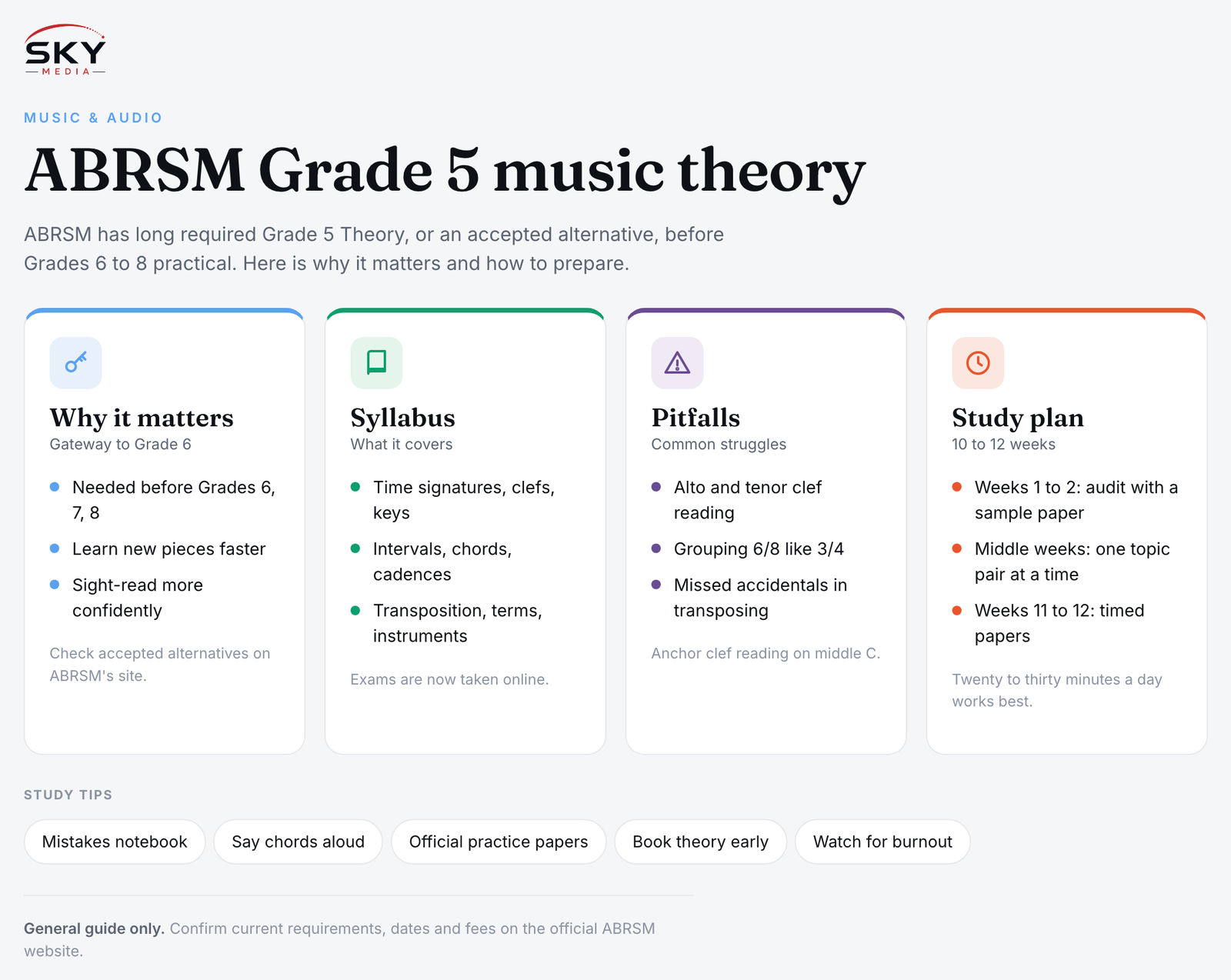
The Associated Board of the Royal Schools of Music (ABRSM) has long required candidates to pass Grade 5 Music Theory, or an accepted alternative, before entering for Grades 6, 7 and 8 practical exams. ABRSM lists the accepted alternatives, such as certain practical musicianship or solo jazz grades, on its website, and these can change, so check before you book.
The logic is straightforward. Higher practical grades use music that is harmonically richer and more stylistically varied. Examiners expect you to shape phrases, understand modulations and make informed choices. That is much easier when you can read what is happening on the page, not just play the notes.
In practice, Grade 5 theory helps you:
- Learn new pieces faster, because you recognise keys, chords and patterns
- Sight-read more confidently, since you anticipate where the music is going
- Understand instructions in foreign terms without guessing
- Communicate with teachers and ensemble members using shared vocabulary
- Prepare for any later study in music, where theory knowledge is expected
Students sometimes treat it as a hurdle to clear and forget. It is more useful to treat it as the point where your reading of music catches up with your playing.
What the Grade 5 Syllabus Typically Covers
Grade 5 builds on everything from Grades 1 to 4. Exact content is set out in ABRSM’s published syllabus, but students generally need to handle:
- Rhythm: all common simple, compound and irregular time signatures, including grouping notes and rests correctly, plus triplets and other irregular divisions.
- Pitch and clefs: reading and writing in treble, bass, alto and tenor clefs, including transposing a melody between clefs.
- Keys and scales: major and minor keys up to the full set of key signatures, scales in different forms, and the chromatic scale.
- Intervals: naming intervals, including compound intervals beyond an octave, with their quality.
- Chords: triads on each degree of the scale, their inversions, and recognising chords in a passage.
- Cadences: identifying and choosing chords for perfect, imperfect, plagal and interrupted cadences.
- Transposition: moving a melody to another key, including for transposing instruments.
- Instruments and voices: ranges, clefs and families of orchestral instruments and voice types.
- Terms and signs: performance directions in Italian and other languages, and ornaments.
- Music in context: answering questions about a short extract that pull these skills together.
ABRSM theory exams are now taken online, with question types designed for a screen. Look at the official sample papers and practice materials so the format is familiar before exam day.
Grade 5 Topics vs Where Students Commonly Struggle
| Topic | What you are asked to do | Common pitfall |
|---|---|---|
| Alto and tenor clefs | Read and transpose melodies between clefs | Counting lines by guesswork instead of anchoring on middle C |
| Compound and irregular time | Group notes and rests correctly | Grouping 6/8 like 3/4 and getting beaming wrong |
| Intervals | Name quality and number, including compound intervals | Forgetting to check the key of the lower note |
| Chords and cadences | Identify chords and suitable cadence progressions | Mixing up inversions and their figuring |
| Transposition | Write a melody in a new key accurately | Missing accidentals that need to change |
A Realistic 10 to 12 Week Study Plan
How long you need depends on how much theory you already know. Students who have done earlier theory grades may move quickly; those jumping straight to Grade 5 often need longer. A steady plan for a student balancing school might look like this:
Weeks 1 to 2: Audit and foundations
– Do a sample paper without preparation to find your gaps.
– Revise key signatures, scales and basic intervals until they are automatic.
Weeks 3 to 4: Rhythm and clefs
– Practise grouping in compound and irregular time.
– Spend ten minutes a day reading alto and tenor clef.
Weeks 5 to 6: Intervals and chords
– Name intervals from scale degrees, then compound intervals.
– Build triads on every degree in several keys and learn inversions.
Weeks 7 to 8: Cadences and transposition
– Learn the chord patterns for each cadence and spot them in real pieces you play.
– Transpose short melodies and check every accidental.
Weeks 9 to 10: Instruments, terms and context questions
– Make flashcards for terms, signs and instrument ranges.
– Work through extract-based questions slowly, then timed.
Weeks 11 to 12: Practice papers
– Complete full sample papers under timed conditions.
– Review every mistake and redo similar questions until they stick.
Short daily sessions of 20 to 30 minutes usually work better than one long weekend cram. Link theory to your instrument whenever you can: name the key and cadences in your current pieces, or identify chord inversions in your accompaniment.
Tips for Students and Parents
For students:
– Keep a small “mistakes notebook” and review it weekly.
– Say intervals and chords aloud as you play them; hearing and naming together strengthens memory.
– Use official practice papers rather than random worksheets that may not match the current format.
For parents:
– Ask the teacher whether theory will be taught in lessons or needs separate classes.
– Plan the theory exam well ahead of the intended Grade 6 practical date, so results are in hand when you book.
– Watch for burnout during busy school terms. A short pause is better than a stressful rush.
Exam dates, fees and booking windows are set by ABRSM and its local representatives, so check those directly rather than relying on past years.
Choosing Between Self-Study, Lessons and Classes
Some students prepare entirely with their instrument teacher, others join a group theory class, and older or highly motivated students self-study with workbooks and practice papers. Self-study works well if you are disciplined and already comfortable with earlier grades. Lessons or a class help if you need structure or are starting theory late.
If you are still deciding on an exam board, our comparison of ABRSM vs Trinity College London music exams explains the differences. For younger learners and parents new to the system, music lessons and ABRSM exams for children covers the wider journey, and music theory basics for beginners is a gentle refresher if you need to rebuild the foundations first.
Passing ABRSM Grade 5 theory opens the door to the higher practical grades, but its real value is lasting. It turns notes on a page into music you understand, and that makes every piece you learn afterwards a little easier.
Further reading: The Music Elective Programme (MEP) in Singapore Schools · Learning Music Theory as a Hobby in Singapore · Music Scholarships and Education Pathways in Singapore