

Ask most Singapore parents about music exams and they will mention ABRSM. It is the board many of us grew up with, and its grade certificates sit in plenty of family files. But Trinity College London also runs graded music exams here, and some teachers actively prefer it for certain students. If your child’s teacher has suggested switching, or you are starting lessons and weighing up both, the question of ABRSM vs Trinity is worth a closer look.
This guide compares the two boards on syllabus, exam format and recognition, so you can have a better conversation with your child’s teacher. Exam requirements are revised periodically, so always check the current syllabus on each board’s official website before entering.
Two UK Boards With a Long Presence in Singapore
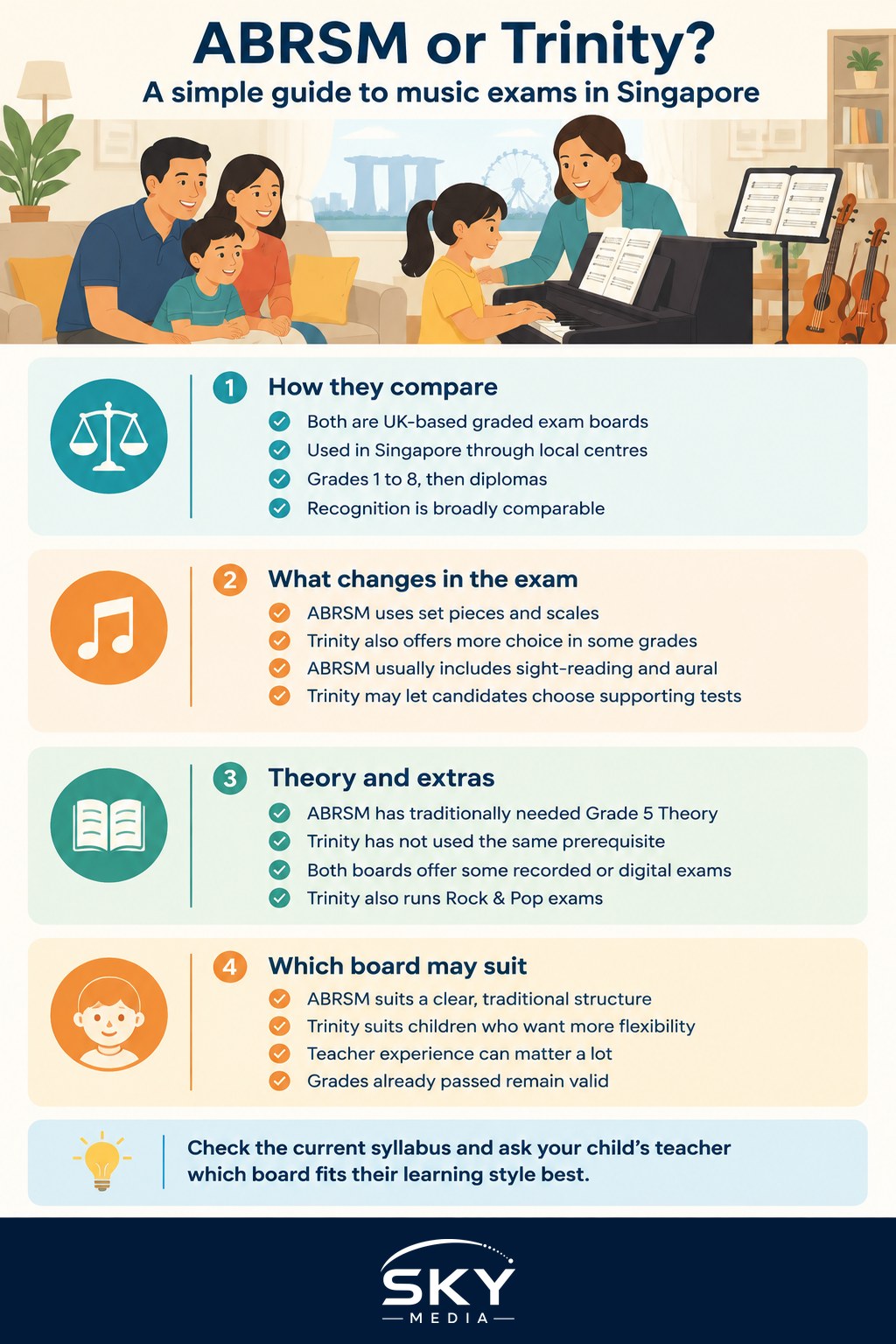
ABRSM (the Associated Board of the Royal Schools of Music) and Trinity College London are both UK-based exam boards that run graded music exams in many countries. In Singapore, both use local representatives and exam centres, and both offer exams for piano, strings, woodwind, brass, singing and other instruments.
Both use a similar ladder: early or initial levels, then Grades 1 to 8, then professional diplomas. A Grade 8 from either board represents a high level of playing, and both boards’ graded exams are regulated qualifications in the UK.
The differences lie less in difficulty and more in how a child is assessed and what they are asked to prepare.
Syllabus and Repertoire Differences
Pieces. Both boards ask candidates to prepare a set number of pieces from published lists. ABRSM pieces are typically chosen from defined lists that cover different styles and periods. Trinity’s lists also span styles and often include a wider mix of contemporary and popular-leaning pieces, and at many grades candidates can include an own-choice piece within set rules. Children who enjoy modern or film-style music sometimes find Trinity’s lists more motivating.
Technical work. ABRSM has traditionally centred on scales and arpeggios, which examiners request from a published list. Trinity’s technical work usually combines scales with exercises or studies, so the candidate prepares short technical pieces rather than only scales.
Supporting tests. This is the biggest practical difference. ABRSM practical exams have usually included sight-reading and aural tests for every candidate. Trinity typically lets candidates choose a combination of supporting tests, which may include sight-reading, aural, improvisation and musical knowledge, depending on the grade and instrument. A child who freezes at aural tests may welcome that flexibility, while a teacher may still want them to build those skills.
Theory requirements. ABRSM has long required candidates to pass Grade 5 Theory (or an approved alternative) before taking higher practical grades. Trinity has not traditionally applied the same theory prerequisite for its graded practical exams, though it runs its own theory exams. Because rules like this can change, confirm the current prerequisite with the board before planning your child’s route to Grade 6 and above.
Rock, pop and digital options. Both boards have broadened their offerings over the years, including recorded or digital exam formats for some subjects. Trinity also runs Rock & Pop exams for guitar, bass, drums, keys and vocals. Check which formats are currently available in Singapore.
ABRSM vs Trinity at a Glance
The table summarises the general differences. Details vary by instrument and grade and are updated with each new syllabus, so treat this as a guide only.
| Area | ABRSM | Trinity College London |
|---|---|---|
| Familiarity in Singapore | Very widely used and recognised by parents and teachers | Well established, but fewer students overall |
| Technical work | Mainly scales and arpeggios | Scales plus technical exercises or studies |
| Supporting tests | Sight-reading and aural usually required | Choice of tests at many grades, such as improvisation or musical knowledge |
| Theory prerequisite | Grade 5 Theory or alternative traditionally needed for higher grades | No equivalent prerequisite traditionally applied to practical grades |
| Repertoire flavour | Broad, often classical-leaning lists | Broad lists, often with more contemporary choices |
| Diplomas | DipABRSM, LRSM, FRSM | ATCL, LTCL, FTCL |
Recognition: Does the Board Matter?
For most families, recognition is the real worry. Here is the general picture.
- UK recognition. Both boards’ higher grades are regulated qualifications in the UK and have been counted towards UCAS tariff points for university admission there. Check the current position if this matters for your child.
- Singapore schools and admissions. Music achievements may form part of a portfolio for Direct School Admission (DSA) or co-curricular activities. Schools tend to look at actual ability, auditions and involvement in ensembles, rather than which board issued a certificate. Ask the specific school what it considers, since criteria differ.
- Teaching careers. Many private music teachers hold diplomas from either board. If your child is aiming for a teaching or performance diploma later, both boards offer pathways.
- Perception. Because ABRSM is so familiar here, some parents feel it is the “safe” choice. That is a cultural preference rather than a formal ranking. A Grade 8 from Trinity reflects comparable effort and skill.
In short, recognition rarely decides it. Your child’s learning style and your teacher’s experience usually matter more.
Which Board Suits Your Child?
Think about your child as a musician, not just as a candidate.
ABRSM may suit a child who:
– Enjoys a clear, traditional structure with scales, sight-reading and aural every time.
– Is likely to take theory exams anyway, or enjoys theory.
– Has a teacher who specialises in ABRSM preparation.
Trinity may suit a child who:
– Struggles with one supporting test and benefits from choosing alternatives.
– Is motivated by contemporary pieces or wants some freedom in repertoire.
– Likes improvising or finds technical studies more engaging than long scale lists.
Questions to ask your child’s teacher:
1. Which board do you have the most experience preparing students for?
2. What would change in my child’s practice routine if we switched?
3. How does the theory requirement affect our timeline for higher grades?
4. Which exam formats and centres are available this year?
5. Can my child keep the grades already earned if we move boards?
Grades already passed remain valid, and many children switch between boards at some point. A common pattern is to move to whichever board fits the next stage, then continue.
Keeping Exams in Perspective
Graded exams are a useful structure, but they are not the whole of music. A child who only ever prepares three pieces a year for an exam may lose interest. Mix in ensemble playing, recitals, playing for fun and learning songs they love. If you are still getting to grips with the grade system itself, our explainer on music exams and grades covers the basics, and Music Lessons and ABRSM Exams for Children goes deeper into the ABRSM route.
Exam nerves are normal. Rehearsing the walk into the room, playing for family, and keeping practice routines steady in the last week all help. If your child becomes very anxious, ease off the pressure and talk with their teacher; our guide on supporting a child with exam anxiety has more ideas.
Whichever you choose, the best board is the one that keeps your child playing, learning and enjoying music for years to come.
Further reading: ABRSM Grade 5 Music Theory: Why It Matters and How to Prepare · The Music Elective Programme (MEP) in Singapore Schools